The Metropole Hotel has announced the reopening date of its rooftop hotspot, Odyssey Lounge Bar and Restaurant, where guests can enjoy everything from a relaxing after work apero to a Mediterranean dinner under the stars.
Located next to a swimming pool, the Odyssey was forced to stay closed due to health restrictions despite the reopening of the Metropole Hotel in April. But not for much longer.
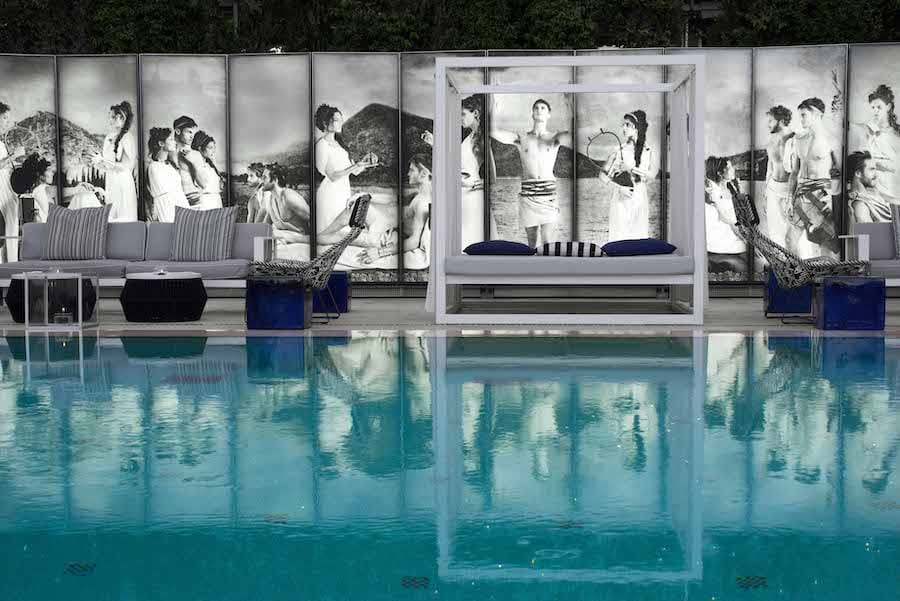
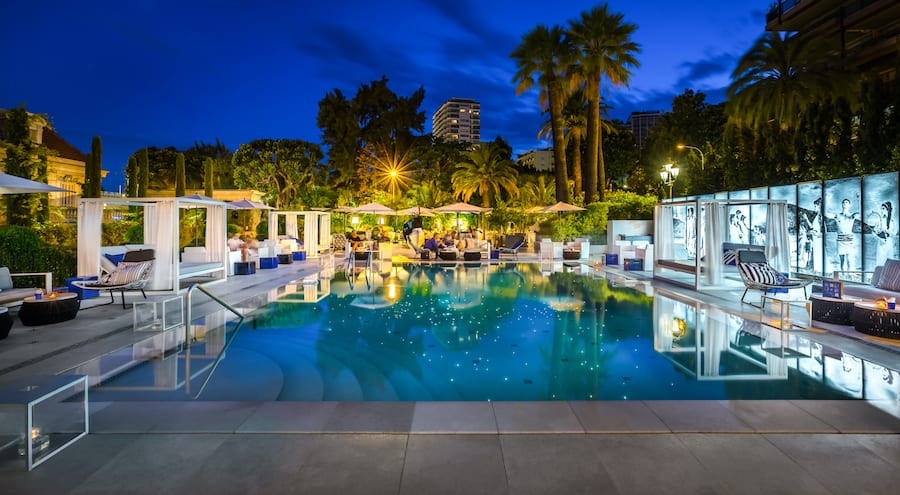
From Thursday 10th June, the Odyssey Lounge Bar and Restaurant returns, ready to host guests for cocktails and dinner. Photo of the Karl Lagerfeld-designed rooftop by C. Larit
Situated in Monte-Carlo, the beating heart of Monaco, this peaceful locale, imagined and designed by the late, great Karl Lagerfeld, is a place to relax and enjoy the best of Monaco’s summer.
It will feature music curated by the hotel’s sound designer, Beatrice Ardisson, and from 7pm onwards, Odyssey will offer aperos and gourmet tapas including a cocktail bar menu.
When the sun goes down, the full impact of the Lagerfeld mural depicting the voyage of Ulysses will be played up using artistic and tasteful lights twinkling off the pool to create a stunning overall effect.
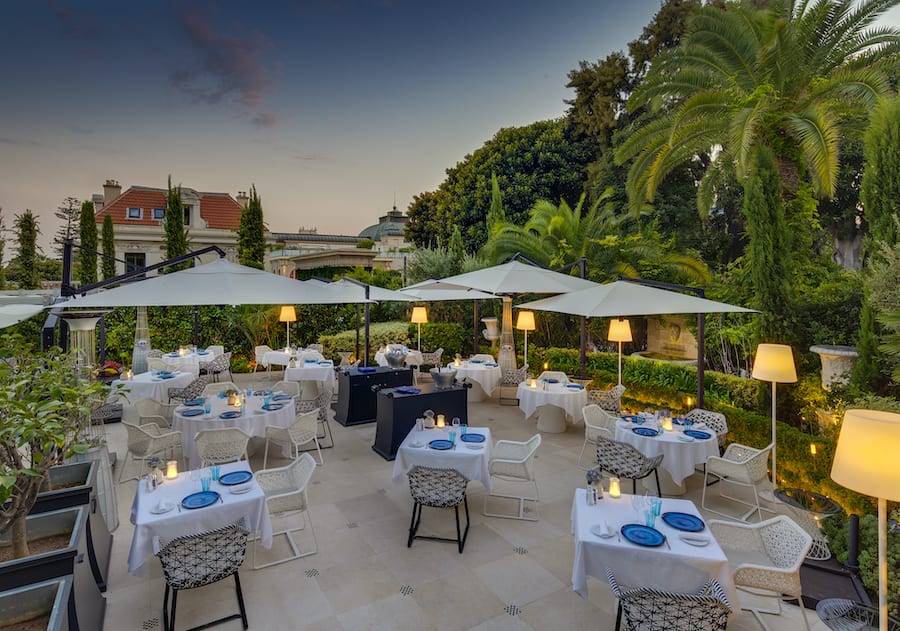
To top it all off, Executive Chef Christophe Cussac will be serving up Mediterranean-style fare using fresh, seasonal products, offering the best the Côte d’Azur has to offer from his newly renovated kitchens. Photo of the Odysee Restaurant by C. Larit
“People do not see what has been done in the back of house, but it is a revolution for our teams, it is so exciting,” Chef Cussac told Monaco Life during April’s hotel reopening.
For a taste of Monaco elegance, check out the Odyssey, open for dinner from 7:30pm Thursday to Monday all summer.
Venturi, the Monegasque high-performance electric vehicle constructor, is set to unveil the world’s first ever zero emissions polar exploration vehicle on World Environment Day, 5th June.
Returning from a trip to the Antarctic in 2019, Prince Albert II of Monaco remarked to Venturi’s President Gildo Pastor that the research stations there had no environmentally-friendly, non-polluting vehicles. So, the Prince Albert II Foundation asked Venturi to come up with a zero emissions solution, to carry passengers and equipment to and from the scientific research sites.
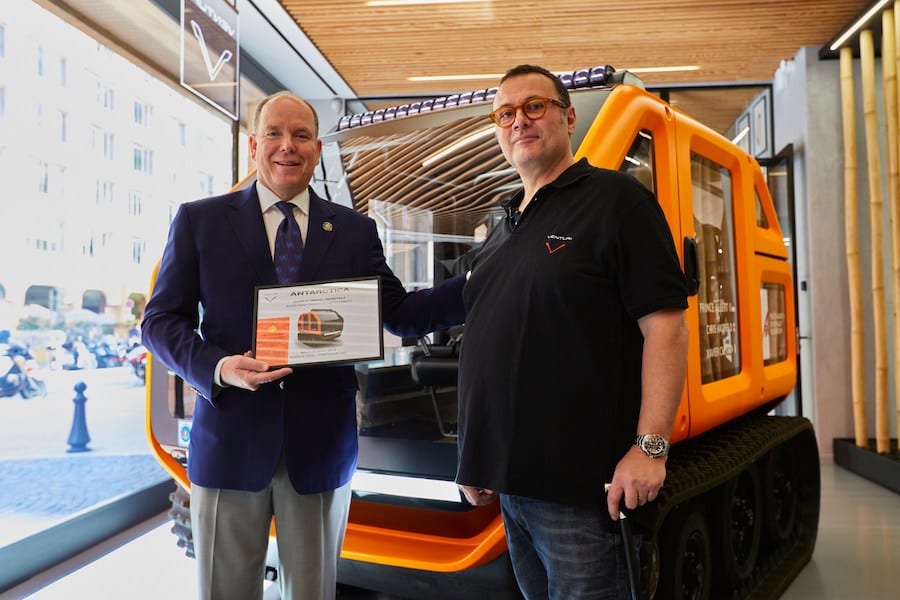
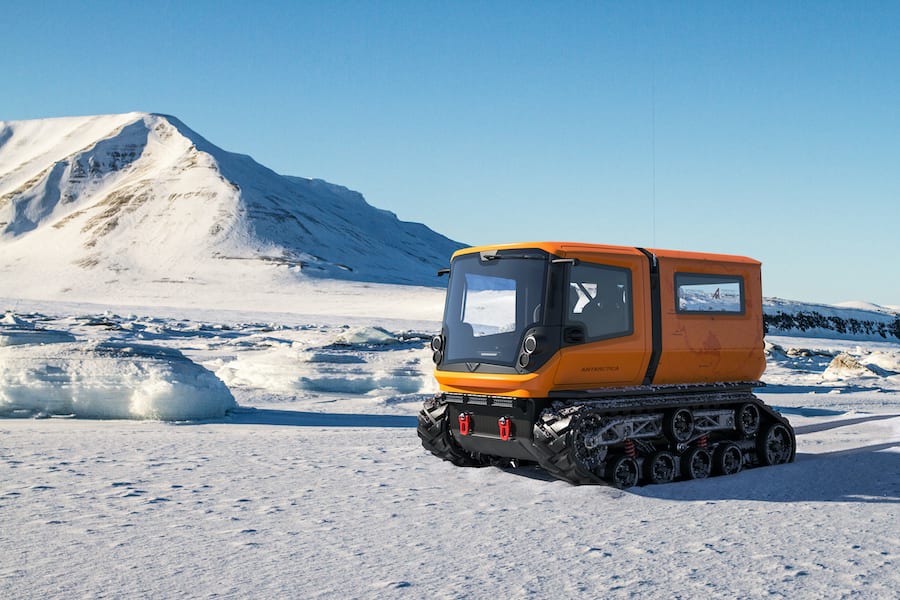
Three successive versions of the vehicle were designed. The latest, presented to the Prince at Venturi’s workshops on 1st June, will be operational from 7th December 2021 at the Belgian Princess Elisabeth research station. Photo of Venturi’s explorer vehicle with Spitsbergen – Svalbard and Jan Mayer Icebergs peaking from a frozen sea with mountains in the background, supplied by Venturi
Antarctica’s bodywork and styling were created by Sacha Lakic, the designer with whom Venturi has worked closely for many years. His vision cleverly navigates the technical constraints imposed by the research and development department, most of which are to do with the vehicle’s thermal insulation, the size of the battery, and the chassis’ tubular structure.
Sacha Lakic also succeeded in the challenge of devising a design that is versatile, yet ensures the right level of comfort for the vehicle’s occupants. With its fold-down bench seats, Antarctica is able to carry up to six people, along with equipment and a second battery to extend the initial range of 50 kilometres.
Antarctica is the encapsulation of Venturi’s technological expertise. The Research and Development teams – already working on the Voxan and Venturi world speed records programme – have created a completely unique vehicle, equipped with cutting-edge technological solutions that are both bold and clever.
On Tuesday 1st June, during his visit to see the next generation Antarctica for the first time, Venturi presented the Prince with a gift of the original prototype that he drove in Canada in March 2019. Prince Albert II took the controls of the vehicle to navigate part of the 42-kilometre mountainside route between Dease Lake and Telegraph Creek, on the lands of the Tahltan people. Prince Albert with the team in Canada 2019, photo provided by Venturi
“It remains a source of great pride for the Prince Albert II of Monaco Foundation to work alongside intrepid and visionary entrepreneurs like Gildo Pastor, making sustainable innovation not just the core of their R&D, but using it to further the cause of science and preserving our planet,” said Olivier Wenden, Vice-President and Chief Executive of the Prince Albert II Foundation.
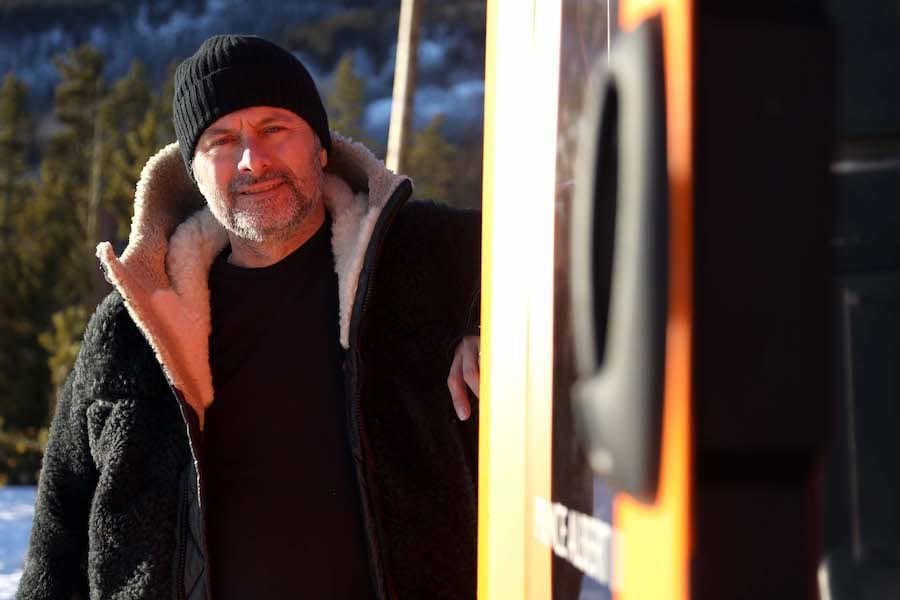
“This new Antarctica vehicle is itself a magnificent example of the feats we are capable of, and I am sure it will be a real asset for the scientists at Princess Elisabeth Antarctic research station. The polar regions, particularly fragile and vulnerable, must be the focus of all our attentions. They are on the front line of the devastating effects of climate change. To improve our knowledge without disturbing ecosystems, using a zero-emissions vehicle capable of withstanding extreme conditions, is a major step forward.” Photo of Gildo Pastor by Venturi
Since 2000, the Venturi Group has specialised in the design and manufacture of high-performance electric vehicles. Whether through world records, expeditions on hostile terrain, the creation of the first electric sports car, the development of innovative vehicles or its involvement in the Formula E World Championship, the Venturi Group embodies and demonstrates all the capabilities of the electric vehicle on two or four wheels.
“With the Venturi Antarctica, scientists are getting an efficient, easy-to-handle vehicle with very good performance,” said Gildo Pastor, President of Venturi. “They will be able to carry out their research in optimum conditions, without polluting sites where the quality of analyses needs to be accurate down to the last molecule. We are proud to have developed a technological solution that fulfils the remit given to us by the Prince Albert II Foundation.”
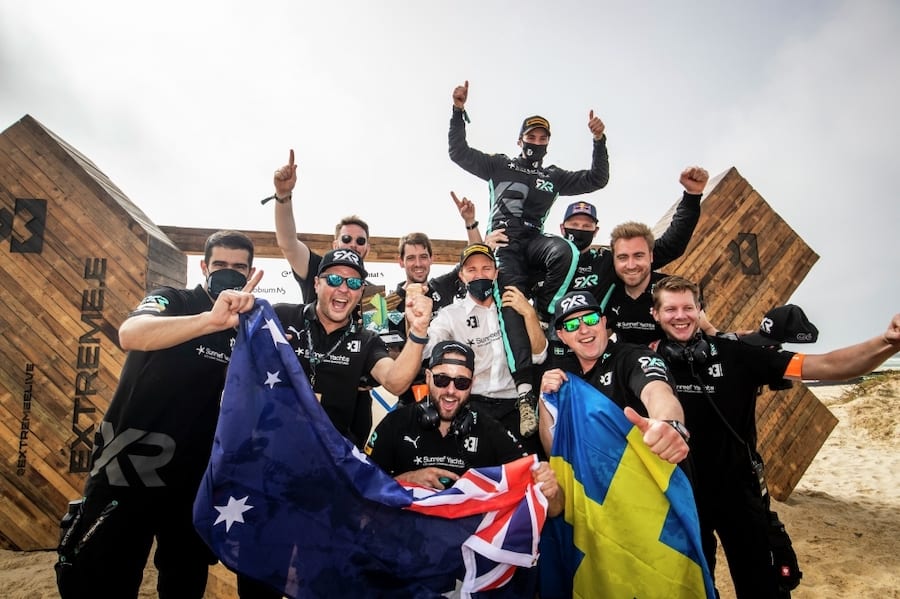
Nico’s Rosberg X Racing has scored its consecutive Extreme E championship victory in Senegal, despite a first-corner collision with Lewis Hamilton’s X44 team.
The pioneering electric SUV, off-road racing series delivered even more spectacular moments and overtakes on the weekend than the dramatic curtain-raising Desert X Prix in the Saudi deserts of AlUla eight weeks ago.
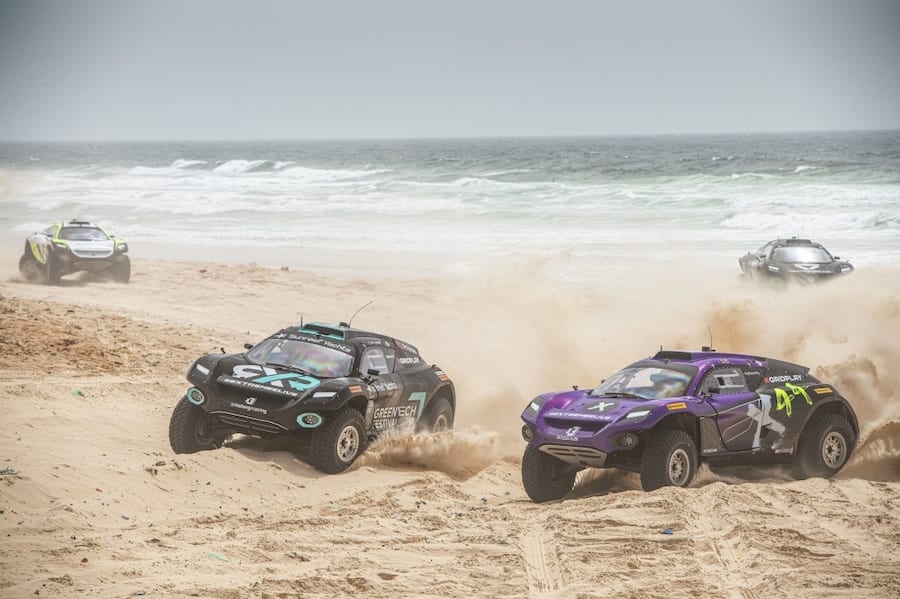
Running alongside the stunning backdrop of the Atlantic Ocean in Dakar, Senegal, the Extreme E showdown featured the notoriously bumpy and flowing ‘Moguls’ section, a single file wooded area and a spectacular start/finish straight running along the beach, a course that has been heralded by the drivers as more technical and closer to their initial vision of Extreme E. Molly Taylor (AUS)/Johan Kristoffersson (SWE), Rosberg X Racing, Cristina Gutierrez (ESP)/Sebastien Loeb (FRA), X44, Jamie Chadwick (GBR)/Stephane Sarrazin (FRA), Veloce Racing, and Cristina Gutierrez (ESP)/Sebastien Loeb (FRA), X44.
Rosberg X Racing (RXR) teammates Molly Taylor and Johan Kristoffersson overcame intense pressure from their rivals to be crowned winners of the first-ever Ocean X prix, after both Jenson Button’s JBXE outfit and Lewis Hamilton’s X44 squad retired in the early stages of the two-lap, 12.6km race.
Hamilton’s car sustained damage to its right-front wheel after contact between Cristina Gutierrez in the X44 and leader Molly Taylor for Rosberg X Racing. That was almost immediately followed by Button’s SUV sustaining terminal damage on the long, bumpy shoreside run at the start of the lap.
After the race was red-flagged so that the two cars could be cleared, a standing restart saw Rosberg’s Johan Kristoffersson and Veloce’s Jamie Chadwick battle for the lead, but the former pulled away and completed the second lap to win by 14 seconds.
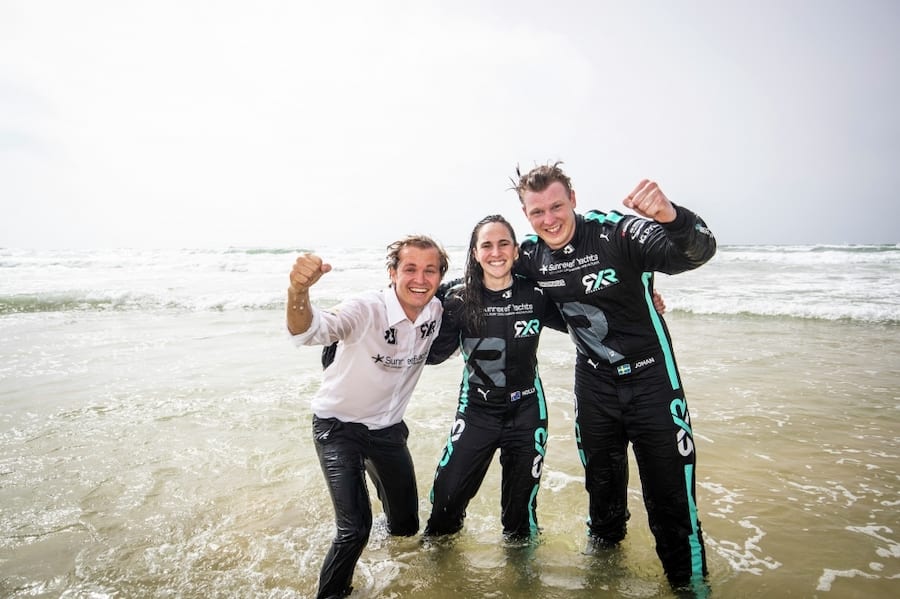
Button’s team came in third, and Hamilton’s fourth. Nico Rosberg, founder and CEO, Rosberg X Racing with Molly Taylor (AUS), Johan Kristoffersson (SWE), and team members.
“I’m so happy for us as a team to have won in Extreme E for the second time. Two out of two, wow,” said Nico Rosberg, founder and CEO of RXR, after the win. “You know, it’s not to be underestimated the challenge that was out there this weekend. It’s so difficult because no one really understands the cars properly, as you don’t get a chance to test them. So, you have to guess and figure things out – as a team, we’re really trying to bring a Formula 1 approach to Extreme E here which is really helping us as a team to perform.
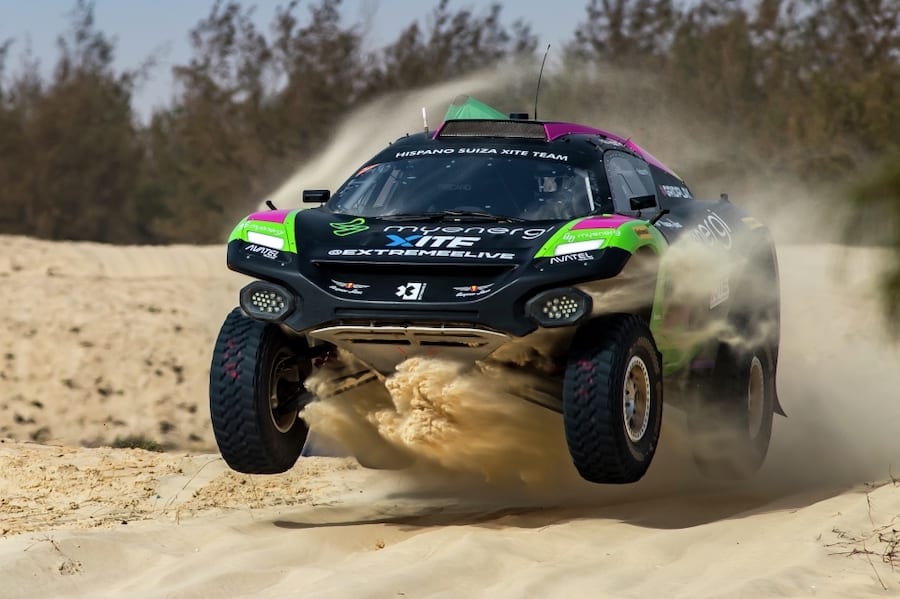
“It’s so cool as well that in AlUla, it was Johan that very much did it at the start and Molly followed on, but today it’s Molly that made the magic in the final and then Johan brought it home,” the former Formula 1 champion added. Christine ‘GZ’ Giampaoli Zonca (ESP), Oliver Bennett (GBR), Hispano Suiza Xite Energy Team.
Nine teams and 18 drivers competed, but in a slight change to the Saudi Arabia race format, the final was a four-car battle, with two teams from each of the two semi-finals progressing to the concluding race.
Segi TV Chip Ganassi Racing’s Kyle LeDuc took the new Super Sector title, earning an extra five points for his team setting the fastest time of 1 minute 50.891 seconds – 1.289 seconds ahead of X44’s Sebastien Loeb.
“The race format here has been a big step forward from AlUla in terms of development for race excitement – but it’s still early stages and there’s still a way to go,” Rosberg said. “I love this whole championship and being in the role of team principal – I’m still as competitive as hell even though I’m not actually driving. Anyway, we have the two best drivers in the car who are doing a much better job than I could – and I couldn’t be happier.”
Rosberg’s team is sitting at the top of the championship ahead of the third event of the climate-aware series, the Arctic X Prix, in Greenland on 28th to 29th August.
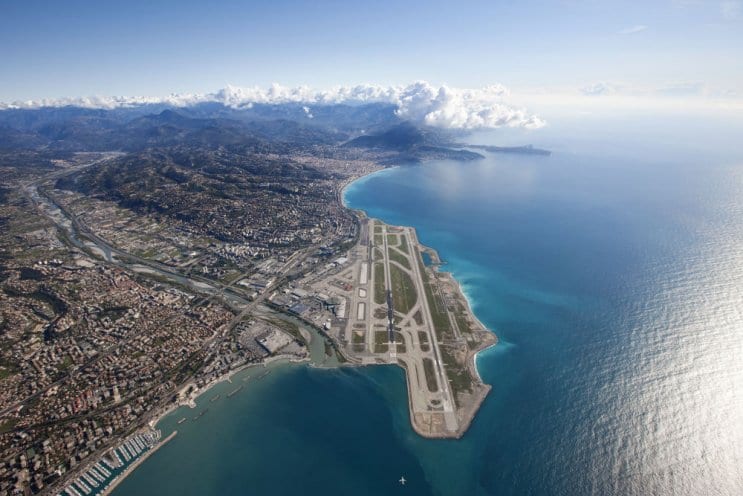
Landings at Nice Côte d’Azur airport are set to become a lot softer thanks to the acquisition of a super-powerful lidar to detect sudden episodes of windshear, a first for any European airport.
Nice airport’s proximity to the sea, mountains and plains of the Var make it a prime locale for sudden variations in wind direction, also known as wind shear. This phenomenon can make difficulties for pilots, especially during landing phases.
Now, the airport is benefitting from one of the world’s most powerful Doppler lidars in Europe. Acquired by Météo France and built by Japanese manufacturer Mitsubishi Electric Corporation, this new equipment compliments the observation systems currently in place and will make for safer journeys all around.
“We warmly thank Météo France for having acquired and implemented this lidar, which strengthens the safety of aircraft and their crews, and passenger comfort in the service of the performance of our Nice platform,” said Franck Goldnadel, Chairman of the Management Board of the Airports of the Côte d’Azur.
Lidar, which stands for Light Detection and Ranging, is a remote sensing method that uses light in the form of a pulsed laser to measure variable distances to the Earth. A lidar is effective even in dry weather, whereas a x-band radar, the equipment used prior to the arrival of the lidar, is effective only in wet conditions as it uses raindrops and clouds to sense the patterns.
The lidar works using aerosols suspended in the atmosphere’s lower layers to measure wind by Doppler effect to follow movements. This allows forecasters to predict wind shear and its close cousin, turbulence, up to 10 minutes in advance. This allows pilots to anticipate the coming conditions and adjust during crucial take-off and landing phases.
Several airports are using the Mitsubishi lidar, notably in Southeast Asia and Japan, and Nice is the first in Europe to have access to it.
A penthouse restaurant headed by Mauro Colagreco, a luxurious spa with infinity pool, and an elegant outdoor ballroom perfect for one of Monaco’s many charity galas… Here is what we know about The Maybourne Riviera, soon to open in Roquebrune-Cap-Martin.
The Maybourne Hotel Group, owned by the Qatari royal family, is the operator of Claridge’s, The Connaught and The Berkeley in London, and The Maybourne Beverly Hills in Los Angeles. The group will be launching its fifth hotel this summer in Roquebrune-Cap-Martin.
“The opening of The Maybourne Riviera marks a new era for Maybourne Hotel Group, with our first newly built property in one of my favourite places in the world: Roquebrune-Cap-Martin, a truly untouched French gem,” said co-owner of Maybourne Hotel Group Paddy McKillen. “We plan to bring the legendary service and spirit of hospitality that have made our London hotels so successful and much loved, building The Maybourne Riviera into one of the great hotels of the world.”
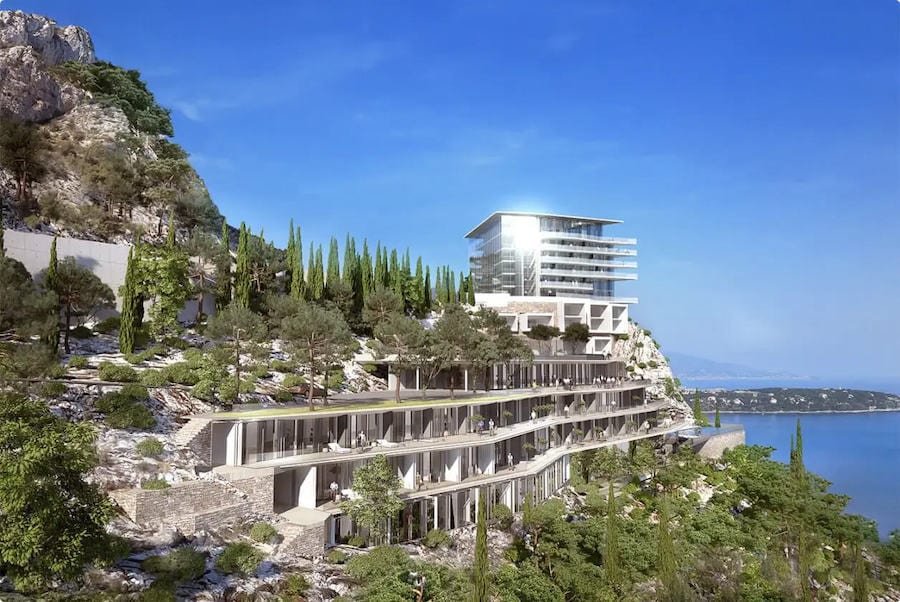
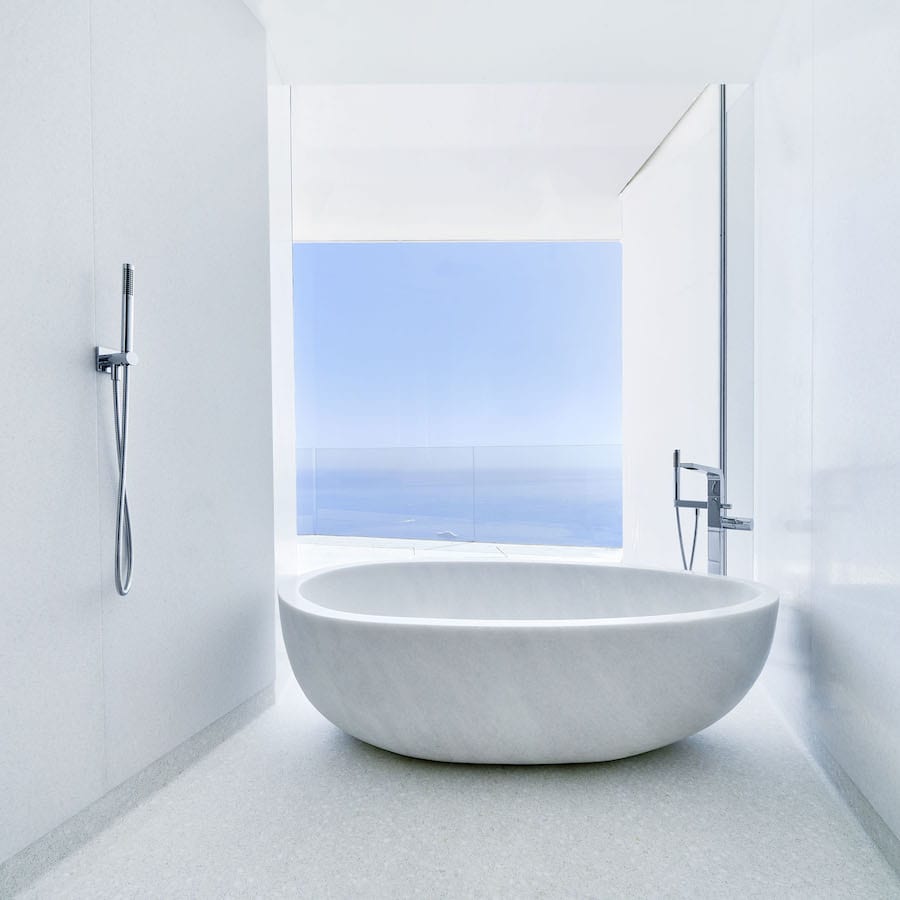
The striking modernist hotel features an exterior design by Jean-Michel Wilmotte, a nod to modernist architects Eileen Gray and Le Corbusier who built their contemporary homes close by. Among his many other projects, Wilmotte is responsible for the rehabilitation of the auditoriums of the Palais des Festival in Cannes and designed the Teotista residential building in Monaco, also known as the Monte-Carlo View. Bathroom design at The Maybourne Riviera Bringing luxury to Roquebrune-Cap-Martin
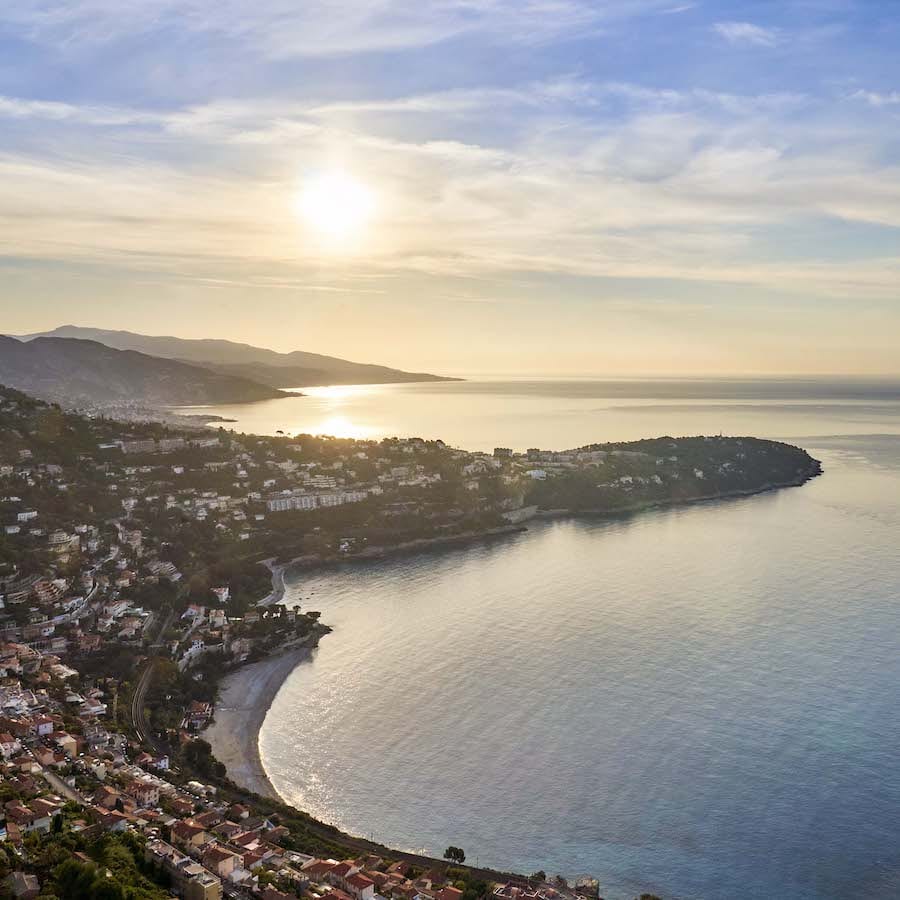
Floor to ceiling windows in each of the 69 rooms will enable guests to take in the dramatic views sweeping from Italy in the east to Monaco in the west. Among them will be 24 suites with private terraces or balconies, some even offering private horizon plunge pools.
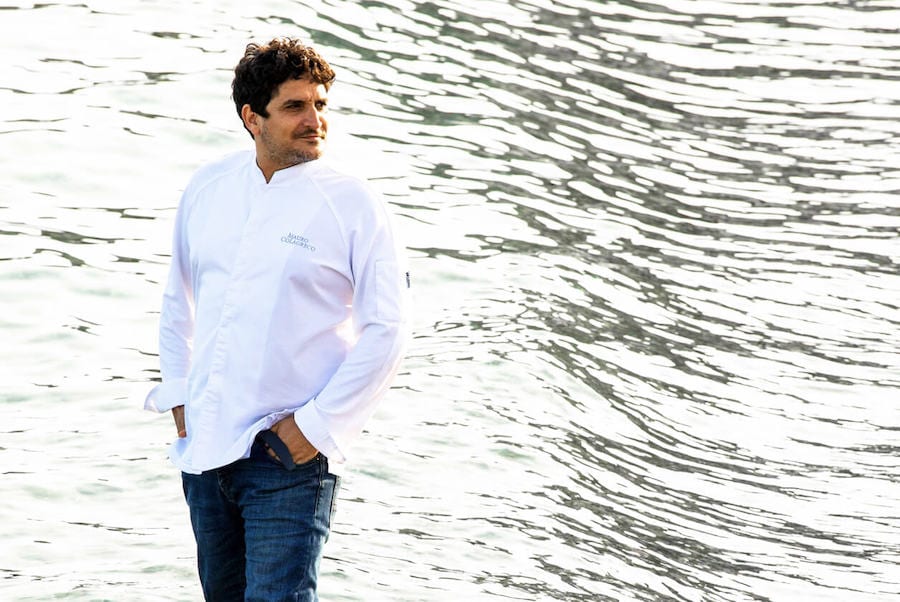
The group has been collaborating with some of the most globally recognised artists, designers and architects to create one-of-a-kind spaces, with Andre Fu, Bryan O’Sullivan Studio, Marcelo Joulia, Pierre Yovanovitch, Pascal Goujon and Rigby and Rigby all adding their distinctive style, as well as the Maybourne in-house design team led by Michelle Wu. Mauro Colagreco will head his second Riviera restaurant at the hotel A destination for locals
For people who already live in Monaco, the great news is that The Maybourne Riviera will also be an outstanding gastronomic hotspot with a host of restaurants under the creative direction some of the finest chefs and restaurateurs in the world. The legendary Mauro Colagreco of three Michelin star Mirazur in nearby Menton, and holder of the number one position in the World’s 50 Best Restaurants, will have his restaurant on the enviable top floor with panoramic views, drawing on his favourite theme, the sea.
In addition, global super-chef Jean-Georges Vongerichten will launch his first restaurant in the French Riviera with cuisine inspired by the hotel’s location on the French-Italian border. Finally, Japanese chef Hiro Sato will bring his world class sushi to The Maybourne Riviera.
Other perks for locals include a Piano Bar for a sunset aperitif or final nightcap, a wellness centre with indoor and outdoor pools and André-Fu designed spa, and conference spaces that can accommodate up to 250 guests for everything from wedding receptions to congresses. There are also two ballrooms, one of which is outdoors – perfect for Monaco’s many charity galas. The hotel will feature incredible views from Italy to Monaco
The hotel is set on the rocky peninsula high above the coast in restored ancient gardens with walkways, citrus orchards and a seasonal herb garden.
When contacted by Monaco Life, the group said it was unable to give a specific opening date of The Maybourne Riviera as it is currently finalising timelines. But stay tuned as we will be updating our readers on this exciting new destination.
Pandemic halves SBM revenue in 2020/21 fiscal year
Monaco’s largest employer, Société des Bains de Mer, has reported revenues of €336.9 million in the year ending 1st March 2021 compared to €618.8 million the previous year, amid the company’s major restructuring and cost-saving plan.
The pandemic brought havoc to those in the hospitality industry, and the Société des Bains de Mer (SBM) was no exception. CEO Jean-Luc Biamonti announced the company’s financial statements to the press on Friday, after an annual Board of Directors meeting on 27th May.
Among the notable figures, SBM saw gaming revenues decrease by €115 million in the last financial year, equalling -48%. Meanwhile, hotel revenues reduced by €175 million, coming to a depressing -62%. The only bright spot was that rental revenues increased by a small but significant €10 million equalling a +11% gain.
The company also saw an operating loss of €103.3 million compared with a €22.6 million profit in the 2019/20 fiscal year. The consolidated loss was less severe, but still significant at -€79.1 million, as opposed to the previous year which saw a profit of €26.1 million.
Gaming and hotel losses are contributed directly to the forced closures that were periodicallynecessary as part of lockdown procedures throughout much of 2020 and into 2021.
The rental sector increase is being attributed mainly to new residential leases having been signed at One Monte-Carlo, though Monte-Carlo Bay, the Balmoral, the Villas du Sporting’s boutique and office lettings also contributed.
As a result, SBM has worked to reduce overhead in the form of operating and investment expenses, as well as accelerating their global restructuring plan. This led to employees going on furlough or paid leave throughout a good part of the year.
The restructuring plan, which was announced on 4th March, includes a voluntary redundancy plan for employees over 57-years-old, on the essential condition that these workers would not be replaced. Do date, 234 employees have signed up.
Additionally, a collective forced redundancy plan was put into effect. This is currently limited to just two people, with most of the staff departures targeted at certain departments for reasons of overstaffing or re-organisation to restore competitiveness. These individuals have been moved to alternative roles.
The restructuring has resulted in a net cost of €25.3 million.
Looking forward, SBM anticipates, with the implementation of the restructuring plan, a net saving of €18 million this year. These savings, along with other measures to bring costs more into line with seasonal fluctuations in activity, should give SBM Group a return to profitability, says the company.
SBM has also put in place financial measures that mean they are completely solvent. According to Mr Biamonti, they have roughly €90 million in ready cash for the unexpected or the unforeseen.
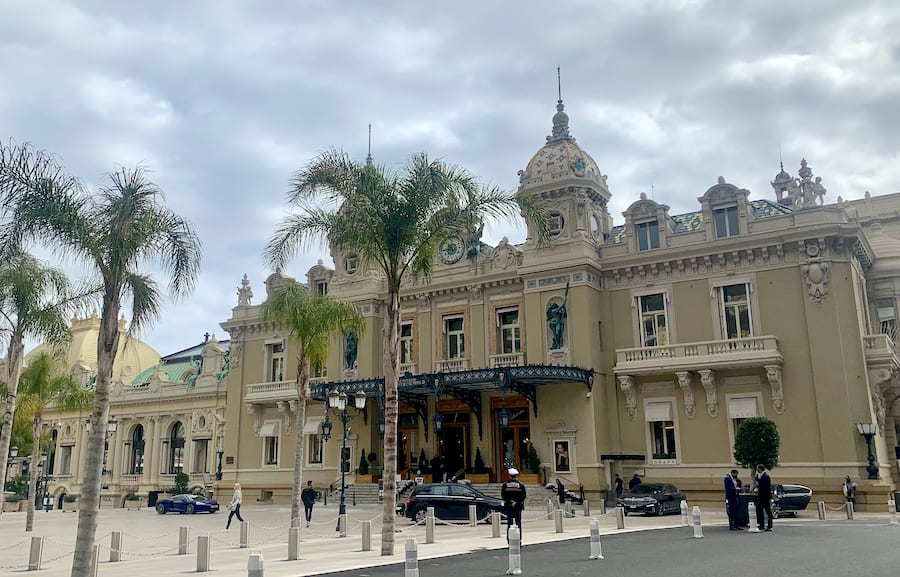
Photo of the Casino de Monte-Carlo by Monaco Life
All the headlines and highlights from Monaco, direct to you every morning