

Josephine Baker, Sir Roger Moore, Anthony Burgess and Grand Prix winner Louis Chiron are among the famous names buried in Monaco Cemetery, the walled two-hectare site below the Princess Grace Hospital Centre near the Cap-d’Ail border.
During a guided tour for Monaco Life, local guide Philippe Borsarelli revealed the stories behind some of its best-known graves.
According to Borsarelli, the cemetery opened in 1868, the same year the railway arrived in Monaco, replacing earlier burial grounds on The Rock and at Sainte-Dévote. Today, the Town Hall manages its 7,500 plots and niches, which he said are reserved for Monegasque nationals and for residents who die in the Principality, with nationals given priority and a 50 per cent discount.
Josephine Baker: A black granite tomb gifted by Princess Grace
The American-born revue star, singer, French Resistance fighter and civil rights activist was laid to rest here following her death in 1975, in a black granite tomb offered by her friend Princess Grace. Her fourth husband, conductor Jo Bouillon, who died in 1984, rests in the same vault. Together, the couple bought the Château des Milandes in the Dordogne, where they raised their 12 adopted children, affectionately known as their ‘rainbow tribe’.
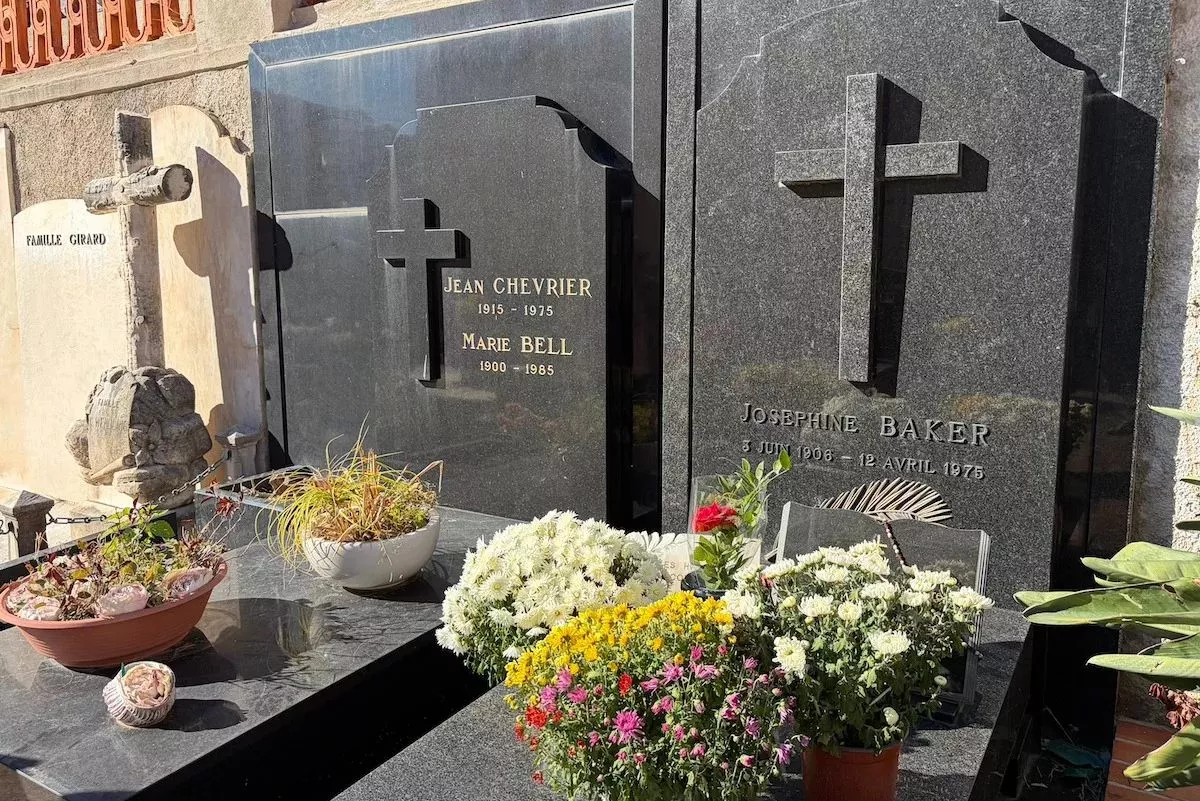
“In 1969, encountering financial problems, it was Princess Grace of Monaco who reached out to her, who provided financial assistance and who found her a home in Roquebrune-Cap-Martin when the artist had to sell her château,” Borsarelli told Monaco Life. Also buried in the family tomb are Baker’s half-sister, Margarette Wallace, and her brother-in-law, Elmo Wallace.
Although Baker was inducted into the Paris Panthéon on 30th November 2021, the anniversary of her French naturalisation, her physical remains never left Monaco, in accordance with her family’s wishes. The day before the Paris ceremony, Prince Albert II collected soil beside her Monegasque grave to be placed in her empty coffin at the Panthéon, alongside earth from St Louis, Paris and the Château des Milandes.
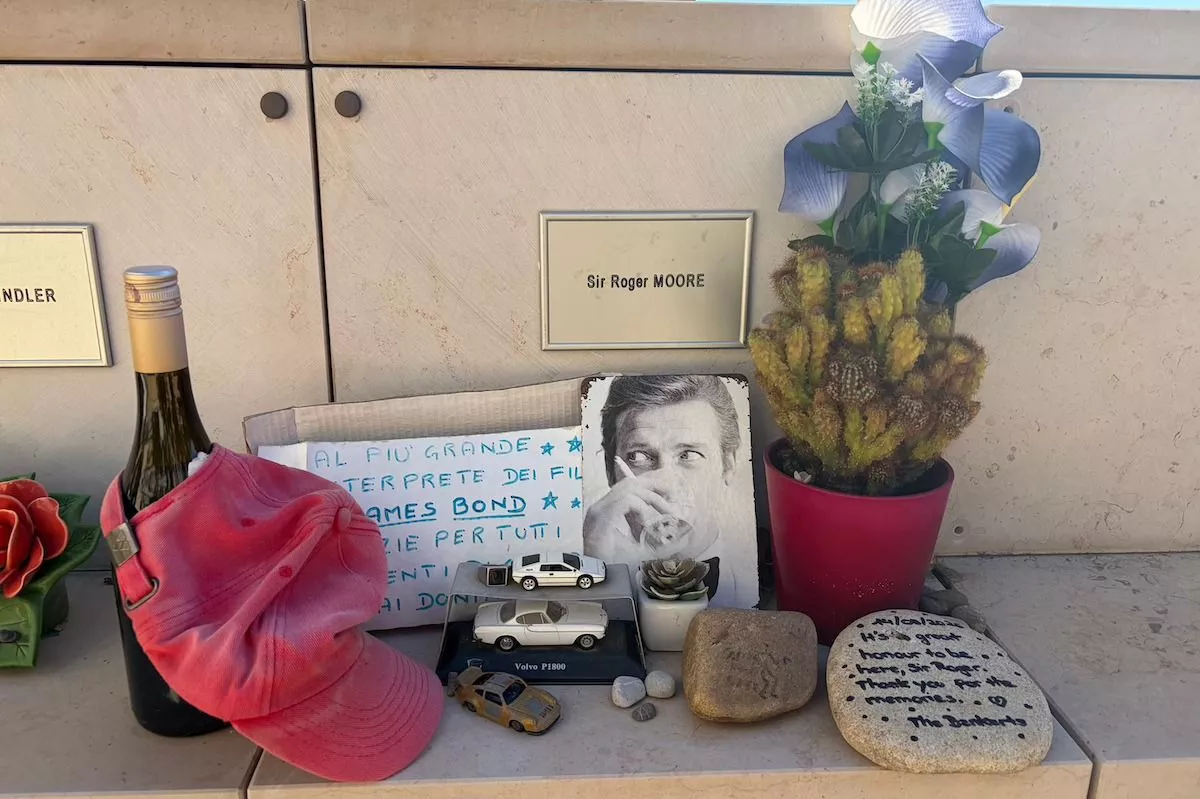
James Bond legends resting rows apart
Two major figures of James Bond cinema rest just rows apart. Sir Roger Moore, who played 007 in seven films and lived in Larvotto, is commemorated with a pebble bearing a drawing of ‘The Saint’, the television series that made him famous as Simon Templar before ‘The Persuaders!’ cemented his stardom. Knighted in 2003 for his decades of work as a UNICEF ambassador, Moore once said Monaco was “the only place in the world where you can park a Bentley without someone coming along with a key and scratching it”.
Close by lies British director Lewis Gilbert, who settled in Monaco in 1975 and died in 2018, about nine months after Moore. Gilbert directed three Bond films: ‘You Only Live Twice’ (1967) with Sean Connery, and ‘The Spy Who Loved Me’ (1977) and ‘Moonraker’ (1979) with Moore.
Behind ‘A Clockwork Orange’: Anthony Burgess
The British writer, musician and linguist once lived at 44 Rue Grimaldi in La Condamine. Best known for his 1962 dystopian novel ‘A Clockwork Orange’, adapted for the screen by Stanley Kubrick in 1971, Burgess also created the prehistoric language spoken in Jean-Jacques Annaud’s 1981 film ‘Quest for Fire’.
“Normally on this grave you can see two words: ABBA ABBA, which is the title of his 22nd novel, published in 1977. The term is also said to be the final words spoken by Christ on the cross; those two words mean ‘papa’,” said Borsarelli, pointing to the inscription on the niche.
Auguste Macario and sculptural artistry
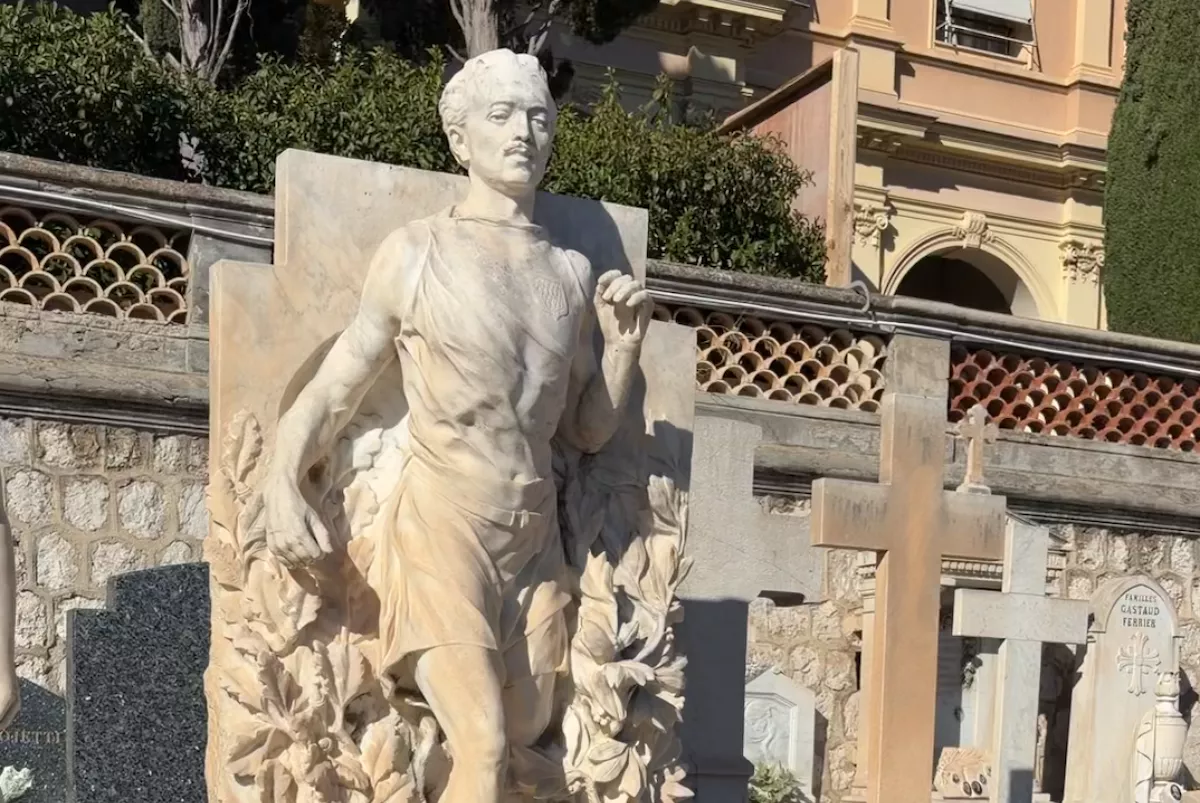
Beyond its famous names, the cemetery doubles as an open-air gallery of early 20th-century stonework. Among the standout monuments is the grave of distance runner Auguste Macario, who was born in Ventimiglia and lived in Monte-Carlo, where he was a member of the local sports club. Competing for Italy as Augusto Maccario at the 1920 Summer Olympics in Antwerp, he finished fourth in the 10,000 metres, behind the winner, Finnish running legend Paavo Nurmi.
“The cemetery is full of very interesting sculptures,” Borsarelli said, adding: “The sculptor who made this beautiful sculpture of the Monegasque athlete was Umberto Bassignani. The people who live on The Rock of Monaco are familiar with the statue of Saint Nicholas on the little square adjacent to the Monaco Cathedral, we are talking about the same sculptor, who had his studio down below on Boulevard Charles III.”
The men behind the Monaco Grand Prix
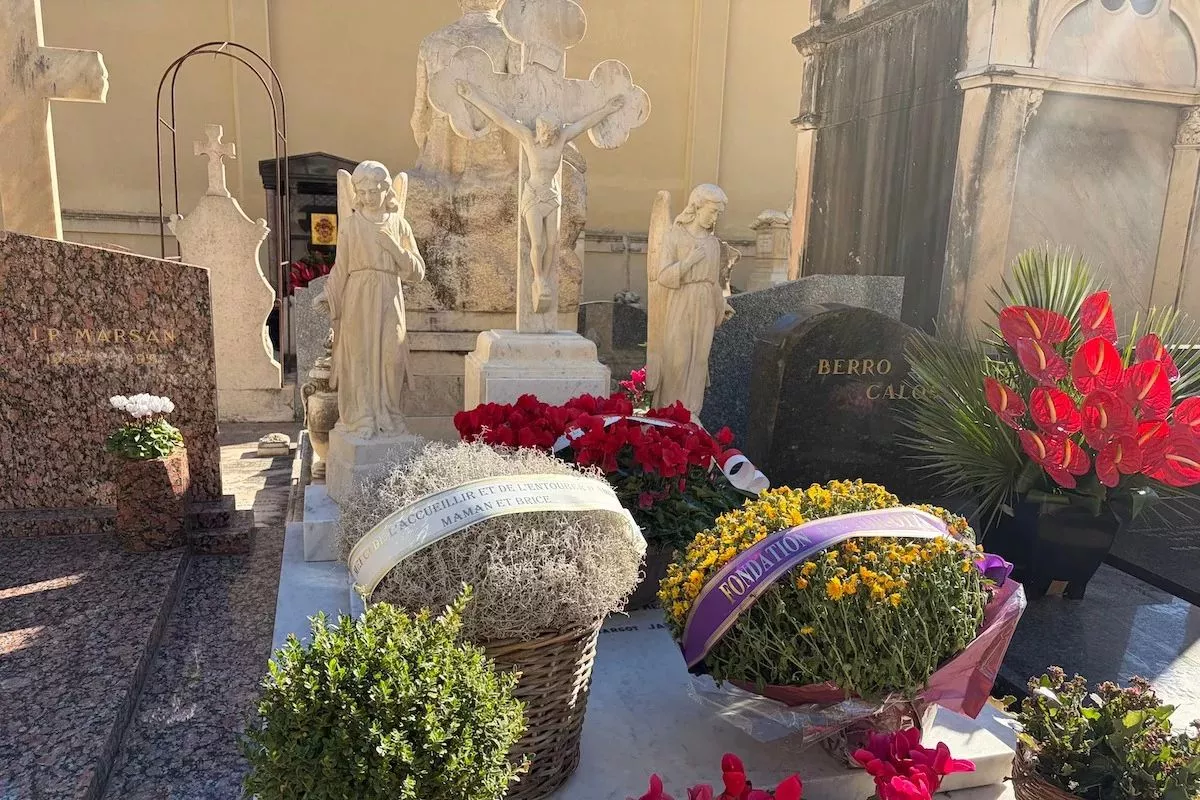
Monaco’s motorsport heritage also runs deep through the cemetery’s avenues. Before Charles Leclerc’s 2024 victory, Louis Chiron was the only Monegasque driver to win his home Grand Prix, taking the chequered flag at the third edition in 1931.
Not far away stands the tomb of Alexandre Noghès, founder of the Automobile Club de Monaco (ACM) and former Treasurer General of the Principality, and his son Antony Noghès, who died in 1978. Antony helped create the Rallye Monte-Carlo in 1911, launched the Monaco Grand Prix in 1929, and introduced the black-and-white chequered flag now used to finish motor races worldwide.
Tex Willer and his horse carved in stone
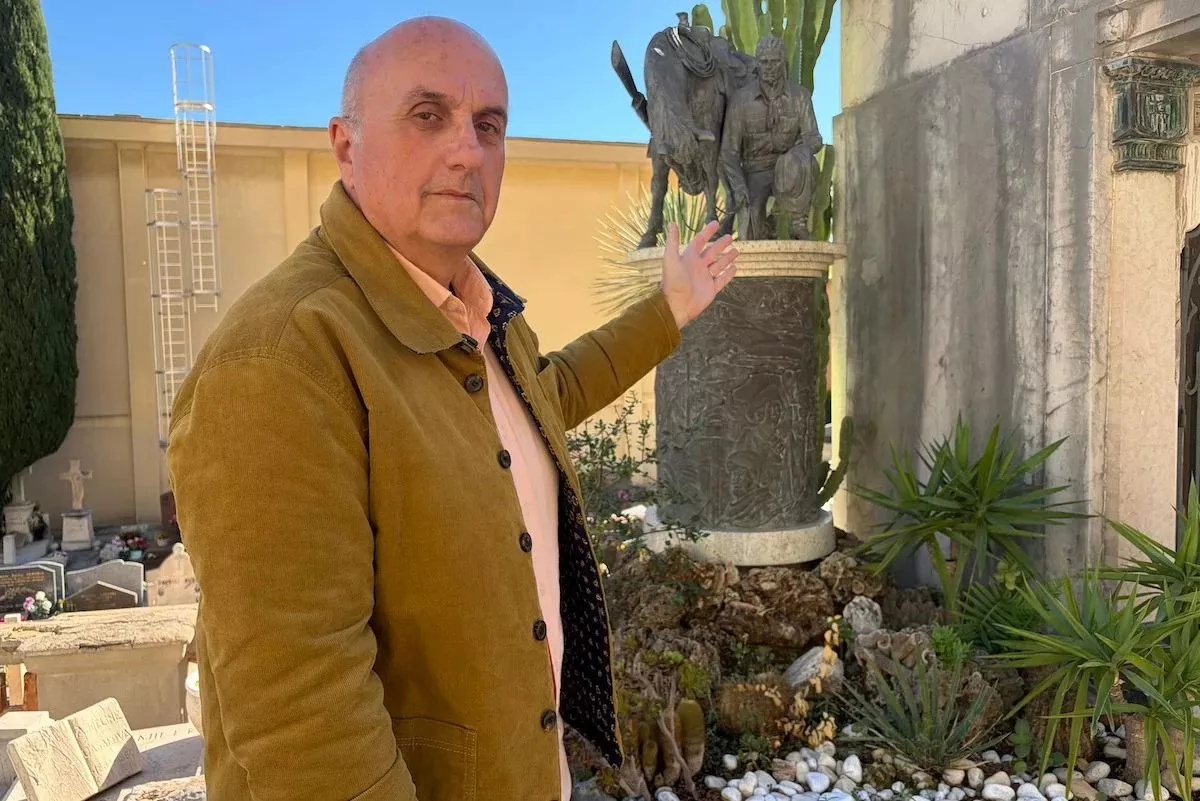
Another striking monument belongs to Milanese comics pioneer Giovanni Luigi Bonelli, who died in 2001 aged 92. Over a career spanning more than half a century, Bonelli created some of Italy’s best-known fumetti heroes, most famously Texas Ranger Tex Willer, launched in 1948, who is sculpted on the monument alongside his horse, Dinamite.
A quiet chronicle of the Principality
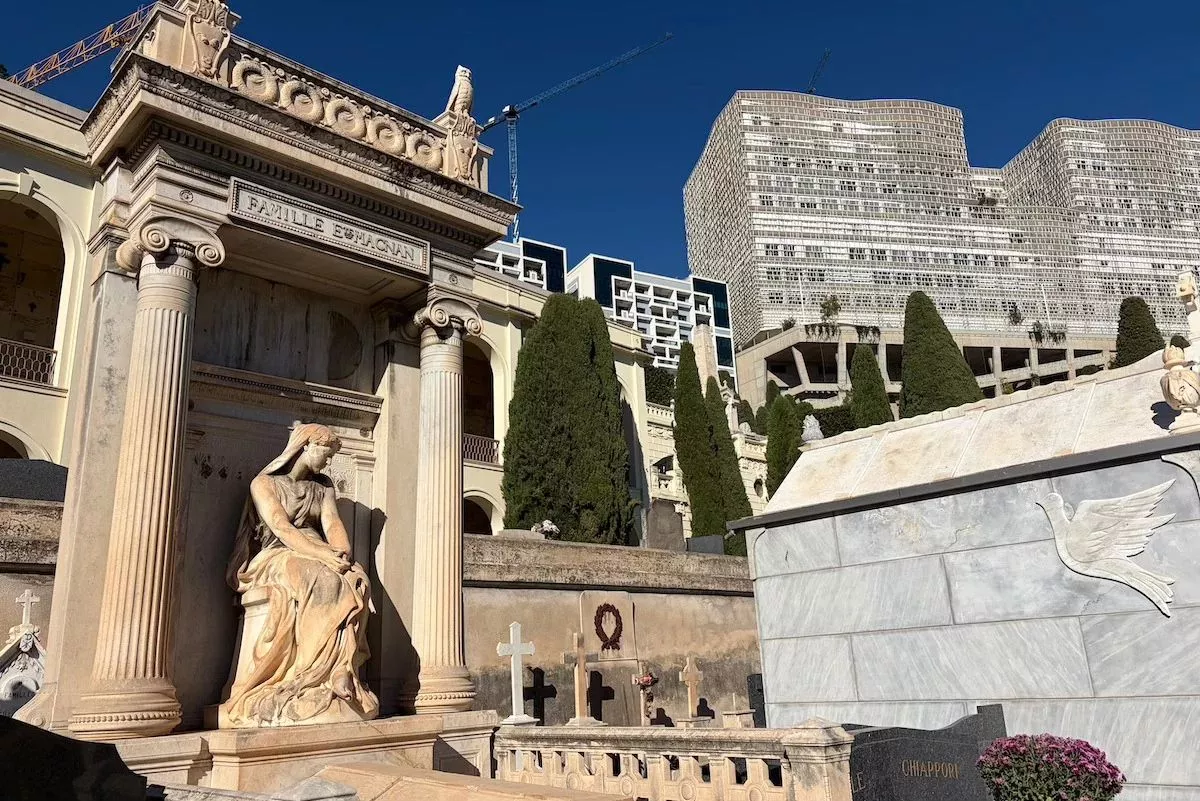
The cemetery’s terraced paths trace the international lives that have shaped modern Monaco, with local racing dynasties and Olympic pioneers resting beside British screen legends, Italian illustrators and an American icon who found refuge on the Riviera.
“For visitors and residents alike, it remains one of the most revealing, if overlooked, corners of the Principality,” concluded Philippe Borsarelli.
Stay updated with Monaco Life: sign up for our free newsletter, listen to our podcasts on Spotify, and follow us across Facebook, Instagram, LinkedIn, and Tik Tok.
Tour guide Philippe Borsarelli in front of Milanese comics pioneer Giovanni Luigi Bonelli’s tombstone. Photo credit: Virginia D’Umas