Stay sane, sustain

Love and marriage, horse and carriage, and now, superyacht and sustainability: bonded at the hip, paired for life, you can’t have one without the other.

Sustainability is this year’s MYS buzz word.

If you blink in the Darse Sud Exhibition Tent you might miss the sustainability ‘suite’, but “It’s a step in the right direction”, clamours this 14-stand strong army of exhibitors. And, what they might lack in numbers they make up for in enthusiasm: This corner is busting to save the earth and seas and has (some) of the wherewithal to make it happen.

Monaco Life pulled back the tent flaps and ventured inside to discover some of the innovative solutions on offer and learn what they mean for the future of yachting.

Hello Hydrogen

‘It’s time to shift’ is the rallying cry of EODev (Energy Observer Developments). This business, created in 2019, draws on the experience accumulated on board the 30.5 metre vessel, Energy Observer – the first hydrogen-powered, zero-emission vessel to be self-sufficient in energy.

EODev presents the RexH2, an onboard hydrogen fuel cell power generator. It has a footprint of one cubic meter and weighs 540 kilograms, which, for the non-scientific among us, is not very much.

Business Developer Fernando Szabados explains: “Basically, we produce hydrogen based on fuel cell technology supplied by Toyota and adapt it to our products. They have been using this technology for decades and they know how to use it and its nature. We integrated the product into the Energy Observer in 2019 and she’s been navigating now for two years with no failures.”

Right now, the biggest boat that can be powered this way is a 30m, “But”, says Szabados, “We can supply power for bigger boats, for ‘hotel load’, which means overnight power when the vessel is not moving.  Simply put, this can replace a diesel generator with no emissions, because we use hydrogen which can be produced in a totally renewable way; what we call ‘green hydrogen’. So even in the process of producing hydrogen there are no emissions. It can be used to go to protected areas with zero emission navigation.” The company is currently working on different sizes of power unit, bigger units for bigger and smaller units for smaller yachts. “The greatest challenge we have right now is for hydrogen storage, because it’s quite voluminous.”

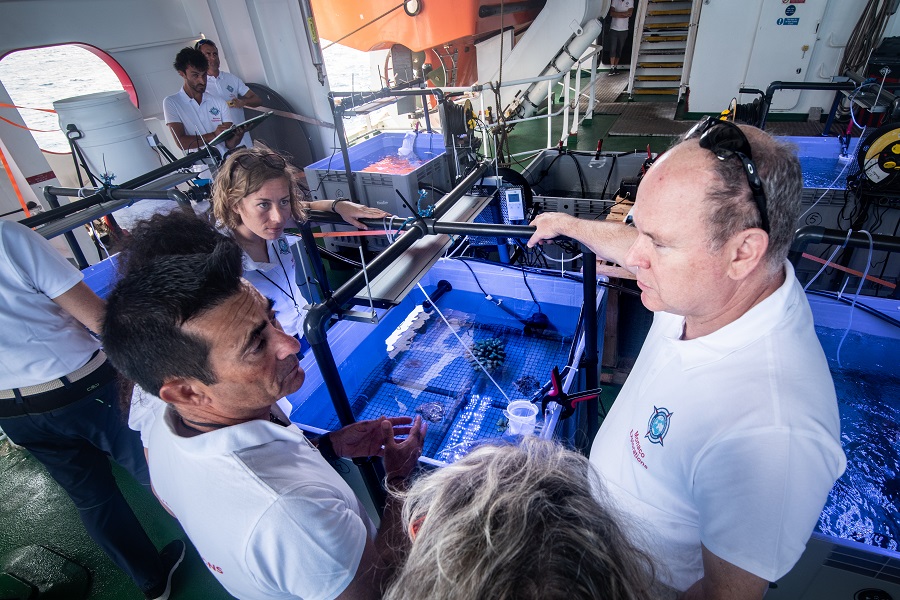
Dr Elisabetta Zerazion, Scientific Coordinator of Water Revolution Foundation. Photo by Monaco Life

Drastic plastic

Chris Desai used to work on yachts, but during a yachtmaster course decided he wanted to work to save the sea rather than sail on it. So, he founded the charity UOCEAN 2050. “We believe we can mitigate the plastic and carbon footprint of the yachting industry,” explains Desai. “We think the yachting industry should drive the change because yachts are on the ocean and enjoy its nature. Our aim is to minimise the plastic footprints of yachts and make sure it doesn’t reach the sea.” The charity missions are, by 2030, to remove a billion kilos of marine plastic (they are currently 330,000 kilos in), and restore the abundance of the oceans by 2050.

The charity encourages plastic clean-ups throughout the world: rivers, canals, beaches, and engaging schools and all types of communities. Desai explains, “It’s about getting people who have never had access to conservation to get involved at a grass roots level to protect their communities.”  

“Unsustainable practices on superyachts have to stop,” he insists, “And there is no reason why they cannot adapt to a more sustainable model by reducing their plastic and off-setting their plastic, emissions etc.”

The charity offers and is conducting an audit service for yachts on the plastic and carbon usage and work with the yachts to find alternatives.

Track Back

The Water Revolution Foundation has some hefty industry supporters with some hefty projects. The Board of Directors includes superyacht industry heavyweights such as Henk de Vries III, Chairman of De Vries Scheepsbouw, who also have a 50% share of Feadship, yacht designer Philippe Briand, and Peter Lürssen of Lürssen Yachts. They are partnered with doctors in sustainable development, marine biology and science. The aim is to track, understand and change the impact of yachts on the environment.

Their work is a study in the collective term for initialisms, but no less relevant for it.

Explains Dr Elisabetta Zerazion: “YETI (Yacht Environmental Transparency Index) will be launched at METS 2022 in November this year. It offers owners the possibility to compare their superyacht by its environmental credentials and get a YETI score.” Other innovations include a Database of Sustainable Solutions (DOSS) to have sustainable solutions verified by a third party, and perhaps the most exciting is IMMA (Important Marine Mammal Areas). This allows yachts to identify, give clear passage and react responsibly to marine life locations and behaviour.

Lee Hirons of OceanLED, photo by Monaco Life

Lights please

OceanLED Marine are all about lights. Lee Hirons points out the Sustainable Solution Verified certificate from the Water Revolution Foundation. “We are one of the first to get this verification and we are very proud. One of the main features of our lights are the optics. They give the best beam and water penetration possible. A lot of our competitors do not use optics they just push a lot of power through. We don’t have to use so much power through the lights.” Because of the reduced heat, the lights can also be smaller and therefore created with less material, another sustainable factor.


Monaco Life emerged from the tent enlightened and inspired. Go peek.


Princely Family unveil Prince Rainer III commemorative logo

Prince Albert and Princess Charlene were joined by members of the Princely family in unveiling the official logo that will accompany all commemorative events linked to the centenary of the birth of Prince Rainier III, which takes place next year.

As Honorary President of the Commemorative Committee, Prince Albert on Wednesday was joined by his sister and Honorary President Princess Stéphanie, as well as Princess Charlene, Caroline Princess of Hanover, Mr. and Mrs. Louis Ducruet and Camille Gottlieb, as well as government ministers and other personalities, in unveiling the official logo.

Commemorations are due to take place in 2023, marking 100 years since the birth of Prince Rainier III.

They will begin on 31st May, the day of his birth, and will pay tribute to the late Prince, former Head of State, a “passionate man and father of a family”, said the Palace in a statement on Wednesday.

Photo by Eric Mathon, Prince’s Palace

“The year 2023 will make it possible to celebrate his memory, to make it known to the younger generations his work, and to remember the man who devoted his life to the service of the Principality,” concluded the Palace.

The logo includes a profile portrait of Prince Rainier III, his insignia, and the red and white colours of the Principality of Monaco.


Photo above by Eric Mathon, Prince’s Palace


Principality to start trial of free buses for everyone

All buses within the Principality of Monaco will be free for a two-month period, beginning 3rd October, and depending on the success of the scheme, the change could become permanent. 

From 3rd October until 27th November, the government is testing the free bus scheme that, if successful, will be extended before being made permanent. The objective of the scheme is three-fold: decrease traffic within Monaco, reduce greenhouse gas emissions, and improve the quality of life of Monaco’s residents, visitors and commuters.

The National Council have described the move as “a responsible, ecological and economical approach”. They added that it, “incites motorists residing in the Principality to leave their cars at home, and instead favour green forms of transport when moving around the Principality.”

More than 49,000 cars take to the roads of the Principality on a daily basis, which not only generates a high level of congestion within Monaco, but also has negative effects upon the quality of life in the Principality, and the environment. The government is hoping to reduce traffic by 20%, and a key arm in this battle is making public transport the main way of moving around the Principality.

During this test period, the government will carry out surveys by asking public transport users their opinions on the Principality’s network in order to further improve the service.

The National Council has announced that should the scheme have the desired effect of reducing traffic and increasing public transport usage, they will call on the government to extend the measure with the aim of making free public transport permanent.


Photo source: Government Communication Department


MonacoTech enter partnership with Hinduja group

MonacoTech has signed a collaboration agreement with the international group Hinduja promoting exchanges and networking between startups and companies.

The agreement was signed by Lionel Galfré, Director of MonacoTech, and Monegasque company HGM – member of Hinduja, represented by Ajay Hinduja and Edouard Mousny.

The purpose is for the two structures to benefit from the strengths of the other, namely the very vast, international, multi-sectoral experience of the Hinduja group and the innovation and dynamism of the projects supported by Monaco Tech.

“MonacoTech start-ups have the ability to free themselves from routines and burdens by proposing either a technological innovation capable of reinventing the processes and business models of a market, or to reverse the market approach of a sector by providing concept innovation,” said the government-run business incubator in a press statement. “They have the creativity, the dynamism and the breath of creation linked to their youth. These start-ups, on the other hand, very often suffer from a lack of funding, experience and knowledge of sectors, networks, support and relays internationally.

“Meanwhile, large companies, such as the Hinduja group, have expertise, know-how, financial resources and a particularly international network of great value and potentially very powerful.”


Photo source: MonacoTech


Interview: Naval Architect and Designer Espen Oeino

As the curtains go up on the The Monaco Yacht Show 2022, the organisers have a new word on their lips: ‘Seducation’. It’s their three-year programme designed to attract a new generation of yachting clients with two core concepts: ‘education’ and ‘seduction’ and thus, ‘seducation’. The idea is to ‘zing up’ what some might call an already blisteringly wow-fuelled event.

So with this backdrop in mind, who better to front the first of a series of Monaco Life forays into MYS 2022 than one of yachting’s most iconic figures of innovation and forward-thinking: Espen Oeino, one of the naval architects and designers of the superyacht industry.

He has been designing yachts since his early 20s; the first, 74.5m MY Eco (now MY Zeus) still ‘bobs’ about in Monaco’s Port Hercules harbour.

Oeino was born and grew up in Oslo, southern Norway, where he skied by moonlight and spent endless summers messing about on boats. He says, “We have a very nice coastline in Oslo and Norway in general and in the summer we had long nights and short working days – it gives rise to an interesting lifestyle. If you include all the perimeters of all the island coastlines in Norway it adds up to 100,915km, which is the second longest coastline after Canada.”

When Espen Oeino was 17-years-old he was packed off to boarding school in Normandy, France. From there it was only a short step across the water to study naval architecture and offshore engineering with a focus on the oil and gas industries at the University of Glasgow in Scotland. “It was ship design basically. I went to university because I wanted to study naval architecture: mechanical engineering and civil engineering.”

The first few years were spent learning about principles and structure then floating structures and stability, hydrographics and hydrodynamics, hull designs.

“I was a passionate sailor so I wanted to design sailing boats,” he reveals.

After an internship with foremost designer Martin Francis, he was offered a full-time job, which is where his involvement with MY Zeus, formerly MY Eco, began. “Martin Francis was invited to tender a design for a motor yacht,” says Oeino. “None of us had ever designed a motor yacht before. We were really the underdogs but we ended up winning the competition and this boat was built, and I ended up being responsible for the project in the office.  And that was my accidental entry into  motor yacht design”.

Oeino worked with Francis for eight years before starting up on his own in 1994. Nearly 30 years later, the Espen Oeino International studio counts a staff of 30. He’s been designing yachts since he was three or four years old but the first big boat for which he was known was the mighty 126m MY Octopus in 1998. “I think at the time she was the fourth biggest yacht in the world and was certainly the biggest explorer yacht,” he remembers.

Photo credit Guillaume Plisson

For Oeino, the Monaco Yacht Show is an opportunity to catch up with clients and industry friends. Several EO designs also feature in the Show including two new launches built by Amels shipyard: the 60m MY Come Together and MY Energy (78m).

With the introduction of a Sustainability Hub at the MYS this year, is it feasible to talk of sustainable superyachts? Oeino likes to think it is. “Obviously the bigger the yachts, the more energy they require to function, but you need to try to minimise whatever you have to spend to make it all work: use renewable resources and limit the damage in terms of emissions.”

The EO studio is currently working on designs using multi-hulls. The ‘Silver Cat’ is being built in Australia. This 23.9m catamaran has open sides, front and back, to allow for natural air flow and no air-conditioning, limiting that particular energy consumer to the cabins below deck, a bit like a Bali beach house, he suggests. “I experimented a little bit myself with reducing requirements this summer with a small catamaran I built for myself.”

His interest in ‘fast but efficient’ dates back to the early 2000’s and beyond, particularly with the shipyard Silver Yachts. MY Silver Fast (2015), lightweight and slender, was designed to glide through the water with very little power. He is now working with catamarans at the shipyard looking into making the catamaran hull even slenderer than the mono-hulls and addressing the question of transversability.

“I am proud of the Silver Yachts,” he says, “they are very sustainable, and again they were against the mainstream when we built them. The volume is distributed longitudinally when the trend was to go taller or wider.  It’s extremely efficient, you can cruise it at 18.5 knots and burn less than 400 litres an hour, which sounds like a lot but it’s not for a boat that size.”

Silverfast, photo credit: Guillaume Plisson

The EO studio is also working on some commercial projects with electric propulsion combined with fuel cells and hydrogen. The life cycle of yachts and their materials are another consideration – the question of the choice of materials and the impact of the life cycle of a yacht. What energy is required to produce the material? How much energy is required to get rid of the material after the life cycle of a boat? “It’s a massive calculation, and we are starting to talk about it, like other industries, but it’s a huge subject,” explains Oeino.

“No-one needs a yacht to live. They do not perform any work like a cargo ship or a ferry – carrying passengers or goods. So, I can always argue, I guess, that it has no purpose and the emissions could be avoided. But there are many things you can say that about. I think that in this industry we realise that sustainability is high up on the agenda and something we have to do our utmost to address. It’s a question of trying to reduce requirements and trying to be as clean as possible with whatever power and power source you are using. The last thing you want is a dirty sea, either the sea around you or the fumes from generators in your face.”

Raising awareness is critical, Oeino says. “If you take a typical displacement yacht of  80m, and bring her from a cruising speed of 14 or 14.5 knots to 17 or 18 knots, you pretty much multiply the power by a factor of 2.5/3 for a speed increase of 3/4 knots – so you’re doubling or tripling the power. This is crazy. So, think about that. Maybe you don’t need to get to St Tropez that bit earlier. That’s a very simple thing to do. The resistance curve is really cubic, it’s not linear; even reducing the speed a tiny bit can save energy and money.”

The man whose finger tips have brought us the world’s most iconic yachts still has ideas tumbling from the drawing board: “What I find interesting,” he says, “is trying to make the most out of whatever you’ve been given.”

Monaco presents MYS 2022… enjoy!


Photo above: Espen Oeino, credit Guillaume Plisson 


Seeds of sustainability begin to take root

A few days before the Monaco Yacht Show, a number of start-ups, marinas, architects and yachting professionals were awarded for their sustainable projects at the Monaco Smart and Sustainable Marina Rendezvous. These are the winners.

The final phase of a six-month project to unite and award start-ups, marinas, architects and yachting professionals culminated in a meeting at the Yacht Club de Monaco on 25th to 26th September.

The two-day event is the second ever Monaco Smart and Sustainable Marina Rendezvous, and it focused on sharing actions and ideas for the yachting industry to meet environmental challenges.

Back in May 2022, 50 start-ups, nine marinas and eight architects were selected from a pool of over 10,000 for consideration.

Nicola Beck, Principal Architect at NBAX, picked up the International Smart and Sustainable Architecture Award for the Sanya Yacht Club project.

Speaking at the conference, Nicola Beck explained: “In China, generally, sustainability is not a big issue yet, so we focus 90% of our project on being standard, while one area we try and introduce some sustainability is in the materials or technology. That is why we are working with Canada Wood, which is a non-profit organisation promoting the use of Canadian wood. In China, the use of timber structures is starting to grow – its not used on a big scale yet – but we use it for the marine environment and it really showcases what timber structures can do. Wood has this reputation of being weaker than steel, which is not the case at all.”

Winning the award was a special moment for Beck. Having spent over 10 years in China, including the lockdownyears, she is happy that the work she had done during the pandemic in China is now being recognised and applauded in Europe. Said Beck on receiving the Award: “Im really honoured to receive the Monaco Smart and Sustainable Architecture Award 2022. Its incredible to be selected by such a high-profile international jury for our work in Sanya, Hainan.”

She added, “To realise large landmark projects is always a challenge but especially to accomplish it in a sustainable manner. The support of the conference, the community and the Yacht Club de Monaco will give this project and our future ventures the platform they require to showcase the great environmental potential of timber structures to a wider audience.” 

Left to right: Philippe LeBlanc, EU Sales & Business Development Manager, Econcretetech (Winner of Smart & Sustainable Start Up Award), Ben Lesage from the Sustainable Ocean Alliance, and Marc Hervàs, Head of Sustainability, MB92. Photo by Monaco Life

The Marina Award went to Flisvos Marina in Greece for its sustainable approach to the coast and eco-responsibility.

The Start-up Award was collected by Philippe LeBlanc of Econcretetech, a company that makes a type of concrete that promotes the growth of organisms such as oysters, corals or barnacles which act like biological glue and enhance the strength and durability of structures and add to their durability and strength of structures. On receiving the Award LeBlanc commented: “This award is a great recognition of the commitment from the marina industry to apply solutions to preserve and promote the most important asset of any marina worldwide – its biodiversity and water quality”.

The Smart and Sustainable meeting also gave professionals the chance to discuss and share their experiences and innovative ideas.

One such idea came from refit and repair shipyard MB92 based at Barcelona. There, explains Head of Sustainability Marc Hervás, they have built a wall’ of bi-valves (oysters or mussels) that they use to purify the water in the dock. He explains: The bi-valves filter the water and eat the organic matter, keeping the water clean so the oxygen levels rise again. So, you have a much better quality of water using a natural process without any kind of technology.”

At the end of the bi-valves’ natural life cycle, the shell and meat are separated: the meat is sent to an insect farm and the shells to a local interior design start-up that grinds down the shells to make lamps and vases etc.

2° Monaco Smart & Sustainable Marina Rendezvous, photo credit Arthur.G

MB92 is this week launching its sustainability consultancy service to yacht clients. We come up with a repair maintenance plan which introduces sustainable measures, such as energy efficiency or water treatment,” explained Hervás. We already have yachts that are interested, so we are hopeful the service will be well received. At the end of the day, most of the solutions that we offer are not only positive for the environment but also come with economic savings for the client, maybe not in year one, but long-term.

Being sustainable almost always means being efficient on economics. Its a long-term project and once we are underway, we will introduce new propulsion systems like hydrogen and bio fuels – there are a lot of innovations coming in the future, starting with basic things, quick wins that can be implemented easily and fast like purification water systems, anti-fouling, LED lighting, and domotic energy efficiency.”

The 2022 International Smart and Sustainable Architecture ‘Special Mention’, or Coup de Coeur Award winner, was Snøhetta (Norway), an underwater restaurant, and Habacoa (Bahamas) picked up the 2022 International Smart and Sustainable Marina Coup de Coeur Award for design excellence of smart sustainable marinas and yacht clubs worldwide.

The Monaco Smart and Sustainable Marina Rendezvous was organised by Monaco Marine Management and Blumorpho, experts in innovation for sustainable business.


Photo above: Maarten van de Voorde, West 8, and Nicola Beck, Principal Architect NBAX Architecture & Design (Winner of Smart & Sustainable Architect Award). Photo by Monaco Life