
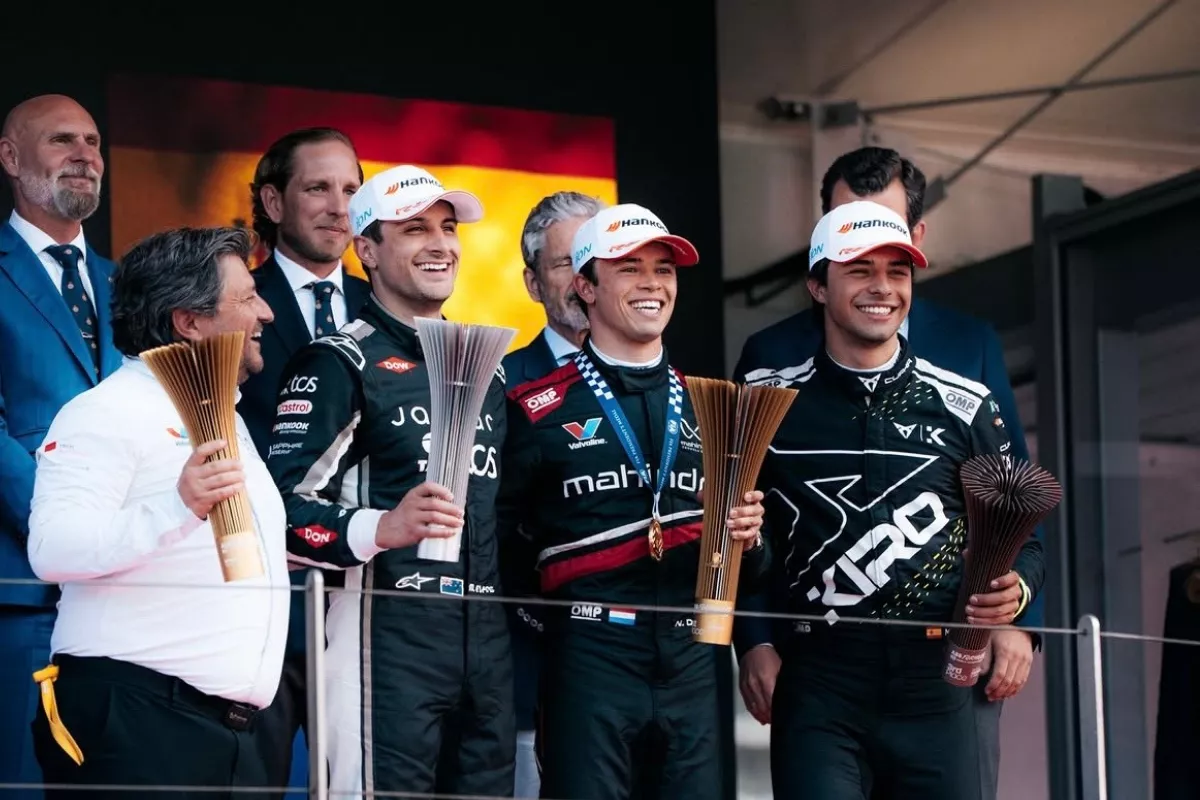
Nyck de Vries claims Monaco Formula E victory in opening race

Mahindra Racing driver Nyck de Vries claimed victory in Saturday’s opening Formula E race of the weekend, following an action-packed contest in Monaco.

With a unique race structure where Free Practice, Qualifying, and the race itself all take place on the same day, the circuit was filled with excitement from the early hours of the morning.

Qualifying split drivers into two groups, allowing the top four from each group the opportunity to advance to the quarterfinals. From there, drivers competed head-to-head to seal their place on the starting grid. After qualifying, Dan Ticktum of Cupra Kiro secured pole position alongside Mahindra Racing’s Nyck de Vries on the front row. 2025’s race winners, Oliver Rowland and Sébastien Buemi, found themselves starting from 12th and 15th, respectively.

With a perfect start to the 29-lap race, drivers largely held their positions through the opening laps. With a safety car deployed on Lap 4, drivers were able to reduce gaps, including António Félix da Costa, who had already moved up from eighth to fifth place.
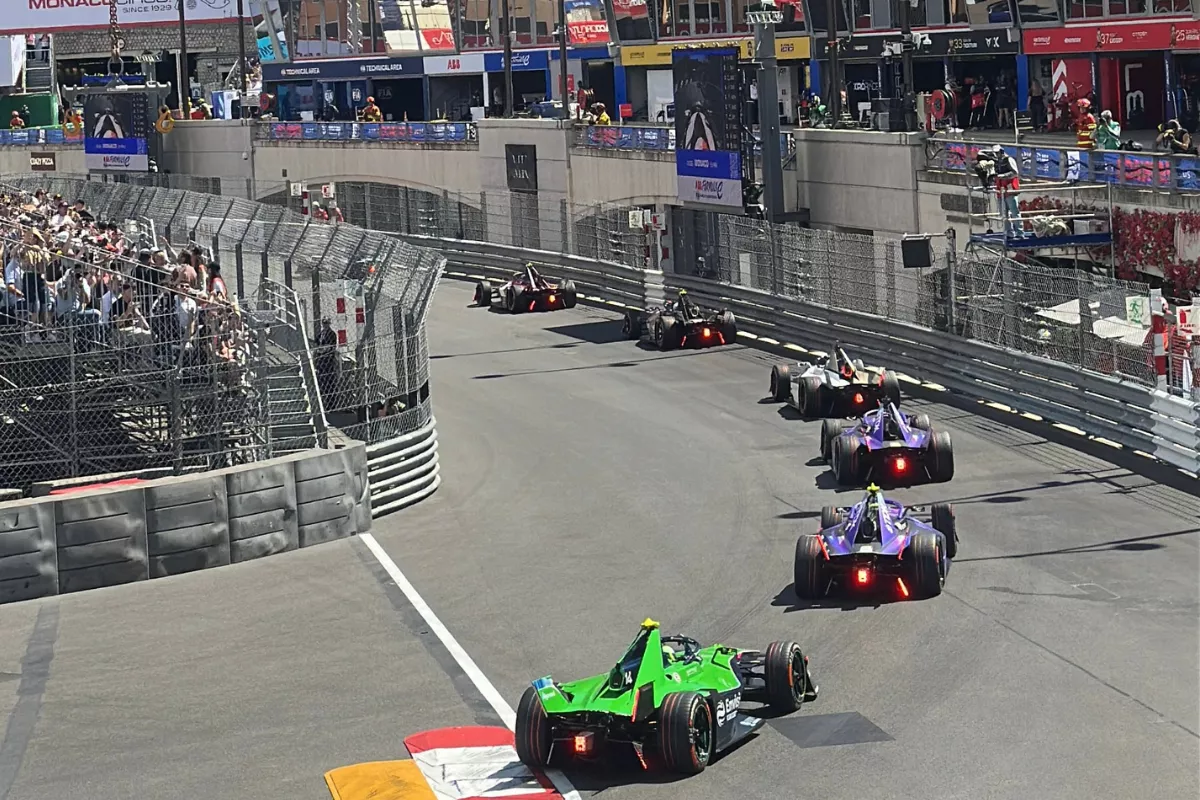
View from the grandstands during Saturday’s Monaco Formula E action. Photo credit: Kayla Sauceda / Monaco Life

This opening race featured Formula E’s Pit Boost format, adding another strategic element as drivers were required to complete a rapid-charge stop during the race for a 10% energy increase.  By the 16th lap, drivers began entering the pits to complete their Pit Boost charge. Among the early drivers to pit were Nyck de Vries, Maximilian Günther, and Mitch Evans, allowing pole-sitter Ticktum to remain in the lead while da Costa made gains in pursuit.

In a strategic use of Attack Mode, da Costa found himself leading the race on Lap 17 as many of the drivers behind him followed suit, entering Attack Mode.

De Vries, however, moved into the lead by Lap 20, overtaking da Costa and remaining ahead of pole-sitter Ticktum, who had come out of his Pit BoostT stop in fourth. Lap 27 of 29 saw a dramatic crash at Turn 10, requiring a Full Course Yellow. Although this minimized any gaps created, there was little time remaining for challengers to overtake de Vries.

The final lap offered a green flag, but no one was able to catch de Vries. Mitch Evans and Dan Ticktum initially crossed the line behind de Vries to round out the top three. Despite this, Ticktum received a post-race drive-through penalty, dropping out of the podium positions and promoting teammate Josep María Martí, known as Pepe Martí, into the top three.

The result now moves Evans into the lead of the Drivers’ Championship, while Martí secured a career-high finish. However, winner Nyck de Vries took time to celebrate a long-awaited win. Since his last Formula E victory in 2022, de Vries has been chasing a return to the top step. With a combination of impeccable, composed driving and an effective, innovative strategy, de Vries claimed victory with a three-second gap to the cars following.

As a former Formula E champion, de Vries is no stranger to the top step on the podium. However, this marked the Dutch driver’s first win with Mahindra Racing. This result also marked the team’s first victory in several seasons, adding further significance to the achievement.

With another race ahead in this double-header weekend, teams now face a quick turnaround as strategies, momentum, and energy management continue to shape the action on the circuit.

Stay updated with Monaco Life: sign up for our free newsletter, catch our podcasts on Spotify, and follow us across Facebook,  InstagramLinkedIn, and Tik Tok.

Main Photo credit: ACM Matchavariani
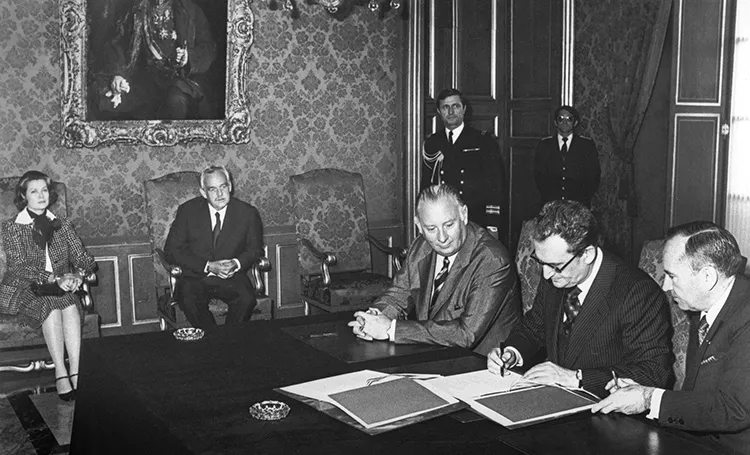
The agreement born in Monaco’s throne room that’s been protecting the Med for 50 years

In May 1976, in the throne room of the Prince’s Palace, the ministers of France, Italy and Monaco signed an agreement that would become the Mediterranean’s first concrete regional protection accord. Prince Rainier III had been calling for it since 1970, when he stood before the plenary assembly of the International Commission for the Scientific Exploration of the Mediterranean in Rome — with Jacques-Yves Cousteau in the room as Secretary General — and urged the three nations to act together before it was too late.

“The coastal states of the Mediterranean must wait no longer,” Prince Rainier declared. “They must act to safeguard their sea.”

Fifty years on, the RAMOGE Agreement — its name drawn from the initials of Saint-Raphaël, Monaco and Genoa, the three anchor points of its original zone — is marking its anniversary with a full programme of scientific, operational and public events running across France, Italy and Monaco throughout 2026.

What RAMOGE has achieved

The numbers tell a compelling story. Over five decades, the accord has overseen more than 30 anti-pollution exercises, recovered nearly 500 tonnes of hydrocarbons from three real-world emergency activations of its RAMOGEPOL response plan, collected more than 600 tonnes of marine debris — the equivalent of 50 refuse lorries — and identified 67 ecologically significant zones covering 3,060 km² of Mediterranean waters. Five marine protected areas have been created or extended as a direct result of its work, and more than 20 sampling sites monitor water quality on an ongoing basis.

The RAMOGEPOL plan itself was born from tragedy. When the tanker Haven exploded off Genoa in April 1991 — spilling 144,000 tonnes of hydrocarbons in the Mediterranean’s worst ever oil disaster — RAMOGE created a coordinated multinational response framework within two years. It has been activated three times since, most recently in 2018 when a collision between two cargo vessels off Cap Corse allowed 90% of spilled hydrocarbons to be recovered.

Previous deep-sea exploration campaigns have delivered discoveries that were as sobering as they were scientifically significant — human waste found at depths exceeding 2,000 metres in the Monaco Canyon among them.

The 2026 programme

The 50th anniversary celebrations began in March with the launch of the international photography competition RAMOGE — L’Homme et la Mer, open until 31st October, with the prize-giving ceremony to take place in Monaco on 4th December.

A travelling commemorative exhibition opens in Genoa on 28th May before moving to France in September, with a version tailored for the Monaco Ministry of State inaugurated on 26th June in the presence of Prince Albert II — who will also cancel a commemorative stamp to mark the occasion. That same day, a live RAMOGEPOL anti-pollution exercise will be demonstrated at sea, with public access to the installations planned for the day before, followed by a public conference at the Oceanographic Museum of Monaco and a virtual reality experience plunging audiences into the Mediterranean’s submarine canyons.

In late July, a week-long deep-sea exploration campaign aboard the research vessel Alfred Merlin will probe the French, Italian and Monegasque waters of the RAMOGE zone to depths of 500 metres — extending a programme of submarine exploration that has run since 2015 and consistently produced both remarkable discoveries and troubling evidence of human impact.

The autumn will bring a workshop on Posidonia oceanica, the Mediterranean’s emblematic seagrass whose beds cover nearly 50% of coastal floors, produce oxygen, absorb CO₂ and shelter thousands of species — yet lose approximately 2% of their surface each year to anchoring damage alone. The session will accompany the launch of a new RAMOGE guide to the plant, updated for the first time since 2006.

Stay updated with Monaco Life: sign up for our free newsletter, listen to our podcasts on Spotify, and follow us across Facebook,  InstagramLinkedIn, and Tik Tok.

Photo source: RAMOGE