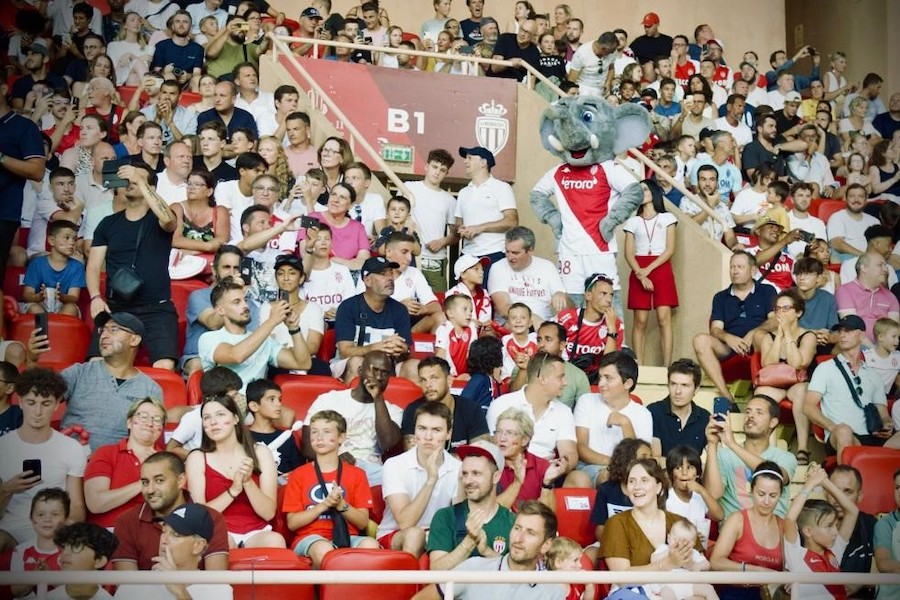
AS Monaco Basketball scraped past Pau-Lacq-Orthez (83-85) on Thursday to reach the final of the French championship, where they will meet their old nemesis Lyon-Villeurbanne in a five-game series.
Monaco have already faced Lyon four times this season, twice in the domestic division and twice in the Euroleague. Currently they are tied on two wins apiece, whilst, apart from a sizeable victory for the Roca Team back in January, fine margins have decided matters.
Monaco also have previous for meeting them in the play-offs. Asvel defeated them in the quarter-finals in 2016/17, in the semi-finals in 2015/16 and in the finals in 2018/19. Since then, however, Monaco have made huge strides, they are now a European force, and Lyon can therefore expect a greater challenge.
After two straightforward ties at the Salle Gaston Médecin in Monaco, the Roca Team haven’t had things all their way over in Pau. Having lost the first tie earlier in the week, Sasa Obradovic’s men were given a scare once again on Thursday night as they had to hold on to secure their progression.
Pau, with the support of the home crowd, got off to a solid start and grew a small advantage in the first-quarter. Wary of falling into the same trap as they did in the third tie of the series, Monaco fought back as they took the reins of the match and dictated the tempo.
After imposing themselves in a dominant second and third quarter, the victory looked to be sealed as they went into the final 10 with a 13-point gap to their opponent (55-68). However, Brandon Jefferson, who has been a thorn in Monaco’s side throughout the series, came to the fore, shooting three-pointers with pinpoint accuracy as he accumulated a monstrous 34 points on the night.
But it wasn’t enough. Monaco clung on to avoid a fifth-leg decider at the Salle Gaston Médecin, and progress to the Betclic Elite final.
Post-match, Obradovic reflected on the victory: “We knew it wasn’t going to be easy. The way they played, with a big temperament was proof of that. We have worked all year to get to the final, and now we’re in a very good position to go and get what we want.”
In the hunt to end their spectacular season with silverware, Monaco must first travel to Lyon for the first two legs of the final, beginning on Wednesday, whilst basketball returns to the Principality on Monday 20th June.
Prince Albert officially opened the Top Marques supercar show on Thursday in Monaco ahead of the busy four-day event that features the absolute best in luxury cars and all things automotive.
After two years impacted by the Covid-19 health crisis, Top Marques returns to the Grimaldi Forum from Thursday 9th to Sunday 12th June as big and as bold as ever.
Filling the exhibition centre are the most incredible contemporary cars by everyone from Bentley, Aston Martin and Rolls Royce, to McLaren, Maserati and Lamborghini.
Top Marques is more than just the world’s most prestigious supercar show. Two wheelers also feature heavily, as well as flying craft such as Mc-Clic’s new manned drone, and Monaco-made Esurf, an electric surfboard.
In officially opening this year’s Top Marques ahead of the public at midday, Prince Albert toured the Grimaldi Forum, meeting with exhibitioners and seeing first-hand the incredible vehicles on display, as well as unveiling some world-premiers.
Highlights include the Deus Vayanne, an electric hypercar derived from Formula 1 pedigree by Deus Automobiles, Italdesign, and Williams Advanced Engineering; McLaren’s new supercar Artura – dubbed the supercar for the next generation; and Jetson AeroOne, a one-man electric helicopter, one of three flying machines at this year’s show.
Thierry Boutsen with his winning Shelby Cobra, photo by Monaco Life
For the first time in Top Marques history, the entire ground floor of the Grimaldi Forum has been dedicated to classic cars, organised by Thierry Boutsen from Boutsen Classic Cars – a venture the former F1 driver only started three years ago.
“It is quite an emotional thing, I mean these cars have been living for 60 years and they are still in top condition, sometimes better than new,” Thierry Boutsen told Monaco Life. “Some, like the GT40 for instance, is in exactly the same condition as it was in 1969… the colour, the edging, the gear box … they are all the same. So, all the collectors come here because they have a passion for these types of cars and they can also buy them.”
Some standout favourites for the Belgium, who has enjoyed three Formula 1 successes with Williams-Renault, include the Shelby Cobra that he won the Tour Auto rally in France this year driving.
“Another favourite is the GT40 next to it, a fabulous car built in the 1960s that still looks like a modern car. We have a former F1 Benetton, that Michael Schumacher won the Canadian GP with. We have the jaguar e-type, BMW M1, an old Porsche from 53, and also a 911 which has been totally electrified with a similar system that powers a Tesla today.”
Top Marques runs until Sunday 12th June.
Visit Monaco Life Instagram to see videos of Top Marques 2022, and click on the gallery below to see more of our images…
Top photo: Manuel Vitali, Government Communication Department
AS Monaco’s topsy-turvy season ultimately saw them reach their most important objective: Champions League qualification. But a fruitful summer is required to consolidate their hard-fought success.
Monaco like doing things the hard way. Just as they did in the 2020/21 Ligue 1 season, their fulfilment of pre-season objectives was dependent on a late, end-of-season dash to the podium places. The remontada-à-la-Monégasque is becoming somewhat of a trademark, and whilst the entertainment value for fans, and especially for neutrals, cannot be understated, the club itself will be doing everything in its power to avoid a similar scenario next season.
Appraising Monaco’s season is no easy task; recency bias would leave one to believe that this has been one of the club’s best in recent years. But once the adrenaline subsides, there is a realisation that this was simply a year in which objectives were met, not surpassed.
Getting off on the wrong foot
Elimination from the Champions League at the play-off stage set the tone for a difficult first half to the season. The mental blow of having scuppered last season’s good work permeated into their league form as they struggled for momentum and consistency.
On a personal level, Ruben Aguilar recently admitted that the defeat to Shakhtar Donetsk in the Champions League, which was sealed by an own-goal by the French right-back, had haunted him throughout the campaign. It certainly looked for large swathes of the season that the rest of the group struggled to overcome that disappointment.
Niko Kovac, meanwhile, was beginning to lose credit. As the size of last year’s achievements dimmed in the rear-view mirror, pressure grew on him to correct a Monegasque ship that had skewed off-course.
A victory against Rennes just before the short Christmas break looked to have bought the Croatian manager time, but Monaco, known to be uncompromising in their pursuit of success decided to pull the plug in a surprising move.
New man in the door
Thereafter, the management at the club would come under increasing scrutiny. Any success or failure would be traced back to that decision taken in late December and judgements made. Philippe Clement was the man who came in. Not experienced in Ligue 1, but boasting an impressive CV thanks to his exploits at Club Brugge, he had the task of turning Monaco’s season around.
The turnaround was not immediate. A difficult start to his reign on Le Rocher received heavy criticism. Whilst Clement wasn’t absolved of blame, most of the anger was directed towards the club management, who for a moment in the season became public enemy number one in the Principality.
At the time, it wasn’t simply the managerial change that incited the anger of the Stade Louis II regulars, but also the summer transfer dealings. Monaco had successfully retained the key architects of that late season surge in 2020/21, but in the eyes of many, failed to add to it. Many of the summer signings underwhelmed – at least initially – and for that Paul Mitchell was in the firing line.
By the end of March, following ejection from the Europa League and the Coupe de France, things had reached boiling point. As well as an explosive article by L’Équipe, which claimed that Oleg Petrov, Mitchell and Clement were all set to depart on the eve of the match against PSG, banners criticising almost every facet of the club were unfurled throughout the fixture as the fans made their voices heard amidst a hostile atmosphere.
“10 finals”
But it is under seemingly stifling tension and pressure that Monaco thrive. Just like a spring, the more pressure that is applied to them, the stronger they bounce back. Questioned by Monaco Life about the club’s objectives going into the final games of the season in the wake of the club’s aggregate defeat to Braga, Clement evoked his now famous “10 finals” mindset for the first time.
Monaco wouldn’t lose again for the remainder of the season. A 3-0 victory against Champions-in-waiting PSG was a catalyst for an end of season revival. From a position of mid-table mediocrity, Monaco began their charge up the table as the chances of European football went from remote to almost nailed-on within a matter of weeks.
As Clement liked to regularly point out, the “dynamic” within the group was good before the win against PSG, but for the first time all season, Monaco had the wind under their sails, and that all-elusive winning feeling was back.
It was unimaginable that Monaco could be in a position at the end of the season whereby they would have been disappointed with third position, but it was certainly the case. Going into the final game of the season in second, a Lens equaliser deep into injury-time saw Monaco slip back to third as Marseille took the automatic qualification to the Champions League group stage. It was a bittersweet moment, which only highlighted the enormous progress that the Principality side had made in such a short period of time.
Uncertainty lingers
Avoiding a repeat of the errors made last year will be no easy task. This will most likely be a more uncertain and challenging summer than the last. Aurélien Tchouaméni looks certain to leave, likely to Real Madrid, whilst Benoît Badiashile and Wissam Ben Yedder, who together form the backbone of the side, have suitors across the continent. Mitchell will therefore likely be charged with a reconstruction job over the summer.
It is widely accepted that it won’t be possible to replace Tchouaméni with a player of the same calibre, but finding an adequate replacement to plug that gaping hole in the Monégasuqe midfield will be at the top of Mitchell’s to do list. Names such as Yves Bissouma, who have been linked with the club, allude to a high-price, high-profile replacement, which would go some way to alleviating his departure.
But elsewhere, the strategy is unclear. The areas where Monaco wish to recruit have been clearly specified, but the profiles remain unknown, and the names being linked with Monaco give little away.
For captain Ben Yedder, the secret to success will be adding experience to the group this summer. Speaking to L’Équipe, he said, “You can’t say that we’re lacking talent. We lack maybe a bit more experience, and it’s with that that we’ll grow.”
And that will be the key this summer in Monaco: following their model and philosophy of developing young players, whilst ensuring short term success. Whilst the sale of Tchouaméni, potentially for around €100 million, puts into sharp focus the success of this model, the importance of blending that philosophy with a sprinkling of more mature, experienced players will also provide the foundation, which will allow them to continue to attract the best players from around Europe.
This season can be considered mission accomplished for Monaco, but work needs to be done this summer to consolidate that success, both in the short and long-term, as the Principality side look to atone for last year’s errors and treat their fans to a European adventure next season.
Jeff Fahey: “I am still processing the impact of this film”
Monaco Life caught up with Jeff Fahey, star of the screen and stage, during the Monaco Streaming Film Festival to talk about his new film which dramatically tells the story of life during Covid-19 lockdown.
By his own count, Jeff Fahey has featured in over 200 films throughout his 45-year career, amongst them The Lawnmower Man, Eldorado, and Machete. That’s not to mention the roles in television series such as CSI: Miami, Law & Order, Under the Dome and Hawaii Five-0, or his theatre performances like in Twelve Angry Men at the Garrick Theatre in London.
Perhaps less known is his humanitarian efforts, which have led him travel, live and work extensively throughout the developing world, focusing the past 15 years on helping the people of Afghanistan and the Western Sahara.
His latest film, A Bird Flew In, had its premier screening at the Monaco Streaming Film Festival. It is a poignant drama about the need for human intimacy during lockdown, and it follows the lives of a cast and crew who are sent home from a film set to self-isolate in their homes during the Covid-19 pandemic.
The film, Kirsty Bell’s directorial debut, is an examination of what happens when we are freed from external distractions and forced to find meaning in our lives. In future years, it will serve as a powerful representation of a significant time in our history.
Monaco Life: How did you feel about the screening of ‘A Bird Flew In’ in Monaco last night?
Jeff Fahey: Well last night was the first time I have actually seen the film, so I am still processing it to be honest.
We did the film two years ago, in the middle of the pandemic – after the first lockdown and before the second lockdown in London. So, by the very nature of how the film was made, we were all in our own bubbles. The story begins at the last day of filming a movie, so the crew, cast, directors, and producers head off to start their isolation in their homes. With each different story, we see over a matter of months how these people, who are alone or in a couple in their homes, we see the evolution of what is happening to them.
The fascinating thing about seeing the film for the first time at this festival is that I am still figuring out the impact it has had on me. I read the script and did the film a couple of years ago, but I was not with the rest of the actors because they were doing their piece in a different location in their house. All my stuff was shot in this one little apartment with just me. So, two years later, watching this film, I forgot some of the things that happened. I only knew them as part of what I read as a screen play, so I was seeing them for the first time. To visually see how those stories came together, to see the actresses and actors playing these characters that were only in a screenplay to me, then to have the whole impact of the film – I was very much a part of that audience last night.
The screening was followed by a Q&A. How was that for you then?
It was such an emotionally impactful film, so when we did the Q&A afterwards, I wasn’t ready to talk about it because I was still taking it in. I mean – boom – the film ends and you’re on stage with people asking you questions about the film; thank god the producers and director were on stage, because I was still in an emotional state. I was so moved by the other actors and the work that they had done, and the journey that their characters had taken, I wasn’t sure how to talk about it.
How long did the film take to make?
I think they put the whole thing together, from the idea to the start of principal photography, in about four to five months at the most, so it was experimental in many ways.
What made you agree to take part in a film like this?
All of the above. I thought that the idea of doing a film in lockdown was fascinating. By that stage, we all knew of isolation. Some of us have had great joy in this time – lives slowing down and being more reflective, but then there are others for who it has been a tragedy; it was not freedom at all but rather imprisonment and destruction.
Plus, I always enjoy that uphill climb on a little film, for the filmmakers and myself. You have a lot of creative freedom. Then again, you have that when you are working with the right people who are secure and clear enough in what they want. Robert Rodriguez is one of them (Director of Machete). There were many times that Robert would write a scene at lunch and say “let’s try this”, and boom, we’d do that; or let you stay within the story but “swing the cat” a little bit, have some freedom to do some jazz.
Was it important for you to be part of a film that documented such a significant moment of history, of how the story will be told to future generations?
I can honestly say that it may have subconsciously been there, but I didn’t think it out to that point. I thought that it was an interesting view on isolation and character study. It wasn’t something I thought about then, but it is definitely something I think about when discussing the movie now. This will be one of the films that people will be looking at – and there may be many others – but this is their interpretation of these characters. People many years from now may pull it off the shelves somewhere and say “Wow that’s interesting, did that really happen? Were people really that isolated?”, and someone will say “Yeah, they really were”.
When you see that scene where the young girl finds out her mother is not going to make it, and the doctor tells her she cannot come and visit her – things like that were very real for so many people.
What are your thoughts on this year’s Monaco Streaming Film Festival?
This is my first film festival that I have attended in around 20 years. I didn’t avoid them, I was just doing other things and there were plenty of people who did the festival thing. But it is nice to be here in the early stages of the Monaco Streaming Film Festival, the second year, and it is great to be back in an arena that I haven’t been in for a long time.
I am one of the students when it comes to streaming and NFTs for funding, etc., so I thought it would be a wonderful opportunity to be part of something and learn in the process, because pretty much everything that I do has been baptism by fire.
You were also presented with the Monaco Streaming Film Festival Humanitarian Award. Can you tell me about your work in that area?
They asked if I would receive the award, and I was actually very close to saying no. I mean, I love that there is someone who wants to give me an award for the work I have been doing in that world for many years, but I have always kept it under the radar, just because I got a lot more done in conflict and post-conflict areas. And then I thought, “Just accept it Jeff, if somebody wants to give you recognition for some things you’ve done, it is wonderful and move forward”. And so how do I feel about it? I am honoured.
Jeff Fahey received the Humanitarian Award at the 2022 Monaco Streaming Film Festival, photo by MSFF
When and why did the humanitarian work begin?
It goes back to my old hippy days. I’ve been going in and out of Afghanistan and that part of the world since the early 70s, and have seen things change. I didn’t go in as a humanitarian, but you just become involved in things, whether it is an orphanage or helping somebody meet someone, then one thing led to another and it evolved. Before I knew it, I was introducing local people in certain parts of Afghanistan to those working with the ambassador, and then in north Africa and Western Sahara, Syria, Jordan, working with different governments and embassies, and it just continues. But I don’t necessarily think of it as humanitarian work, it is just putting good people together and trying to keep bad people out of it, and in the process getting some things done.
What do you love most about being an actor?
I have always been a bit of a gypsy, and I have always said that one of the great joys of being in this industry is to be able to travel the world, to be involved in different stories, working with different film makers, and working in different genres. I love walking towards new adventures, and that’s what my life in this industry has allowed me to do, to stay on this adventure and make a living.
Do you have a favourite genre?
No. Well that’s not true, I try not to talk of favourites, but in film I have to say westerns, because I am fascinated by that period of time.
What then do you enjoy about performing in theatre?
When you are part of a fantastic play, and doing it eight times a week for months at a time, you’re always refining; you’re not changing the story but you’re changing the beats and the rhythms, and the pace even. And what happens is, it changes you. It’s like being a musician and playing a beautiful song with a little bit of difference here and there. The audience doesn’t hear a different song, but you know – through experimenting with this piece of well-written material – that you are refining it. Then, after 100, 200, 300 performances, you really have it going.
There is also an immediacy with theatre; when that curtain goes up you have to have it together, there’s no take two. So, you start prepping, getting into that zone, three or four hours before the curtain rises, every day. And then what happens is, you become one with the audience. You can feel the energy of 750 people, and not the “do they like it or not?” energy, but you can feel an audience when 700 people gasp, or it goes still in that theatre. It is a fascinating thing and quite something to experience.
At almost 70 years of age, you’ve been in the industry for 45 years. What do you consider the key is to success?
Luck and being prepared. There are so many talented people out there who just couldn’t climb that mountain, for one reason or another, because it is a tough industry. I don’t mean luck just like walking down the street and it falling out of the sky, luck in staying in the game.
Top photo of Jeff Fahey by Cassandra Tanti, Monaco Life
Monaco’s main congress and cultural centre, the Grimaldi Forum, is set to grow enormously as it fuses into the new Mareterra eco-district. Here’s what it will look like in just two and a half years’ time.
A year after it celebrates a quarter of a century of existence, the Grimaldi Forum will in 2025 unveil a vast extension, boosting exhibition capacity by an impressive 50%.
The new site, created as part of the land reclamation project, will add an extra 6,000 m2 to the current 35,000 m2 space.
It will consist of three zones: the Diaghilev Gallery, the Carré and Patio Rooms, and the Pinède Hall – the largest of the three spaces. Each will offer plenty of surface area to accommodate exhibition stands and meeting rooms, as well as catering.
In making the most of the Principality’s exceptional location and its 300 days of sunshine per year, 2,000 m2 of outdoor space will also be created, including the new Indigo terrace, the Emeraude Forecourt, the Patio, the Ravel terrace with a view of the open sea, and the covered Patio.
The new dimension is made possible thanks to Mareterra, the new eco-district that is currently under construction by the Monegasque government.
This six-hectare extension of the Principality will offer housing, a car park, shops, restaurants, a pine trees forest and a marina. Answering to very strict environmental requirements, it is part of the Principality’s objective to achieve carbon neutrality by 2050.
With the 1,500 solar panels installed on the Grimaldi Forum’s roof supplying energy to the surrounding buildings and this new district, it is natural then that the congress and cultural centre, which has been certified ISO 14001 since 2008, is part of this ambitious project.
The recent renovation of the nearby Larvotto beach, with its new shops and restaurants, is an additional asset that will enable congress participants to enjoy all that Monaco has to offer close to the congress centre.
The expansion will allow the Grimaldi Forum to build upon its current ability to host an average of 100 events and 250,000 visitors per year, and will enable more events to be held simultaneously.
Click on the gallery below to see more images of the new-look Grimaldi Forum…
Photos source: GRIMALDI FORUM Monaco
ASM reach €100m deal with Real Madrid for Tchouaméni
After plenty of speculation, AS Monaco have reportedly agreed to sell midfielder Aurélien Tchouaméni to Real Madrid in an agreement worth over €100 million, the second highest ever paid for a Ligue 1 player.
Rumours surrounding Tchouaméni’s departure have swirled for months. Real Madrid have always maintained a strong interest in the France international midfielder, whilst Ligue 1 rivals PSG entered the fold in the past weeks. Liverpool also had a strong interest, and Fabrizio Romano reported that manager Jurgen Klopp had even established personal contact with the Bordeaux academy product.
Ultimately, however, it is Real Madrid who have prevailed, although they aren’t the only benefactors from the saga. The package of the deal is yet to be fully confirmed, but RMC have reported that Real Madrid will pay €80 million upfront, €20 million in bonuses (€10 million of which will be easily triggered), and then a 19% tax on the deal to the Spanish government.
Monaco will make a tidy profit on a player who cost them just €18 million back in January 2020. The fee is also the second-highest paid for a player from a Ligue 1 club after Kylian Mbappé, also from Monaco, to PSG for €18 million in 2018. This most recent deal shines a positive light on Monaco’s model of developing players and selling them for profit.
Bordeaux, who sold Tchouaméni to Monaco back in 2020, are also set for a windfall. The club are entitled to 10% of the profit made on the player, and will therefore receive approximately €6 million from the sale.
Monaco must now set about what Philippe Clement described to L’Équipe as an “impossible” task: replacing Tchouaméni. Brighton midfielder Yves Bissouma and Lille’s Amadou Onana have both been linked to Monaco by Saber Desfarges, whilst Eliot Matazo, who signed a contract extension with Monaco earlier this season, can also expect to feature more prominently in 2022/23.
The deal has not officially been announced by any club, although it is only a matter of time before the agreement between the clubs is made public. For Monaco, the transfer represents very good business. Tchouméni’s departure has been an inevitability for some time, but his progression this year has garnered a higher fee, whilst the timing of the deal affords Monaco time in their hunt for a replacement.
Photo of Aurélien Tchouaméni by Luke Entwistle, Monaco Life
All the headlines and highlights from Monaco, direct to you every morning