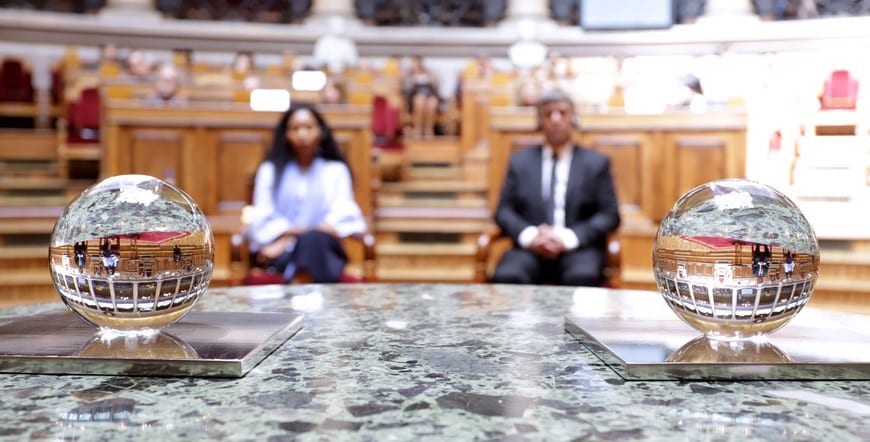
Dr Nathalie Hilmi, environmental economist from the Scientific Centre of Monaco and contributing author to the first MedECC environmental assessment report, has co-won the 2020 North-South Prize of the Council of Europe.
The 2020 North-South Prize of the Council of Europe has been awarded to Mediterranean Experts on Climate and Environmental Change (MedECC) coordinators, science officer and authors, including Dr. Nathalie Hilmi from the Scientific Centre of Monaco (CSM) for their work on a study released this year.
The North-South Prize has been awarded each year since 1995 to two candidates who have stood out for their exceptional commitment to promoting North-South solidarity. MedECC shares the prize this year with the International Commission against the Death Penalty.
MedECC, founded in 2015, is an independent network of professional experts who study climate and environmental change in the Med. Their first Mediterranean Assessment Report, entitled ‘Climate and Environmental Change in the Mediterranean Basin – Current Situation and Risks for the Future’, assessed the risks currently affecting the Mediterranean basin in order to give policymakers, stakeholders and the population-at-large a clear picture of the situation.
The report was a truly collaborative labour of love, incorporating the research of nearly 190 scientists from 25 countries, who contributed without any financial compensation.
Dr Hilmi is an expert in macroeconomics and international finance who, after a long career in both academia and the private sector, focuses on economic policies and sustainable development at CSM.
From establishing the Principality’s first international gallery and its transition in to contemporary art, to Monaco’s “golden era” of the 70s and 80s, Adriano Ribolzi – one of Monaco’s most beloved and respected individuals – shares his story with Monaco Life.
This wasn’t the 100th anniversary celebration that Adriano Ribolzi had in mind when planning began in early 2020. One of Adriano’s favourite artists, Pablo Atchugarry, had been commissioned for the special occasion and a grand opening of the exhibition was set for 4th December, the day his father – Annibale Ribolzi – opened Maison Ribolzi in Lugano in southern Switzerland a century earlier. In 1974, Adriano brought the legacy to Monaco.
But Covid took the world down a very different path than anyone could have ever imagined.
“To plan an exhibition with an important artist like Pablo Atchugarry takes a long time,” says Adriano. “But by the time it came to creating the programme, it was clear that we would not be allowed to do a grand opening like we would do normally, with hundreds of people.”
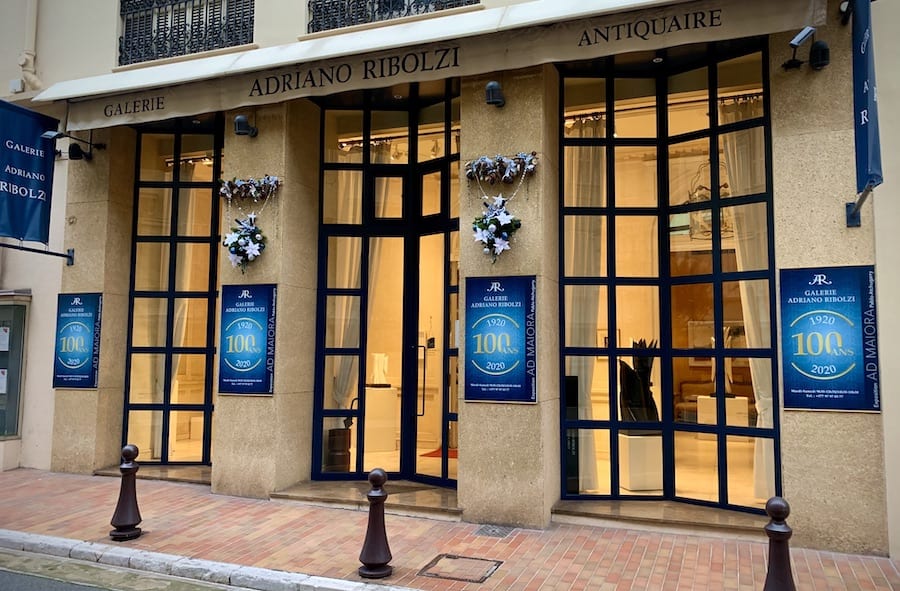
It was a difficult moment of realisation for Adriano, who has never done things by halves. For the gallery’s 40th year in Monaco, he had the surrounding streets of Monte-Carlo closed so he could host a big bash. “I like to make large celebrations,” he says unashamedly. The Ribolzi Gallery celebrates a 100 year legacy. Photo by Cassandra Tanti for Monaco Life
But he was determined not to let a worldwide pandemic stop this exhibition.
“I said we will do the exhibition and I will make the catalogue. I know I can’t have a big opening, but we are lucky that the Prince is just putting in a curfew, not another lockdown. I decided that it will be a month-long opening, and we will welcome you every day in December. So, here we are.”
Visitors to the gallery are just as pleased with the compromise as Adriano himself, who acknowledges that it is important for cultural institutions such as his to remain open during difficult times.
“It is also very important to keep the art market open in Monaco, because we are fortunate enough to be in a position to do it. So, let’s push ahead,” he says, full of enthusiasm.
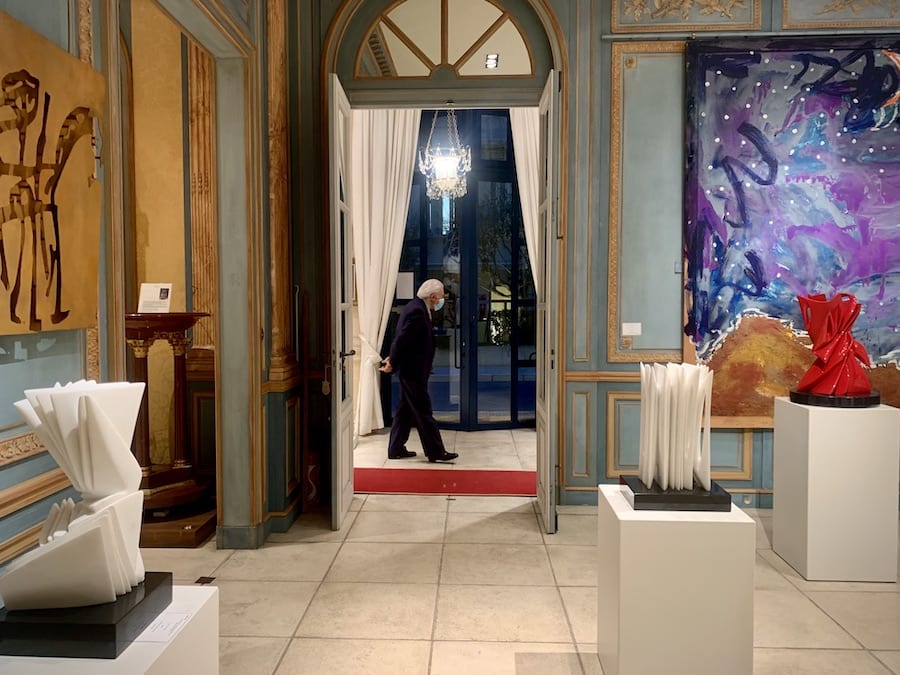
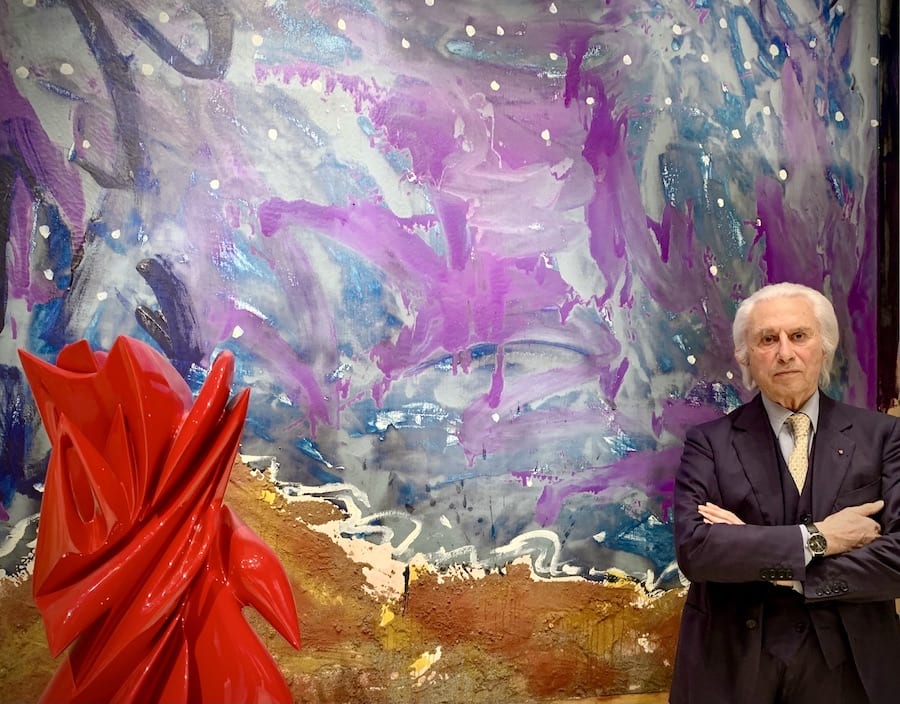
It is that drive and passion that has defined 88-year-old Adriano Ribolzi throughout his entire life, and put him squarely where is today – as one of the most respected gallerists and art collectors in Europe. Adriano Ribolzi walking through his gallery in Monte Carlo, by Cassandra Tanti for Monaco Life
His story began with his father Annibale Ribolzi, who studied 18th Century French furniture design in Lyon and opened his firm in Lugano in 1920. Located within close proximity to Milan, Annibale’s post-war business boomed, and Adriano was sent to study art in Zurich.
“Amusingly, it was a school of modern art,” remembers Adriano fondly. “But I didn’t renounce the masters. In fact, I exhibited the masters for 10 years. My history was 18th Century French furniture, but I was passionate about the modern movement.”
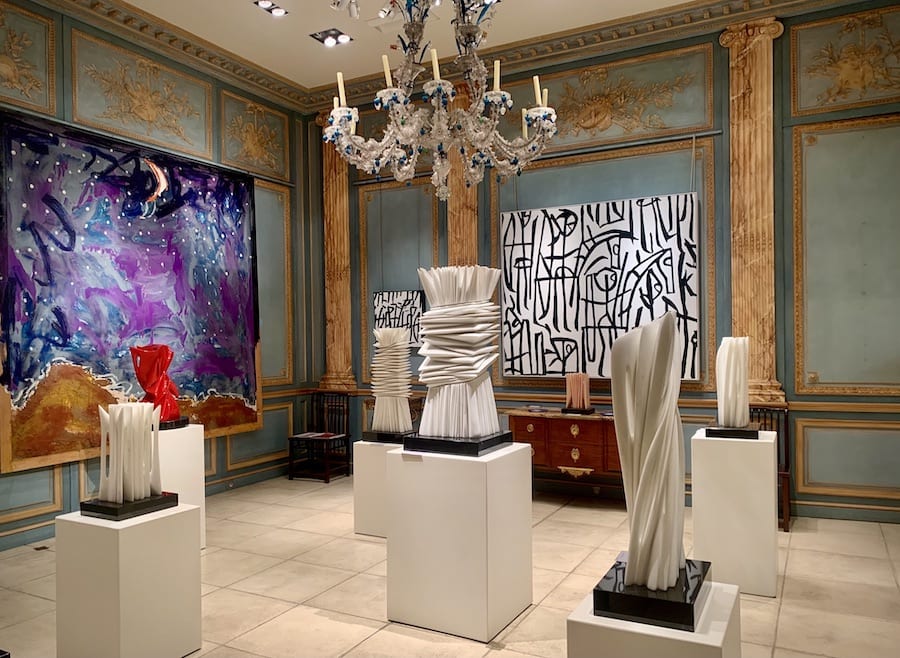
This composition is still played out in Adriano’s gallery today. Situated parallel to the exquisite Hôtel Hermitage, the gallery is designed in classic Louis XVI period, with decorative motifs, straight lines and gilded features. Set against this backdrop are abstract paintings by Schifano, Fermariello, Olivieri and Atchugarry’s latest sculptures. The Ribolzi Gallery by Cassandra Tanti for Monaco Life
What some would see as sharp contrasts, Adriano embraces as the ultimate expression of art.
“I always say that the quality of the art is what is most important, not the period,” he says. “They can be of a different period, but if the quality is not there, then it doesn’t work.”
When Adriano opened his gallery in Monaco in 1974, he initially took up residence on the aptly named Avenue des Beaux-Arts, Monte-Carlo. It was the first real foreign art gallery in the Principality, and Sotheby’s hosted an art auction just one year later. “With that, Monaco became the art market centre of the world, the most important in sales. Then Christie’s came to hold an auction in the Sporting d’Hiver. It was all very clever.”
That same year, at the request of the director of tourism, Adriano was charged with helping to create Monaco’s first Biennale des Antiquaires de Monaco, putting the Principality firmly on the art collectors’ map.
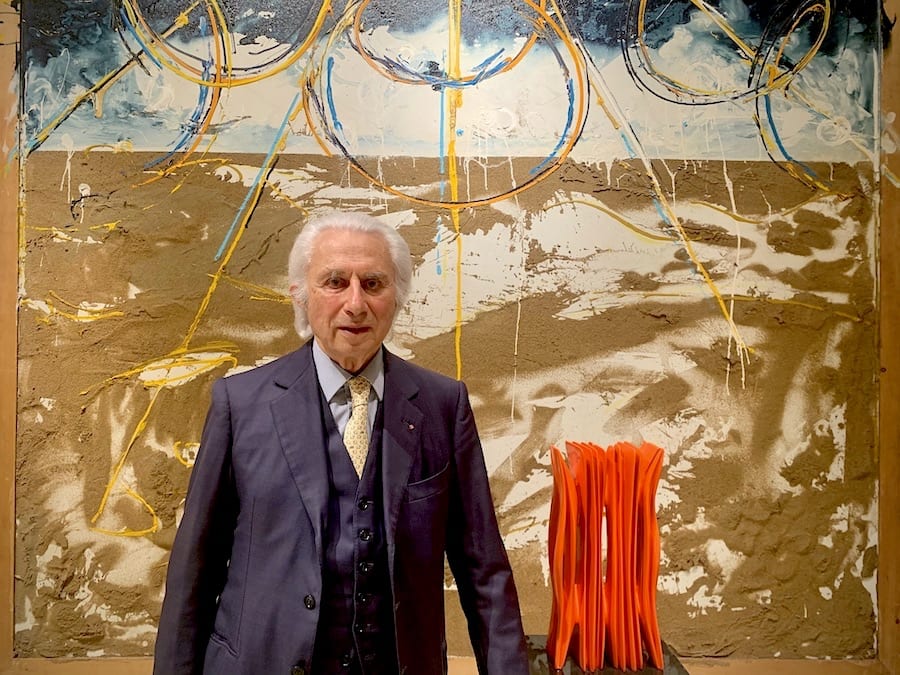
“Surely, this makes you the godfather of art in Monaco?” I ask, only half-jokingly. He laughs and responds, “but I did of course start a lot of things in Monaco.” Adriano Ribolzi in his gallery, by Cassandra Tanti for Monaco Life
Adriano has clearly been a solid force in Monaco’s cultural scene from the very beginning. But it is the 1970s and 80s that he remembers most fondly: the Principality’s “golden era” when fine things were celebrated unashamedly.
“The lifestyle of Monaco then was at such a high level,” remembers Adriano. “If you want to know what Monaco was like in the 70s and 80s, look at photos of the dinners in the Hôtel de Paris. It was not about the money – of course there was a lot of it – it was about the elegance. It was an unbelievable time. Monaco really was the centre of the world.”
In 1998, Adriano brought the gallery on Avenue de l’Hermitage, two striking gallery spaces in fact, where he still spends a lot of his time. Today, his excitement for Atchugarry’s sculptures is as palpable, I imagine, as it was for any Warhol or Picasso painting that has come before.
But it is not the expensive artworks, the parties at the Hôtel de Paris, or the gallery itself that Adriano Ribolzi cherishes most about his career as an art dealer.
“What I have loved most is the people I have met through my work, what I have learned from them, and their attitudes. I have always asked questions and wanted to know more. It is immense and incomparable.
“As an art dealer, I have a special bond with these people. They open their homes to me, and everyone is different. I am lucky to have been fortunate enough to be in that position; to be able to exchange ideas about art, politics, business… there is such a richness to people, and I am not referring to money.”
The Ribolzi Gallery will be exhibiting Pablo Atchugarry’s sculptures for the month of December and into the new year.
Interview: Acclaimed costume designer Paul Tazewell
In this month’s exclusive interview for Monaco Life, Princess Grace Foundation-USA’s CEO Brisa Trinchero catches up with one of America’s most acclaimed costume designers, Paul Tazewell, about the intricacies of theatre design, his favourite Grace Kelly looks, and what’s to come in the future.
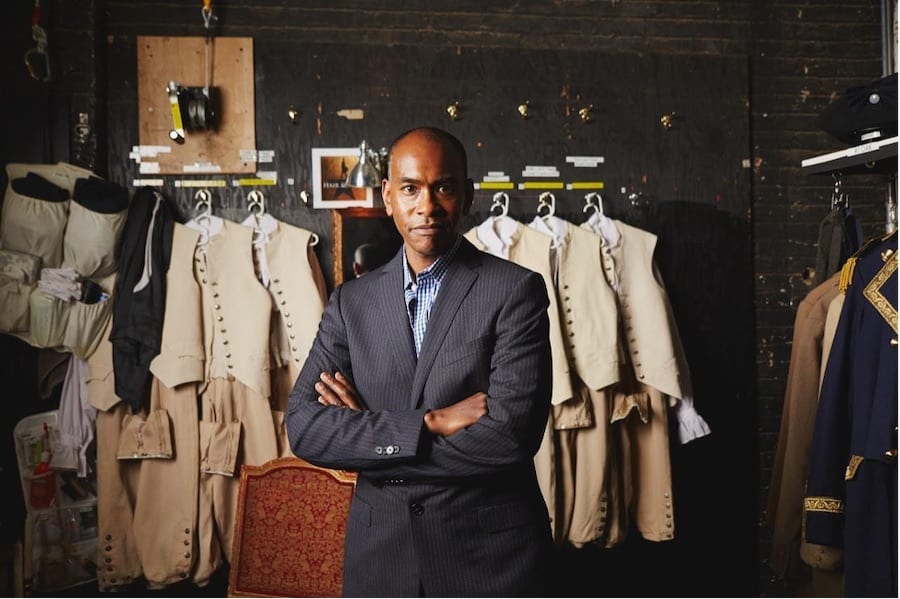
Paul Tazewell is a highly acclaimed costume designer for film, theatre, and dance. Notable masterpieces include Hamilton (Tony Award for Best Costume Design), The Wiz: Live! (Emmy Award) and costumes for Steven Spielberg’s upcoming West Side Story film. Paul received his Princess Grace Award in 1993, and in 2004 Paul received the Foundation’s highest honour, the Princess Grace Statue Award.
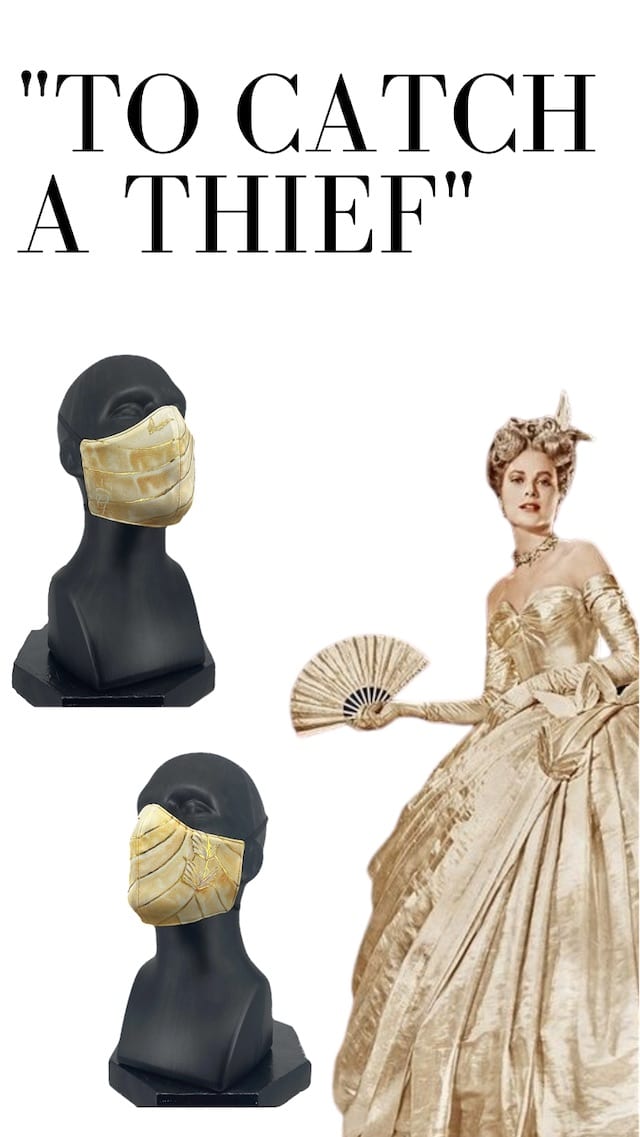
Earlier this month the Foundation partnered with Paul to create four exclusive designs of limited-edition, hand-sewn face masks inspired by Grace Kelly’s iconic fashion looks for the holiday season to support the Foundation and the creative communities that have been impacted by Covid-19.
What made you become a costume designer?
I grew up in an artist-filled family, and when I entered grade school I was transfixed by the performances at the school. There was a production of Oklahoma that I remember seeing at the neighbourhood high school and, when I began high school, I started performing in those productions as well as learning how to sew and design the costumes. One thing led to another and I entered Pratt Institute in Brooklyn to study fashion, but my main intention was to be in New York to start to educate myself around performance.
I decided to transfer to the University of North Carolina School of the Arts in Winston-Salem and by the end of my first year, I decided to let go of my dream to be a performer and take hold of the dream of being a costume designer. Much of it was about longevity, and some of it had to do with avoiding being typecast and being able to embrace many different types of characters. My interest from the performance end has infused itself into how I approach costume design. I use my experience and ability in interpreting character development and understanding movement as I interpret fabric and how it will move in space and live on a person’s body.
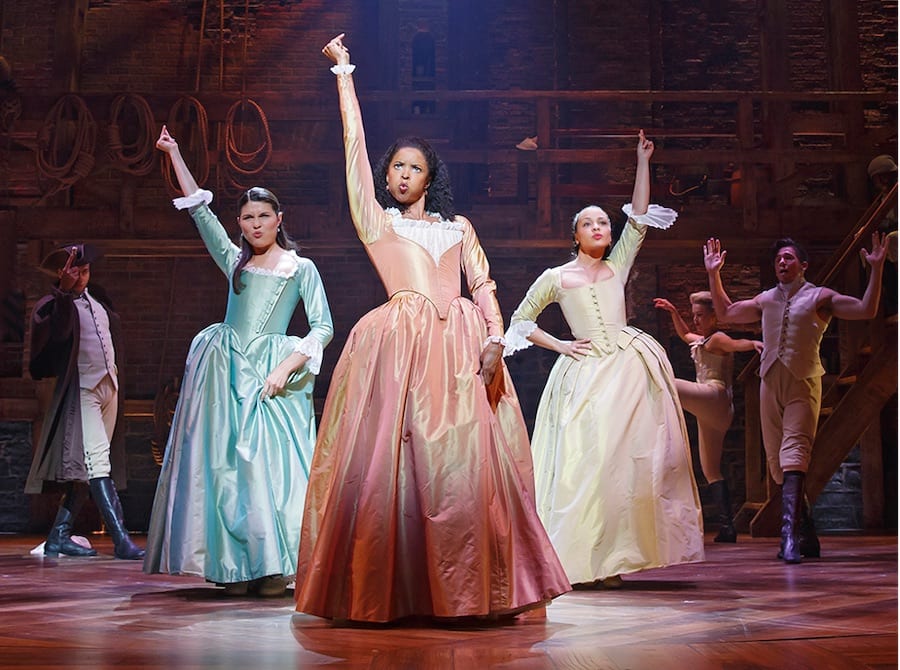
Paul Tazewell’s costumes for the Schulyer sisters in Hamilton, credit Sayaka Matuoka
You won your Princess Grace Award long before your many accolades. Can you tell us where you were in your life at that point and what the Princess Grace Award meant for you?
I was introduced to the Princess Grace Foundation through Arena Stage in Washington. I had just graduated from NYU with my graduate degree in costume and set design. They asked me to come and be a part of their staff for a year. When I entered, they suggested that we approach the Princess Grace Foundation to pay for part of my salary. That experience overall allowed me to hone my skills and mature as a costume designer outside of New York; I was not under the gaze of everyone watching but there was still some visibility.
While I was there, George C. Wolfe saw a production that I had designed and he invited me to New York, where he was a director working on the new Broadway musical, Bring in’ da Noise, Bring in’ da Funk. It was a fantastic show created with Savion Glover and I was invited to design the costumes for his production which was my first Broadway show. I was then nominated for a Tony award for that production. So that was quite a wonderful experience for me.
And that was just the start of your relationship with the Princess Grace Awards…
I continued to stay in contact with the Princess Grace Foundation-USA and later received the Statue Award. It came at a very opportune time; I was just leaving an institution and going into being a freelance designer in New York, which is really hand-to-mouth as an artist. I felt so supported by the Foundation.
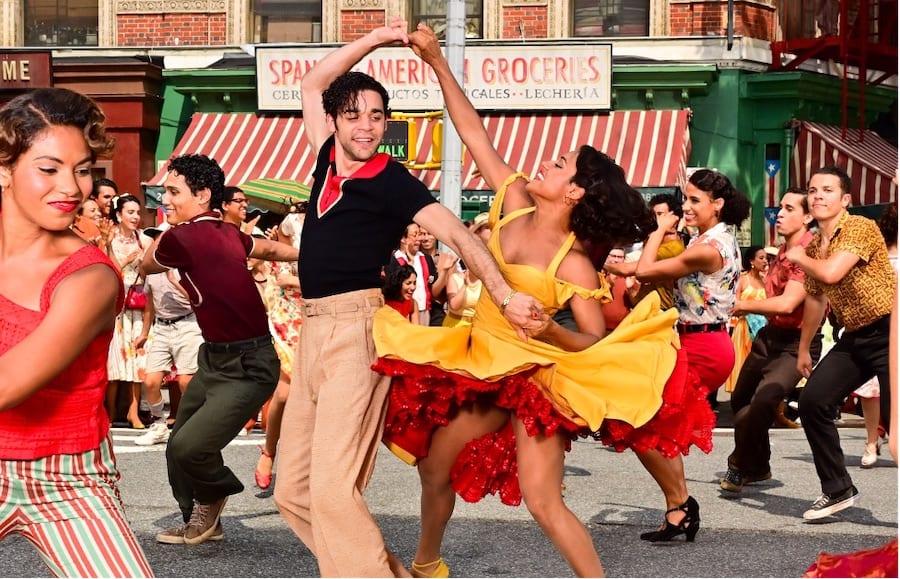
Tazewell’s work in West Side Story
What is your process when you start a new design role?
My process started at North Carolina School of the Arts, where I received a strong foundation on how to approach the text, how to imagine what a world might be developing, what conversation looks like with the director, and the skills to be able to generate those images on paper so that I can hand it over to someone else to build as costumes. Once I understand what the text is, I start to do research and pull images from all over, then whatever music goes along with it and the screenplay. Let’s say I might also go towards something that is emotionally driven. That’s something that speaks to me as I think about how the story might be told, that might be disconnected from the actual period and structure of the text. If it’s a ballet, it’s talking to the choreographer and understanding what the story is that is being told from their point of view.
I see the director as an editor of my images and of my ideas, and the leader that conveys the story because it’s their vision and they need to carry all of the designers and all of the actors through the process of delivering up a story, whether it’s musical or play or ballet. After picking through and establishing what our world will be with the director – with the inputs of the set designer, the lighting designer, and the sound designer – I start drawing.
I make specific choices for specific characters that move through time. Once those elements become two dimensional images, I’ll back it with period or contemporary research and how to realise this idea. I then choose independent costume shops around New York City with amazing tailors and amazing dressmaker’s that do custom beading and embroidery, that will be appropriate for the type of costumes I’ve designed.
Can you explain the difference between designing for Broadway versus film?
For Broadway, the costume has to withstand the wear and tear of eight shows a week. So, it’s less about the fabric that’s chosen and much more about how the interior is built so that it holds up. With Hamilton, we have an amazing wardrobe staff and team, dressers and maintenance people that take care of those clothes and make sure that they all look great every time that the show is performed.
With film, most of the time you’re looking for naturalism. If you look at some of the dresses from the 1930s, many of them were made by the people that were wearing them in real-time; they were made in a person’s home or if they were purchased, they have an interior that we don’t even get in clothing today. There’s a sense today that clothing is more disposable. In previous periods, the clothing was built very well and that was the case for the 30s. Some suits were built beautifully. The menswear is always gorgeous. The fabric might be moth-eaten, but the structure of the garment will still be present.
So, you’re trying to recreate that within the film where with theatre you need to balance both. You need to be able to make something that looks like it has very little support but something that will withstand all the shows.
Do you have a favourite costume from all of your shows and films?
The Schuyler Sisters’ ball dresses for the song ‘Helpless’.
Where can we see your work next?
West Side Story was slated to open in theatres in December [it’s since been delayed]. I know that Harriet is now being picked up by HBO, so people will be able to see that as well in their homes. I’m very proud of all the work that’s in that as well. I am working on the upcoming production of MJ, which is the Michael Jackson story, and it’s a Broadway musical. While I’m resetting the production of Hamilton in Australia, I will also be working on MJ in New York.
Tazewell’s exclusive Grace Kelly-inspired face masks
Speaking of incredible costumes, Grace Kelly had many iconic looks. From your perspective as a costume designer, do you have any favourite Grace Kelly looks?
I reference Grace Kelly’s iconic images from her incredible career whenever I research costumes from the 50s and 60s. My favourites are probably the clothes that Edith Head designed for Rear Window and ToCatch a Thief. One of my favourite looks is from Rear Window – she wears this traveling suit with a halter blouse and wide belt. It’s so classically 1950s and creates this image of a professional woman in New York, and she wears it amazingly well. She also comes in with the Mark Cross bag which is an icon in itself.
Thank you, Paul. Your incredible work truly is a tribute to Princess Grace’s legacy, and we are so honoured to have you as part of the Princess Grace Foundation family.Do you have any final words for the Monaco community?
I am always and forever honoured to be connected to the Foundation and in that, distantly connected to Monaco. I have visited there a couple of times and I’m eager to get back once we can all travel freely. I always feel wonderfully embraced by the Foundation’s work and support of young artists which is so very necessary at this time. To support the Princess Grace Foundation-USA and receive a Paul Tazewell designed mask please visit: https://pgfusa.org/masks/
Monaco Life goes behind the scenes of the Monte-Carlo Gala for Planetary Health to discover what it takes to put together the largest, most spectacular fundraising event in the history of the Principality.
From the very first edition in 2017, the Monte-Carlo Gala for Planetary Health (formerly known as the Monte-Carlo Gala for the Ocean) has been an incredibly unique and extravagant event, bringing together celebrities, royalty, philanthropists, business leaders and scientists on the terraces of the Opera Garnier.
Leonardo DiCaprio, Orlando Bloom, Robert Redford and Sting have all taken centre stage to receive personal honours from Prince Albert for their environmental efforts.
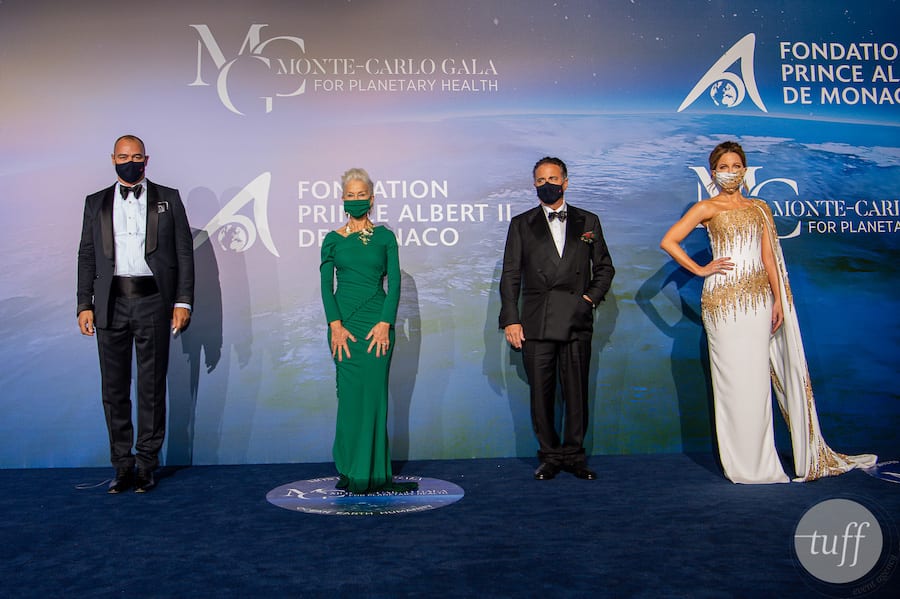
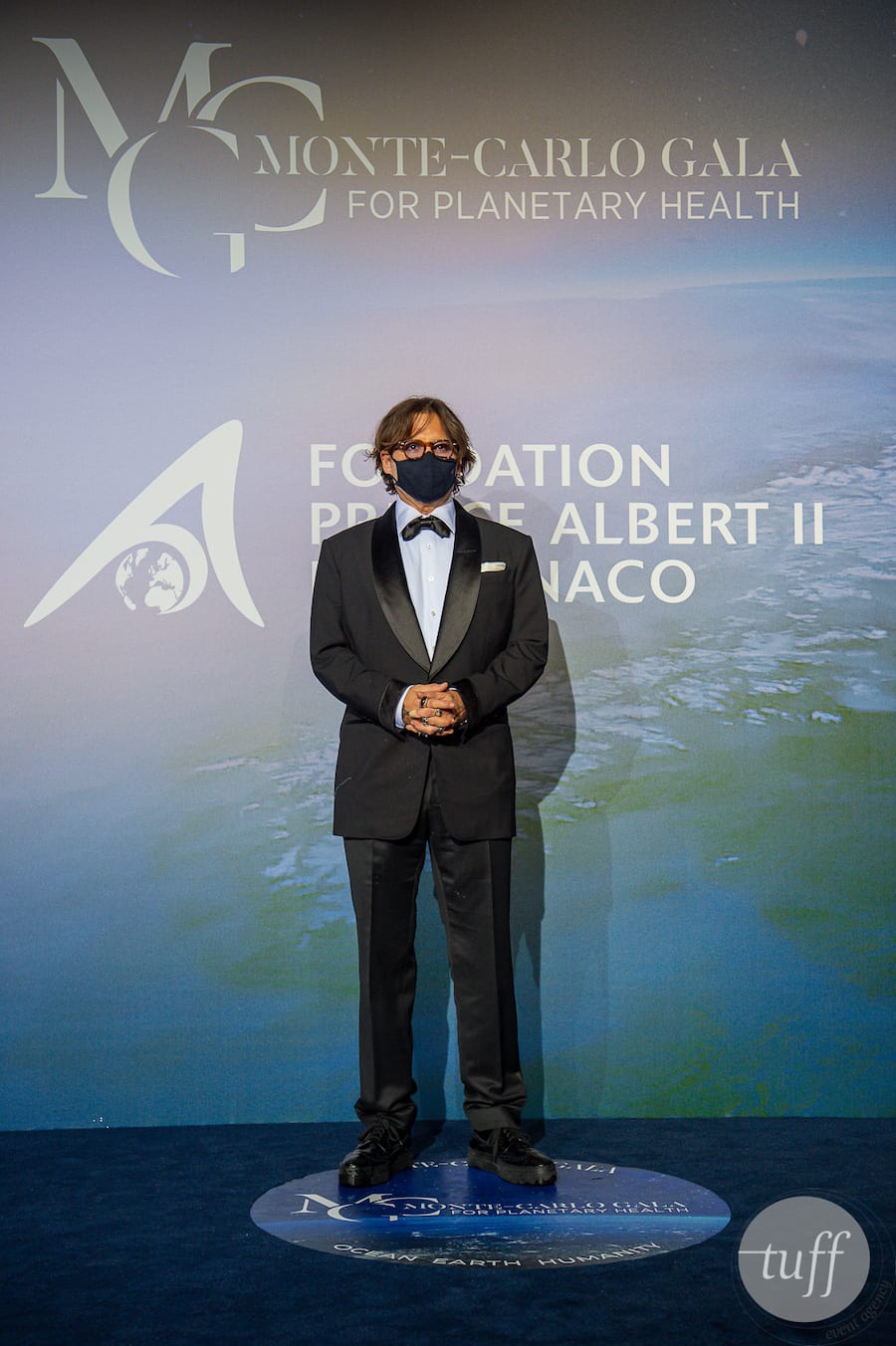
Beside them have stood some of the biggest names in entertainment: Uma Therman, Sharron Stone, Nicole Kidman, Andy Garcia, Gwen Stefani and Johnny Depp, to name a few. Is it no wonder that the Monte-Carlo Gala is the hottest ticket in town?
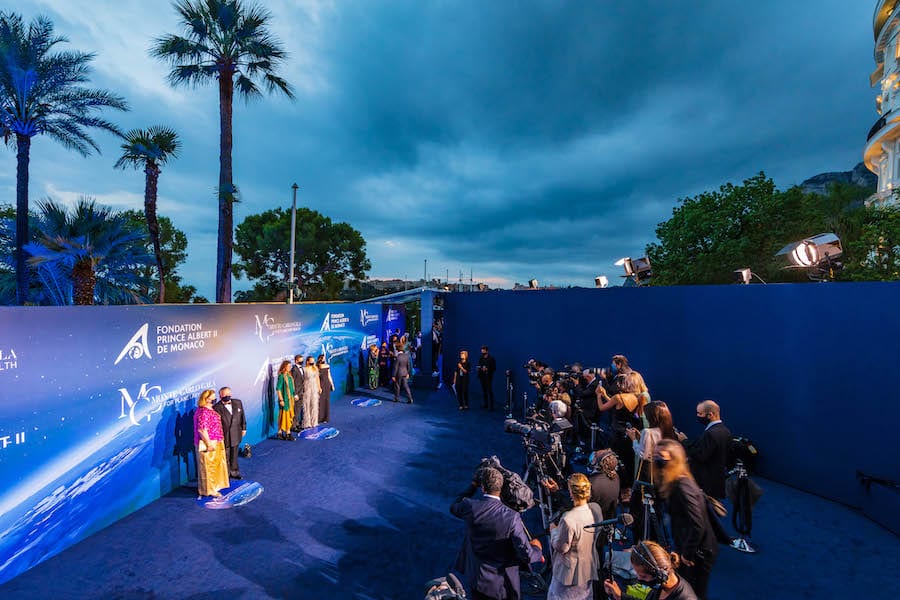
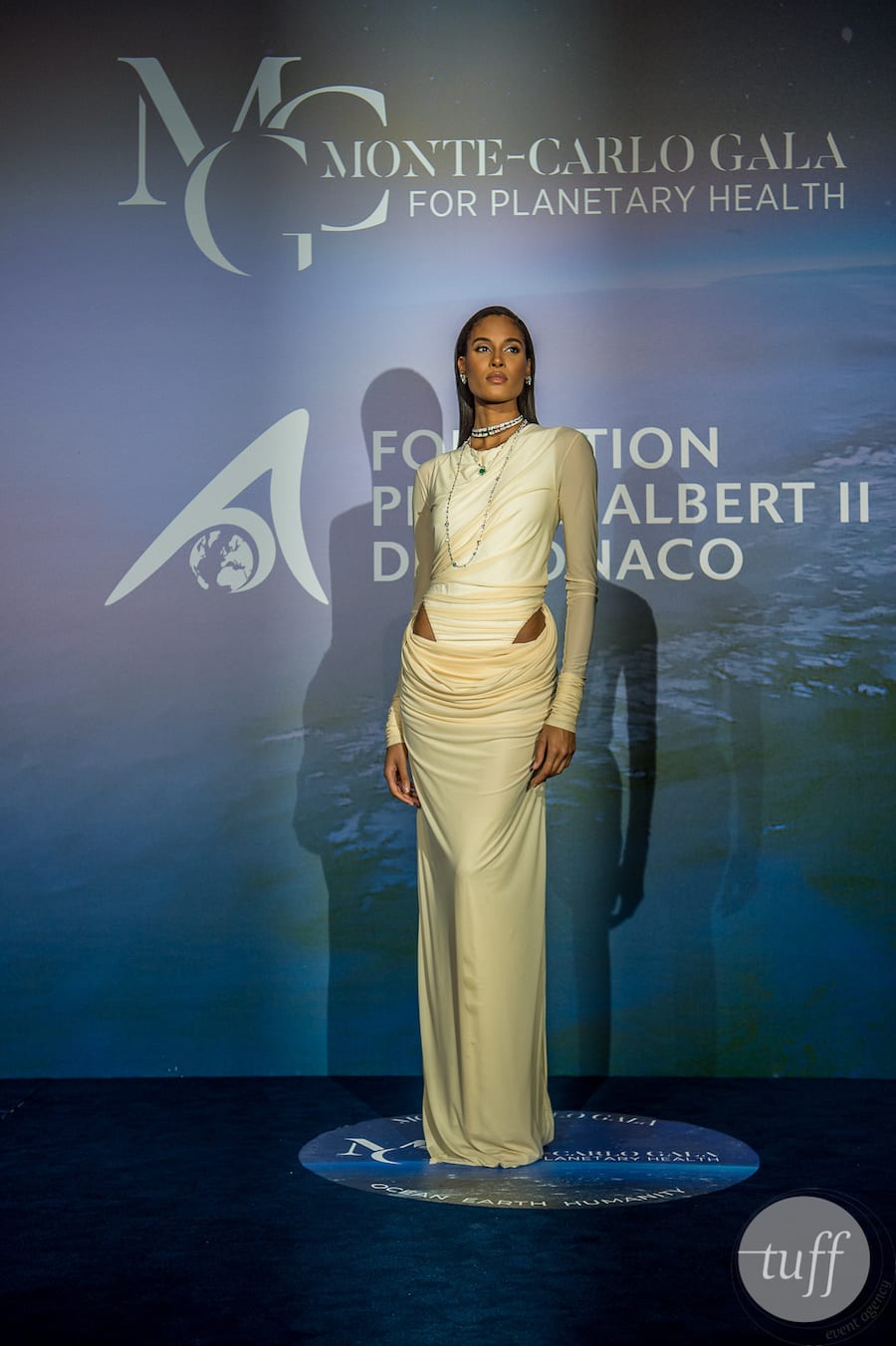
Monte-Carlo Gala for Planetary Health 2020 by Tuff Consult
But like most things here, the gala has a very clear message and purpose: To save the world’s oceans. In exchange for an elaborate star-studded evening, privileged guests are invited to dig deep and provide crucial support to the Prince Albert II of Monaco Foundation.
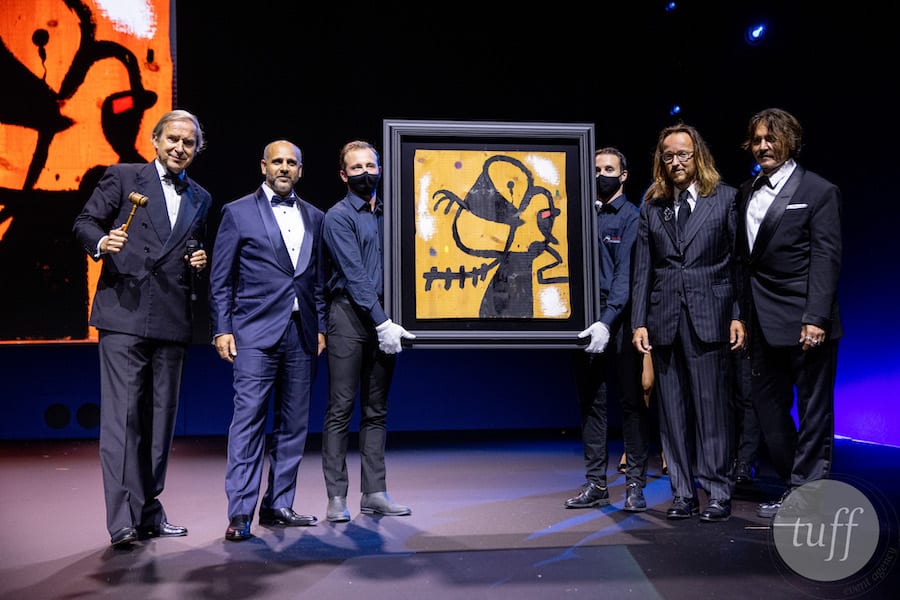
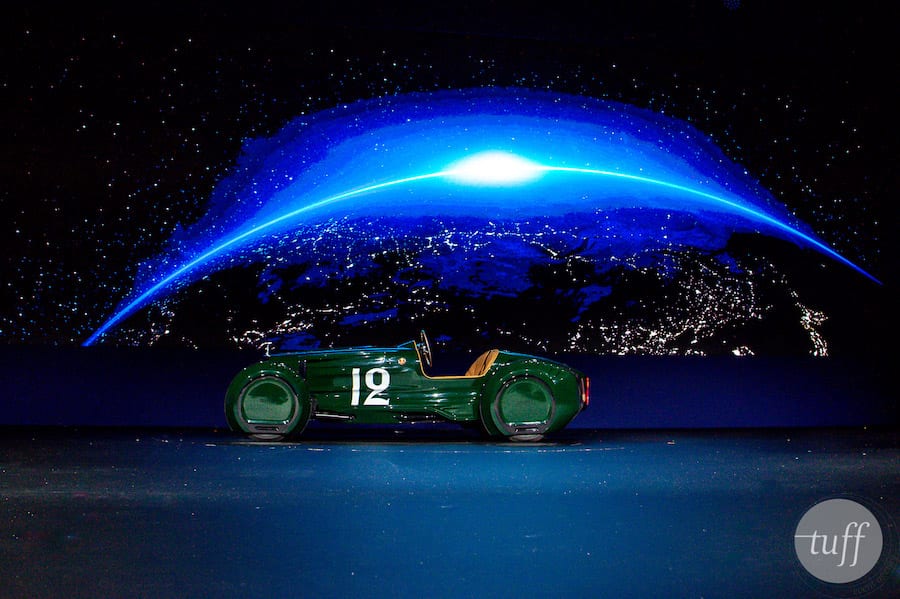
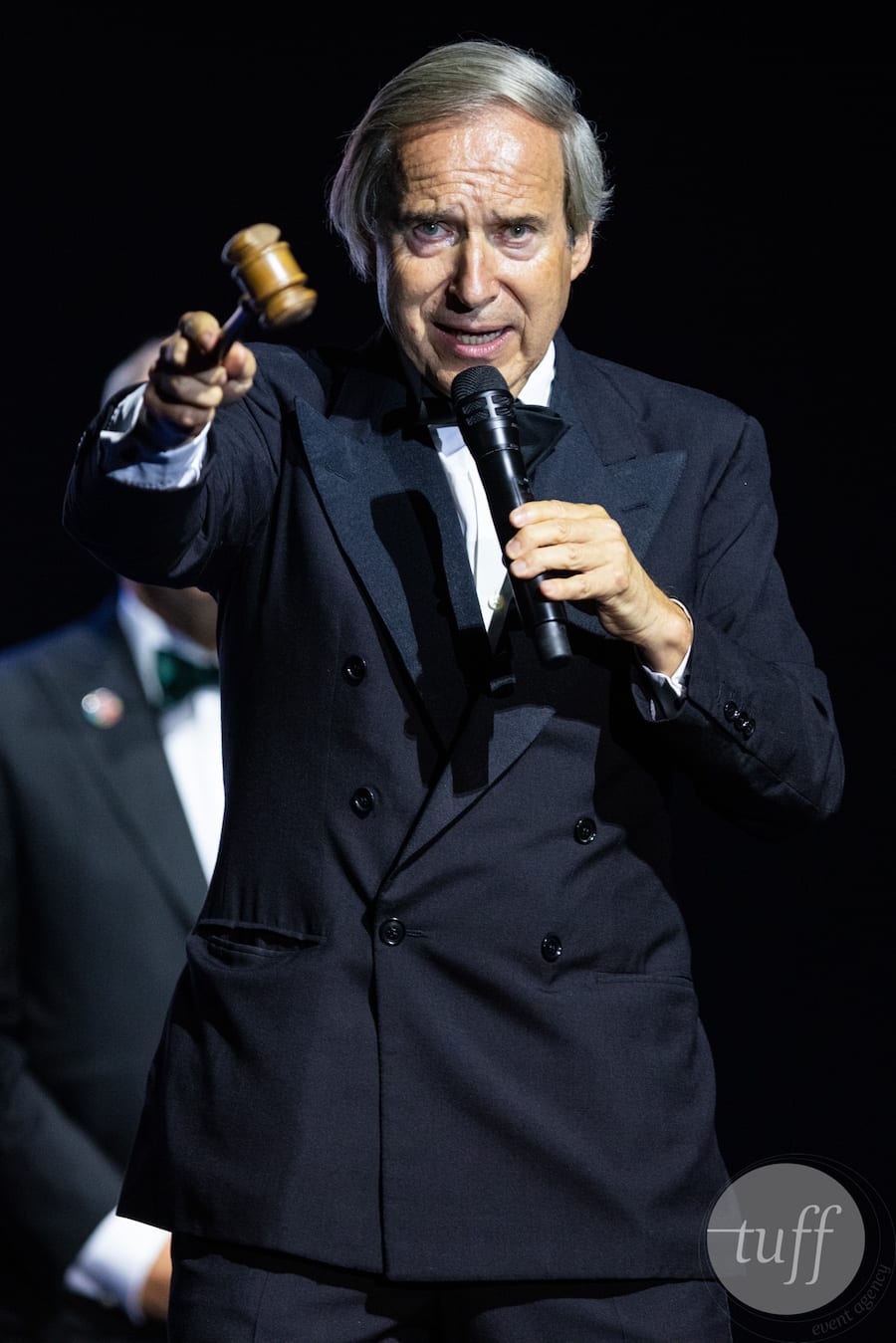
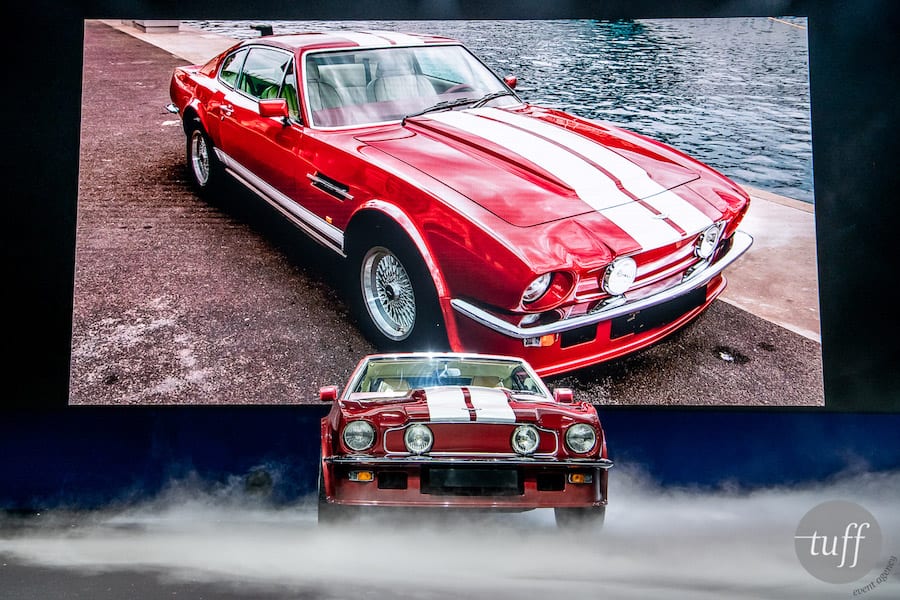
To date, millions have been raised for vital ocean-related initiatives through the gala’s auction, which is as jaw dropping as the gala itself. Organised by Global Fundraising Chairman Milutin Gatsby and featuring the “Mick Jagger of auctions” Simon de Pury, an incredible array of unique pieces have gone under the hammer – from intimate experiences with the Prince and autographed fast cars, to a water bike lesson with Princess Charlene, time on a Hollywood film set and incredible art works.
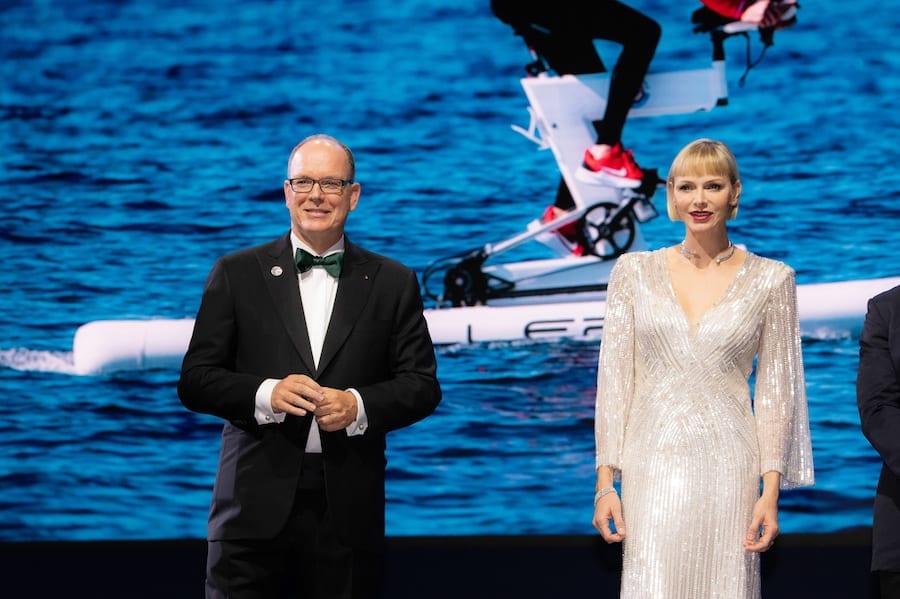
Prince Albert and Princess Charlene at this year’s gala, photo by Eric Mathon / Prince’s PalaceThe “Mick Jagger of auctions” Simon de Pury at the Monte-Carlo Gala For Planetary Health 2020
Even in this unprecedented year of Covid-19, while the world’s most famous A-list events were being wiped from the calendar, the Monte-Carlo Gala for Planetary Health went ahead on 24th September, against all odds.
Its design, production and organisation was entrusted to event agency Tuff Consult. “We had an internal Covid department, providing us with real-time information on what we needed to do to protect people – both guests and the teams putting the event together,” Stefan Santoni, founder of Tuff, tells Monaco Life. “We can be very proud of the fact that from this event, organised for around 400 people, there were zero Covid cases.”
Stefan Santoni prefers to stay behind the scenes at the Monte-Carlo Gala For Planetary Health
The Covid-19 pandemic did put a stop to Stefan’s other major annual gig – the amfAR fundraising gala at the Hôtel du Cap-Eden-Roc during the Cannes Film Festival – but, he says, Milutin Gatsby was always determined that the Monte-Carlo Gala would go ahead.
“Our fundraising chairman believed in it more strongly than anyone else, which was extremely helpful because it gave us all positive energy,” reveals Stefan.
Monte-Carlo Gala For Planetary Health 2020
Together with Vice President of the Prince Albert II of Monaco Foundation Olivier Wenden, the three are credited with creating the elaborate concept for 2020’s gala, dedicated to the Ocean, Earth and Humanity.
The very structure that envelopes guests is the distinguishing feature of the Monte-Carlo Gala. Previously, an enormous transparent marquee has hugged the walls of the Opera Garnier while ocean projections feature on the façade.
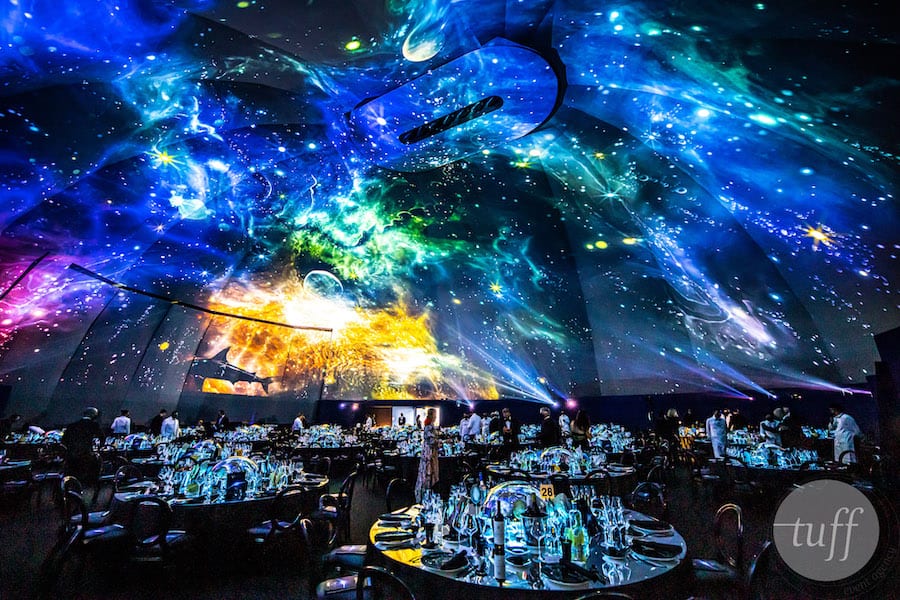
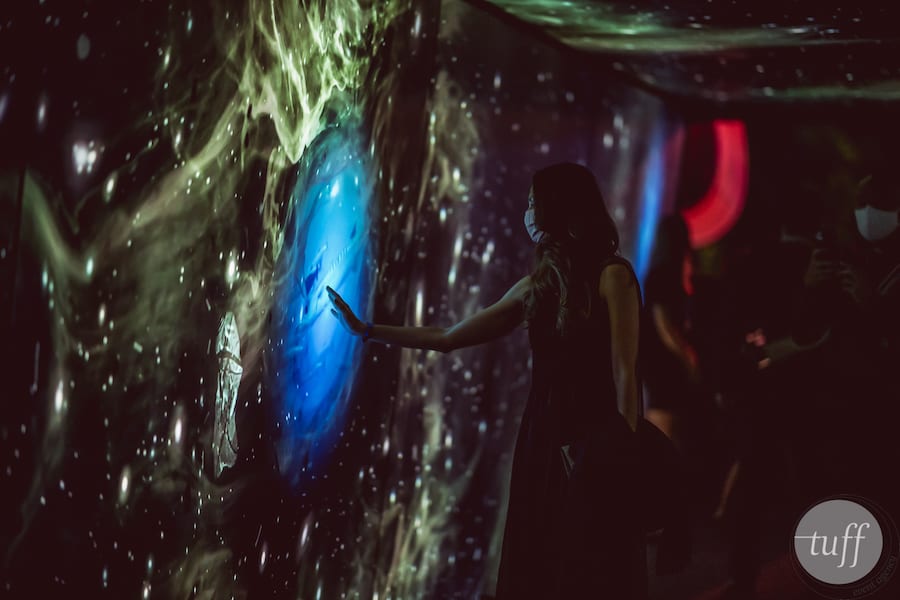
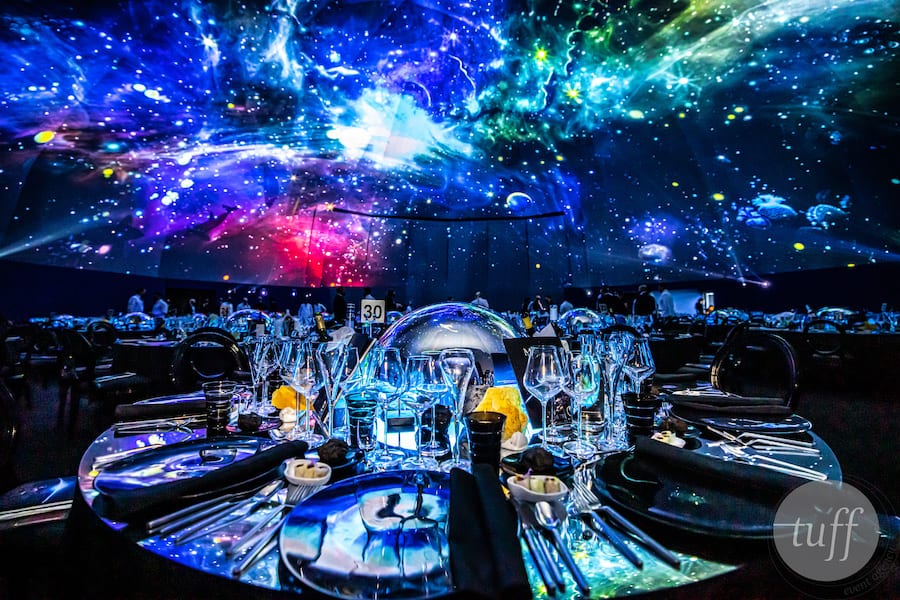
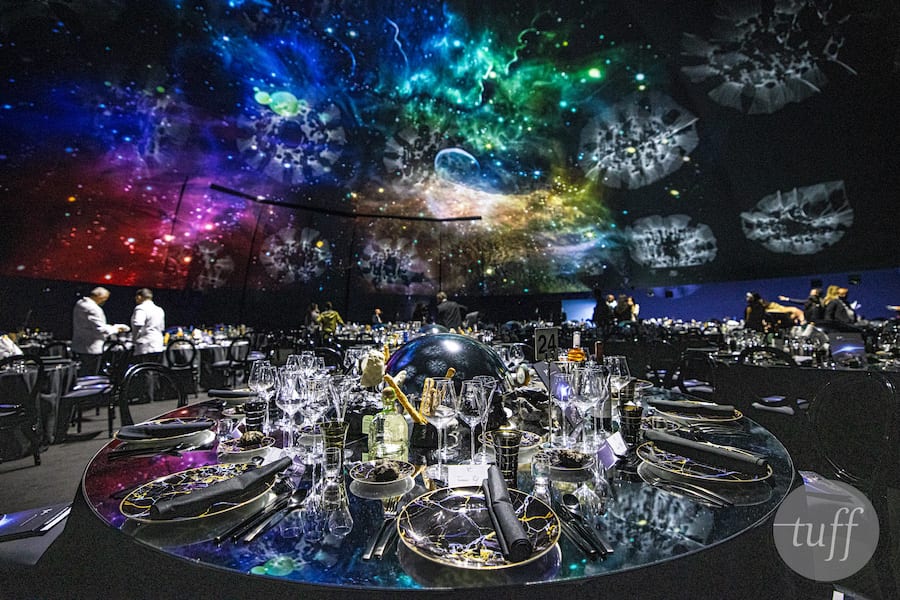
This year, guests were invited to step into a giant 1,500sqm three-dimension dome and be completely immersed in images of galaxies, forests, ocean floors and glaciers.
“The entire structure was created to project these incredible videos of the planet,” says Stefan. “It actually takes about a month to set up and involves around 500 people on the day of the gala to make it happen. But the whole process, from conception to execution, takes a year.”
To achieve a fully immersive experience, the production team used more than 38 video-projectors as well as 3D simulation technology.
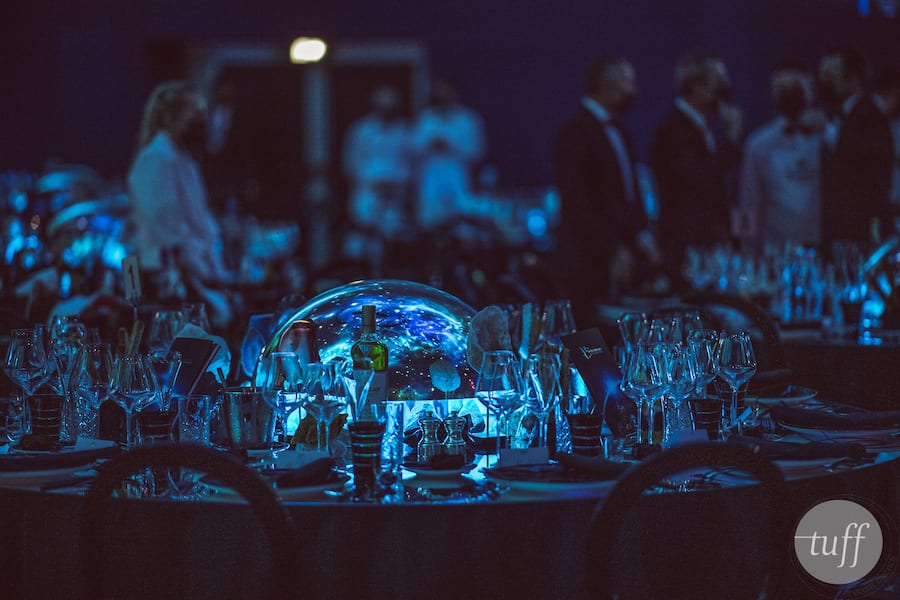
Reflecting these mesmerising scenes was another dome at the centre of each table, upon which guests could also view the entire night’s proceedings.
The galaxy inside the gala’s 3D dome
“With the dome, we were able to project anything we wanted – the art for auction, a movie, or a live interview,” says Stefan. “Last year we had holograms in the middle of each table which showed the auction items that they were selling on stage. We always try to come up with a new technology to surprise people. It’s important for guests to anticipate something different every year.”
Despite the headline-grabbing nature of the event and its celebrity guest list, very few images of the actual gala ever make it in to the media. But Stefan Santoni was proud to share his work with Monaco Life.
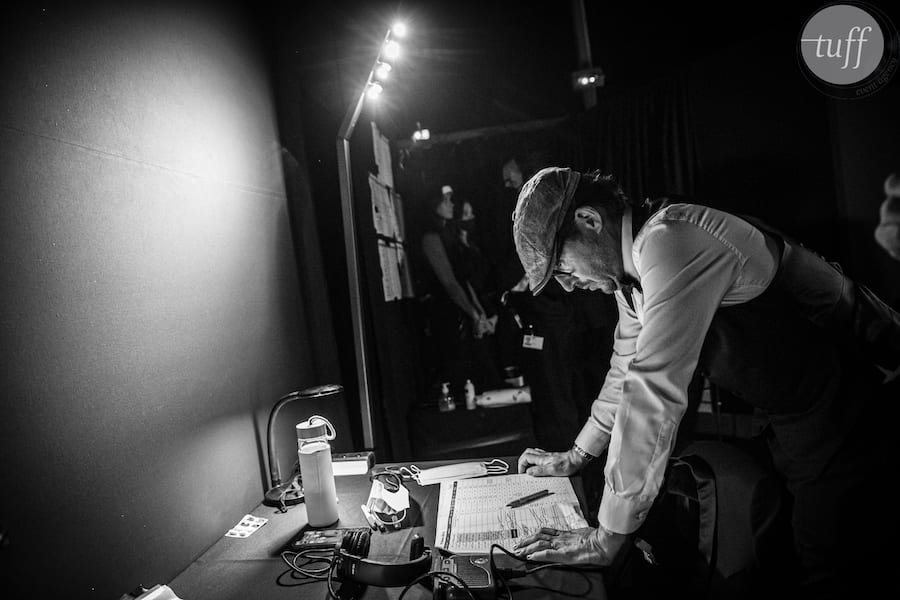
Stefan Santoni keeping a watchful eye over everything at the 2020 gala
Indeed, this modest Swedish man has much to be proud of. He started his career as a roadie running cables under the stage for Pink Floyd in France. From there, he became a production director for high-end fashion shows across the globe. But it was the consultancy firm that he created, Tuff, that eventually propelled him into the lucrative world of celebrity fundraisers and luxury events. He now counts the Leonardo DiCaprio Foundation, Valentino, Saint Laurent, Chopard, and the Elton John AIDS Foundation among his very long client list.
Stefan acknowledges that having a “carte blanche” for the Monte-Carlo gala makes it extremely fun and interesting. “It is a big event with a big result,” he says, highlighting the millions raised for the Prince Albert II of Monaco Foundation.
But catering to the rich and famous can sometimes bring outrageous demands. “Once I was asked if I could put a live elephant in a swimming pool, which we didn’t do obviously. We have many crazy things that people ask for that we can’t do – either because we simply cannot do it, or because it is not appropriate.
“Usually, we take this very seriously, but with a lot of fun,” he says.
Of course, it has not been all fun this year. The global crisis brought about by the pandemic has heavily impacted the events industry, forcing the cancellation of most private parties and fundraising events.
Thankfully, says Stefan, with support from the French Government, he has been able to keep his full team afloat. He only hopes that things will pick up as soon as possible, with the Monte-Carlo Tennis Masters and the Cannes Film Festival signalling the beginning of a busy events season in 2021. But even then, Stefan acknowledges that the industry will not go back to “normal” any time soon.
“I can’t read the future, but I am ready for a change in the events industry,” he says.
We can only imagine what Stefan and his team will put together next year. Of course, he is remaining very tight lipped about it all, but we can expect that it will be very big, very impressive, and very Monte-Carlo.
See more photos of the Monte-Carlo Gala for Planetary Health 2020 here (click to enlarge)…
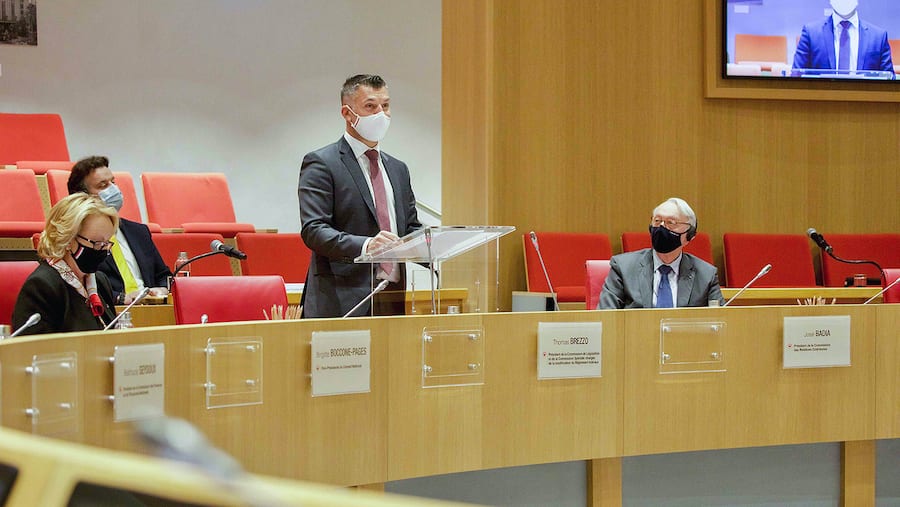
Monaco’s National Council spent their entire session on Wednesday discussing Bill No. 1008 and a report compiled by Thomas Brezzo concerning money laundering, terrorism financing and corruption.
The report was created essentially for Monaco law to incorporate the fifth anti-money laundering directive of the European Union, which has a compliance deadline of 31st December 2020. Implementation of Monaco’s commitments toward this directive are set to be implemented by the end of 2021.
The EU directive stemmed from the European Commission’s action plan of 2016 to fight the use of the financial system in the funding of criminal activities, terrorist financing and the obfuscation of funds.
Brezzo, the chairman of the Legislation Commission, referenced Prince Albert II in saying “Monaco must be irreproachable”, adding that the Principality has been very active in fighting these issues.
The country has been involved with several international associations who deal specifically with anti-money laundering, including Moneyval, the permanent monitoring body of the Council of Europe who assesses compliance with the main international standards to counter money laundering and the financing of terrorism and the effectiveness of their implementation, as well as with the task of making recommendations to national authorities for the necessary improvements to their systems.
Jean Castellini, Minister of Finance and the Economy, said that though the subject may seem rather dry and difficult to follow, it is of utmost importance to Monaco and its people. The text, he reminded listeners, helps banking and finance sectors continue growth by adding to the local economy through revenue from the State’s budget both directly and indirectly. It also, critically, allows Monaco to continue to use the euro as it’s national currency and to be integrated into the SEPA payment system.
Then Corrine Bertani took the floor and made a point of the fact that whilst those who offer services are exempt from the new list of taxable persons, those who trade in goods are not. She clarified that that this is for the sale of all goods paid for in cash over the amount of €10,000, and that traders will be required to identify the purchaser in these cases. Traders can still receive cash payments up to €30,000 in this context.
The bill was put to a vote and unanimously passed.
The report in its entirety, including the 134 separate articles proposed in the bill, will be published in the Journal de Monaco.
Photo: Thomas Brezzo at the National Council meeting on Wednesday, courtesy the National Council of Monaco
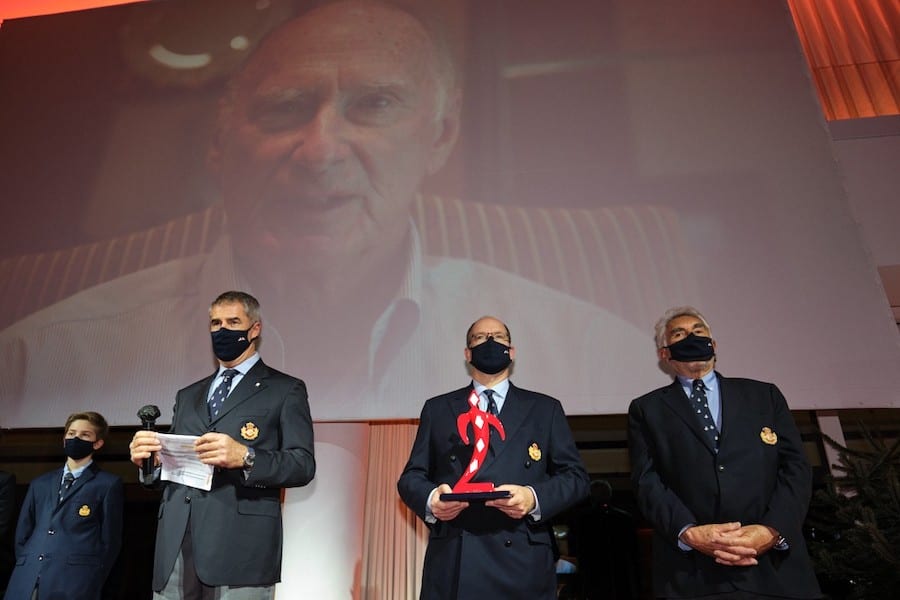
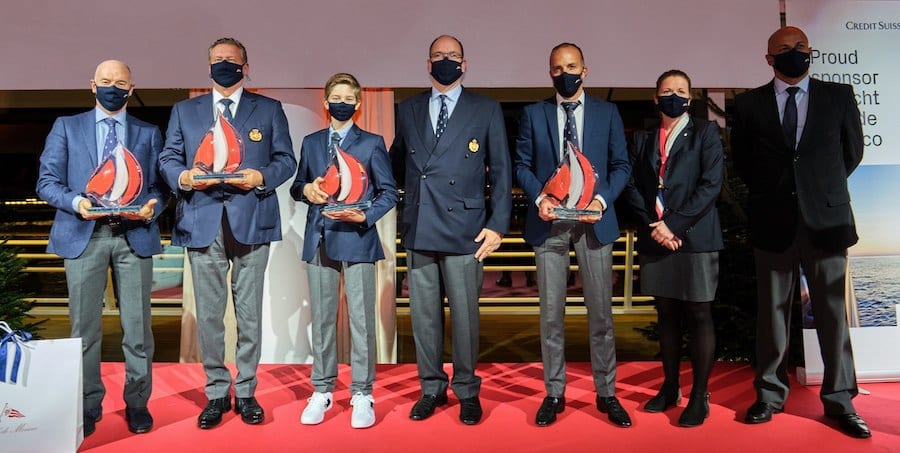
The Yacht Club of Monaco (YCM) Awards may have been held remotely this year, but Club President Prince Albert II still managed to reward sailors who fly the colours of the Principality and make their mark on the world.
The 16th YCM Awards did not look as festive as previous years, but the sentiment was still there.
YCM President Prince Albert II focussed on offshore racing this year, specifically on the participation of Seaexplorer-Yacht Club de Monaco in the Vendée Global. The global solo race is a gruelling test of mettle for any sailor, and skipper Boris Herrmann is doing the Principality proud.
Not only is Herrmann holding his own in the race, he has participated in a “needle in a haystack” sea rescue that saved a fellow racer. He is also collecting vital scientific data to help better understand parts of the oceans that are not commonly frequented by hordes of people.
“Boris’s goal is to collect more data on temperature, salinity and currents, but also the state and chemical composition of the sea in parts of the world less frequented by yachtsmen,” the Prince said in his speech. “Unfortunately, I believe that Boris has already noted the presence of plastic on the surface. I am very proud that we have been able to join the forces of my Foundation and the Yacht Club of Monaco around Team Malizia to make this a sporting and ecological project to protect our seas and oceans.”
It has not exactly been smooth sailing for Herrmann, who has suffered issues with equipment but is still persevering and is currently in 6th place.
“Boris is having a fantastic race,” said Pierre Casiraghi, YCM Vice-President. “The Vendée is a race of elimination, especially in these last two weeks. We have seen lots of breakages on boats. Of course, Boris has had a few small technical issues, forcing him to keep a course further north, but he has managed to preserve the boat which is essential. The milder conditions have enabled him to fix them. For the last couple of weeks, he’s been missing a very important intermediary sail (J2). The boat can now be used in optimum conditions and Boris is in great shape, ready to tackle the second part of the race. It’s incredible that after 37 days at sea, he is neck and neck with four other contestants.”
The ceremony was also an opportunity to remind people of the collaborative efforts made by the YCM, the Prince Albert II of Monaco Foundation and Credit Suisse on the Superyacht Eco Association’s SEA Index, which measures the environmental impact of yachts more than 40 metres long to assist them in meeting carbon emission targets.
The awards were then presented, starting with Matteo Asscher, a 13-year-old sailor who came out on top in the Optimist category for his 3rd place finish at the Monaco Optimist Team Race 2020.
Then Pierrik Devic was honoured, receiving a special prize for his win at the Euro Master Circuit 2020 in the Lasrer Radial Master category, and his 4th place finish at the Laser Master European Championship.
The YCM Awards 2020 also recognises members who have best defended the Club’s burgee during the past year. This year’s winner was Timothy Sukhotin, captain of the Beda who won the Primo Cop-Trophée Credit Suisse, Cappa Europa and had a 2nd place win in the Smeralda 888 finale in October.
For the second year in a row, Ludovico Fassitelli took the prize in the J/70 class, finishing 3rd in the 2019/2020 Monaco Sportsboat Winter Series, 1st in the Med Cup, 7th in Malcesine J/70 Cup, 5th in the J/70 Italian Championship and top spot in the Corinthian amateur category.
Finally, the Sailor of the Year Award went to Lord Laidlaw of the Highland Fling/Oui Fling. His third nomination since 2017 for this award, he wins for the “sum of his successes in the world’s most prestigious races.”
“I like new challenges, but above all I love getting a project to work and making it a success, which is not easy,” Laidlaw declared. “It means finding the right boat, a good crew, organising the training sessions… Everything must dovetail to perfection. What inspires me most is winning. I love competing but I prefer winning races even more”.
Photo source: Yacht Club of Monaco
All the headlines and highlights from Monaco, direct to you every morning