Nearly thirty paintings by thirteen master artists of the golden age of the veduta have gone on display in the Principality. Conceived by veteran art dealer and gallerist Cesare Lampronti, the exhibition Lumières sur la Lagune opened on 23rd September with a press event at Hartford Fine Art – Lampronti Gallery.
As the Monaco Yacht Show brings the global maritime elite to the Principality’s harbour, a parallel voyage across the water unfolds just steps away.
Timed to coincide with the annual gathering, Lumières sur la Lagune establishes an immediate dialogue between the modern superyachts docked outside and the historic lagoons of eighteenth-century Venice captured within.
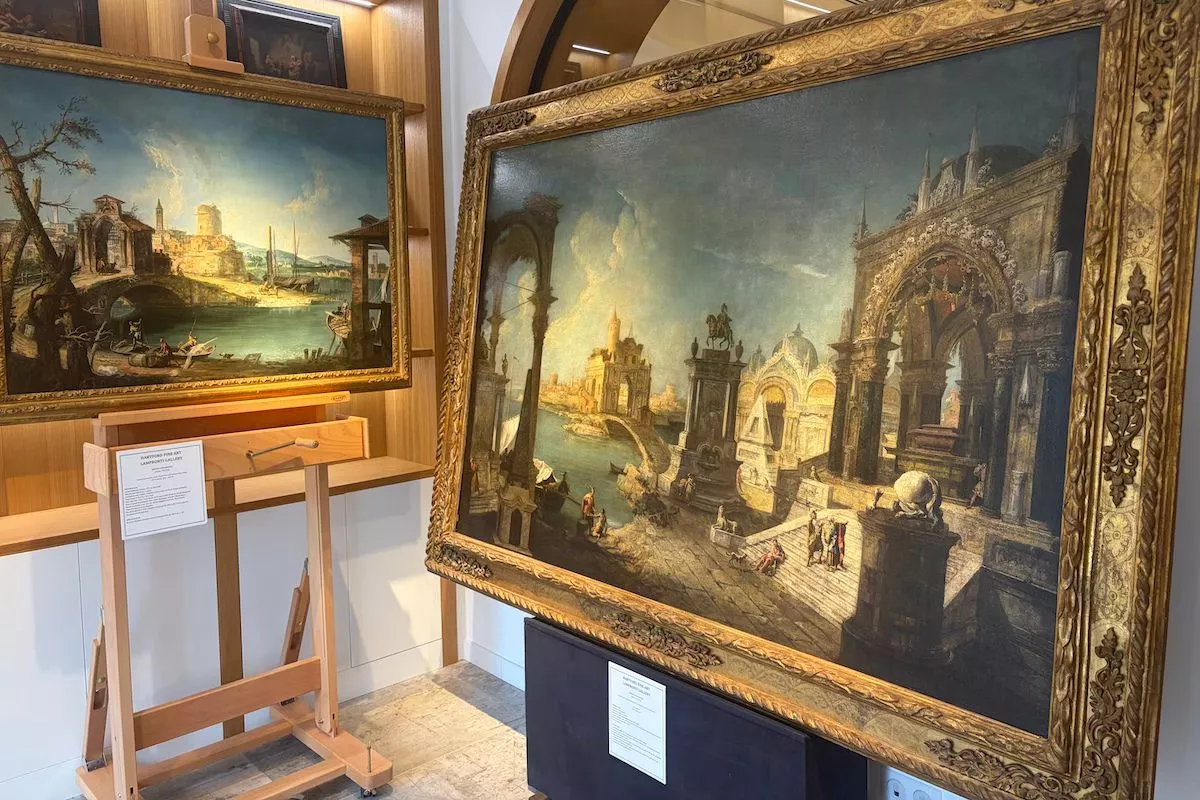
Michele Marieschi’s ‘Capriccio of a Mediterranean Coastal Town with Fishermen by a Bridge’ (left) and ‘An architectural capriccio with figures, the Basilica di San Marco in the distance’ (right). Photo credit: Virginia D’Umas
Sourcing the masters on a global scale
The masterworks, which will be exhibited until 25th November 2026, represent thirteen of the greatest protagonists of 18th-century Venetian view painting, including Canaletto, Bernardo Bellotto, Francesco Guardi, and Michele Marieschi. As Lampronti explained to Monaco Life, assembling this collection was no small task: “As you might expect, this is the fruit of years of dedicated searching—these paintings are notoriously difficult to track down.”
To gather these masterpieces, the gallery sourced works from across the globe—spanning America, England, France, and Italy. The showcase provides a comprehensive cognitive overview of a period when the veduta transformed Venice into a universal cultural image.
Connecting with new collectors in Monaco
The decision to launch the exhibition during the Monaco Yacht Show was a deliberate choice to engage an international audience. Lampronti highlighted the strong synergy between the maritime setting of the yacht show and the nautical themes of Venetian view painting:
“Launching this during the Yacht Show, when the city is so connected to the maritime world, is a wonderful opportunity to present our gallery here. I hope it helps reignite interest in classical collecting, which faces certain challenges in today’s market.”
By placing major works alongside more accessible pieces by lesser-known artists, the gallery aims to inspire a new wave of collecting.
A lifelong dedication to old masters
At 84 years old, Cesare Lampronti looks back on a remarkable 65-year career in the art market. Having started his first gallery at age 19 in Rome on Via del Babbuino, he later expanded internationally by opening a London branch in Duke Street in 2012. Following structural changes in the UK market post-Brexit, Lampronti chose his home of Monaco for the gallery’s newest chapter, opening Hartford Fine Art – Lampronti Gallery in April 2026. Reflecting on his mission, Lampronti shared: “I simply hope to be a strong link in the chain—someone who helps keep the world’s eyes turned toward the beauty of Italian art.”
Masterpiece spotlight: Canaletto’s 1726 Tour de Force
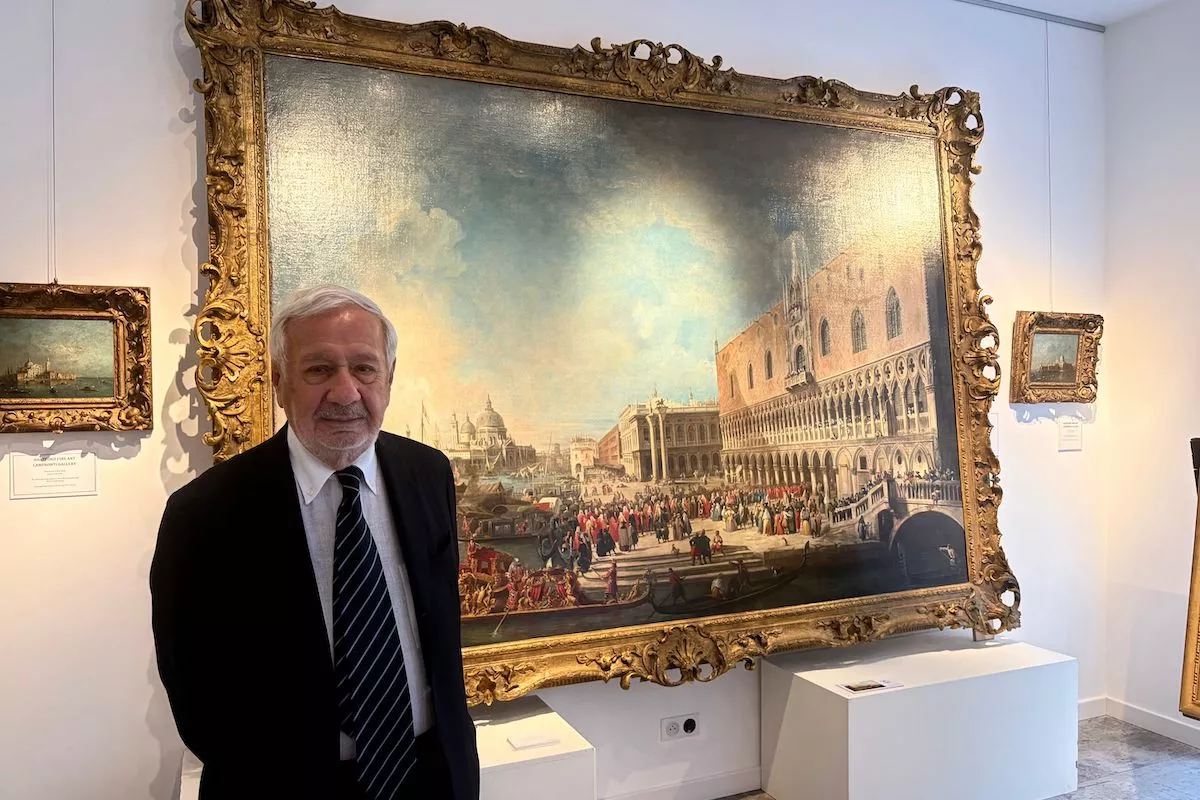
Among the defining highlights that invoke the spirit of the period is Canaletto’s monumental 1726 composition, ‘The French Ambassador’s Arrival in Venice’—depicting the grand reception of Count Jacques-Vincent Languet de Gergy at the Doge’s Palace. Capturing the festivities with analytical precision, the iconic work reflects the absolute pinnacle of Venetian view painting. Describing the magnitude of such masterworks, Lampronti concluded: “It takes a tremendous commitment to secure a piece of this scale. This magnificent painting is truly extraordinary, representing perhaps the most important Canaletto masterwork in existence.”
Whether admiring monumental vistas or intricate architectural details, visitors can experience the exhibition free of charge at Hartford Fine Art – Lampronti Gallery, located at 21 Boulevard Princesse Charlotte in Monaco, until 25th November 2026.
Cesare Lampronti standing in front of Canaletto’s monumental 1726 composition, ‘The French Ambassador’s Arrival in Venice’. Photo credit: Virginia D’Umas
New private club launched in Monte-Carlo to unite Romanian entrepreneurs and Monaco business leaders
An exclusive networking event has been held at the Princess Grace Theatre bringing together Romanian entrepreneurs and Monaco business leaders for strategic exchanges and high-level networking, showcasing the Principality’s distinctive lifestyle.
The selected community – brought together by the CCPMR (Club de Connexions Privées Monaco-Roumanie) on Friday 18th September – featured over 200 key Romanian entrepreneurs alongside more than 50 investors, senior executives, and decision-makers. Attendees focused on forging new partnerships and exploring business opportunities across Monaco and the French Riviera.
Bridging two worlds through a new private connection club
The evening marked the launch of the new Monaco-Romania Private Connection Club, opening with remarks from presenter Mihaela Rădulescu Schwartzenberg—a well-known Romanian businesswoman, television host, and producer—who welcomed guests in Romanian, English, and French.
Mihaela Rădulescu Schwartzenberg at the CCPMR launch in Monaco. Photo credit: CCPMR
Mihaela pointed out that while discretion remains Monaco’s defining currency, local residents and professionals still come together to connect, collaborate, and celebrate success. Having lived in Monaco for 17 years, the presenter expressed immense pride in hosting the first major international Romanian event in the Principality, encouraging attendees to be direct, curious, and supportive of one another rather than staying reserved.
Mihaela also highlighted a defining characteristic of the Romanian business leaders present, explaining the absence of generational wealth: “We don’t have old money in Romania because of our communist past, which dismantled private wealth. Yet, everyone in this room started from zero and built impressive careers and fortunes from nothing. They are a testament to incredible resilience, and they are going to make us even more proud from now on in Monaco.”
Institutional support and core values
Corinne Bertani, Vice-President for Commerce and Productivity of the National Council of Monaco, welcomed the participants, highlighting Monaco’s diverse community and excellent educational system. Following this, Daniel Epuré, the founder and president of the newly launched private connection club (CCPMER), delivered an emotional speech emphasising trust, human connection, and creating concrete opportunities for Romanian entrepreneurs within Monaco’s international business environment, saying: “At the base of any durable construction lies trust.”
Additionally, Iuliu Stocklosa, President of the Bucharest Chamber of Commerce and Industry—an institution representing over 35.5% of Romania’s GDP—shared valuable organisational insights and advised extending leadership terms for long-term stability.
Ultimately, the initiative bridges Romanian creativity, courage, and ambition with Monaco’s prestige, rigour, and prosperity to turn initial introductions into enduring business success stories.
Abu Dhabi, Dubai and Ras Al Khaimah have formed the UAE Yachting Alliance, establishing their first formal three-emirate partnership to promote the country as a connected international yachting destination.
The memorandum of understanding was signed on the opening day of the Monaco Yacht Show by the Department of Culture and Tourism – Abu Dhabi, the Dubai Department of Economy and Tourism and Ras Al Khaimah Tourism Development Authority.
The alliance will develop integrated cruising routes and itineraries intended to make it easier for yachts to travel between the three emirates. By packaging the destinations into a single journey, the authorities hope to encourage longer stays and generate more business for marinas, charter companies and other marine tourism operators.
The agreement also establishes a unified platform through which the emirates can engage with the international yachting industry, participate jointly in yacht shows and coordinate marketing campaigns.
A further objective is to advocate for more streamlined processes for visiting superyachts. Abu Dhabi and Dubai introduced a simplified protocol at the beginning of 2026, allowing sailing permits issued by either emirate to be recognised for travel between them and removing duplicate local entry and exit procedures.
One itinerary across three emirates
The alliance brings together three distinct cruising propositions: Abu Dhabi’s island and cultural attractions, Dubai’s established marina and waterfront infrastructure, and Ras Al Khaimah’s 68 kilometres of coastline beneath the Hajar Mountains.
Saleh Mohamed Al Geziry, Director General for Tourism at DCT Abu Dhabi, said the partnership would help charter operators and destination management companies create itineraries linking Abu Dhabi’s marinas with Saadiyat Island and Sir Bani Yas Island.
“By creating seamless cruising routes with Dubai and Ras Al Khaimah, we are making our capital’s coastal treasures more accessible than ever to the global yachting community,” he said.
Issam Kazim, CEO of the Dubai Corporation for Tourism and Commerce Marketing, said the alliance would give owners and charter operators greater choice while supporting the Dubai Economic Agenda, D33, which aims to double the emirate’s economy by 2033.
“By connecting marinas, coastlines and experiences more closely, we can give yacht owners, charter operators and visitors greater choice, flexibility and even more reasons to explore the UAE as part of a single journey,” Kazim said.
Ras Al Khaimah joins regional yachting push
The inclusion of Ras Al Khaimah significantly broadens the itinerary beyond the UAE’s two largest established yachting centres.
Phillipa Harrison, CEO of Ras Al Khaimah Tourism Development Authority, said the agreement coincided with substantial investment in the emirate’s waterfront and its ambition to attract more than 3.5 million visitors annually by 2030.
She highlighted the emirate’s combination of coastline, mountain scenery, Emirati culture and expanding hospitality infrastructure, including the forthcoming Wynn Al Marjan Island and new marina developments.
The alliance has not yet released specific routes, implementation dates or details of any further regulatory changes. However, the agreement creates a formal framework for the three emirates to coordinate destination promotion and develop a more integrated yachting offer.
Monaco Life is written by qualified journalists, writing original content. Sign up for our free newsletter, listen to our podcasts on Spotify, and follow us across Facebook, Instagram, LinkedIn, and Tik Tok.
Photo provided
What Monaco’s switch to +377 means for mobile customers
All new Monaco mobile numbers will be issued exclusively with the Principality’s +377 international dialling code from 1st October, ending the use of French-prefixed 06 numbers for new lines. Existing customers will keep their current numbers and will not need to take any action.
The change follows new agreements between the Prince’s Government and French telecommunications regulator Arcep, and is intended to strengthen Monaco’s digital sovereignty and improve protection against fraudulent calls.
Decades of shared infrastructure
Since the introduction of mobile telephony to Monaco in 1993, the Principality’s mobile numbering plan has been closely tied to the French network. Early mobile lines were assigned ten-digit numbers beginning with the French prefix 06. Although Monaco secured its own international code (+377) in 1996—a milestone for its telecommunications independence—Monaco Telecom has historically operated number blocks under both French (+33) and Monégasque (+377) prefixes.
The upcoming update formally ends this legacy arrangement for all future line allocations.
Enhanced security and standardised formatting
Under the new protocol, any residential or corporate customer activating a new mobile contract with Monaco Telecom will receive an eight-digit number preceded by the +377 international code. Beyond reinforcing national identity across international telecommunications, standardising the numbering system serves a vital security function. Unifying new allocations under +377 allows for stronger protection measures against caller ID spoofing, fraudulent activity, and nuisance calls, according to the government.
Continuity for existing subscribers
For current Monaco Telecom customers, the transition will involve no disruption. Existing subscribers holding 06 numbers will retain them with no administrative action or adjustments required. By balancing modernised security protocols with total continuity for current users, Monaco continues to advance its overarching digital strategy while streamlining its national network architecture.
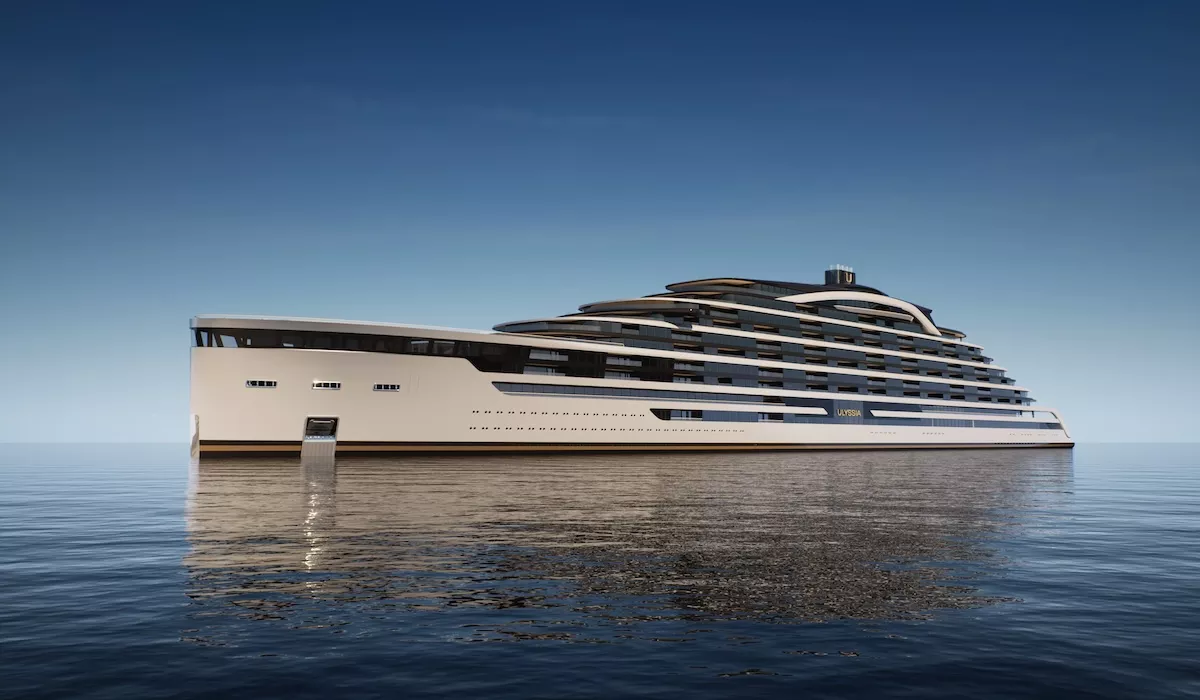
It will stretch 323 metres from bow to stern, become the world’s largest residential yacht and house a few hundred of the world’s wealthiest people in residences costing between €10 million and €100 million. But money alone will not secure a place aboard, and no single nationality will be permitted to dominate the community. In a striking departure for a project of this scale and pedigree, Ulyssia will be built in China.
Ulyssia is the residential superyacht conceived as a permanent floating home for the ultra-wealthy. On the opening morning of the Monaco Yacht Show, I sat in the private Monaco home of its founder, Frank Binder — himself the project’s principal investor and the buyer of the first penthouse on board — as he and lead architect Espen Øino set out where the reportedly €2 billion-plus vessel will be built, and who will be allowed to live aboard.
China Merchants Cruise Shipbuilding (CMCS) in Shanghai has now secured the build, with the definitive contract due to be signed on 12th November 2026, the point Ulyssia regards as the formal start of construction. Delivery is planned for 2031, followed by a maiden voyage from Monaco.
Credit: Espen Øino International
Why China
The most consequential decision has been the move from Meyer Werft, the German builder previously attached to the project, to CMCS in Shanghai. “It comes down to two things: the quality and the capabilities of the shipyard,” Binder said. “It was a big step that we evaluated very carefully, and since then it has been proven to be the right decision.”
One capability set the yard apart: CMCS will provide a purpose-built facility large enough to accommodate the entire vessel. “They offer something very few other shipyards can – we can finish the exterior fairing and the interior outfitting within a climate-controlled facility,” Binder said. “A climate-controlled shed of this size does not exist anywhere else in the world.”
This is billed as a first-of-its-kind marriage: Chinese scale, technology and speed wedded to European design and craftsmanship. CMCS will build the vessel, supported by its Finnish engineering subsidiary Deltamarin, while the interior remains in the hands of Italy’s FM Architettura, with specialist outfitters from Germany, Austria and Italy. “We’ll be building with the best European companies in China,” Binder said.
Credit: Espen Øino International
For Øino, the choice reflects a bigger shift. “We were all very impressed by what we saw: the engineering resources they have in-house, the infrastructure and the people,” he said. “China is already the world’s biggest commercial shipbuilding nation and is moving up the value chain. That is one of the differences between China and the Western world: it takes a long view. When it decides where it wants to be in ten years, it follows through and does what is required to get there.”
Øino illustrated the point by comparing one of Europe’s most prestigious luxury marques with the rapidly advancing quality of Chinese manufacturing. “When I arrived from the United States, I was collected from the airport in a Rolls-Royce. You think: this is the benchmark,” he said. “The next day, the shipyard sent a Chinese car. I cannot remember the brand, but the comfort, suspension, materials and interior were at least at the same level – perhaps even better. For me, it was a real reminder of what is happening in China.”
The subtext is hard to miss. A vessel once destined for a northern European yard is now, in part, a statement about where shipbuilding is heading, and a bet that a Chinese yard can deliver a project of this value to yacht standard.
Credit: FM Architettura
Who gets to live aboard
If the build is the headline, the make-up of the community is the more revealing part. Ulyssia is designed around 122 residences and 22 guest suites, though Binder said optimisation of the layout could eventually allow as many as 130 homes. Buying one is not a straightforward transaction; the project is as concerned with curating a society as with selling property.
“We carry out a detailed background check on every prospective buyer so we understand who they are and where they come from,” Binder said. “It is also extremely important for us to meet people personally. They must demonstrate that they can pay, although we do not require a bank guarantee covering the entire purchase price.” Nor is paying enough: “This is a very exclusive community, and we need to make sure we have the right owners who will fit together to create what we believe will be the most exclusive club in the world.”
Credit: LINLEY, Interior Designer
Interest has come from Europe, Asia and South America, but the strongest demand so far is from the United States. Binder said the mix of residents will be carefully managed: “We do not want one nationality or demographic group to dominate, so we will set an upper limit of 30% for any single group.” Prospective buyers so far are around 53 or 54 years old on average, though the project is also designed for families, with an onboard school planned, and younger owners who can work remotely. Small pets are welcome too.
Even the €10 million entry price is deliberate. “If one person bought for €500,000 and another for €500 million, they might have very different expectations and mindsets, and the community may not function,” said Binder.
Each residence is acquired through a share in the company that owns the vessel, under a Swiss-law structure, and can be inherited or sold. Every new buyer is vetted. In succession, Binder acknowledged, there is “naturally less control”, though he does not expect it to become a problem.
Credit: FM Architettura
A luxury yacht designed as a floating home
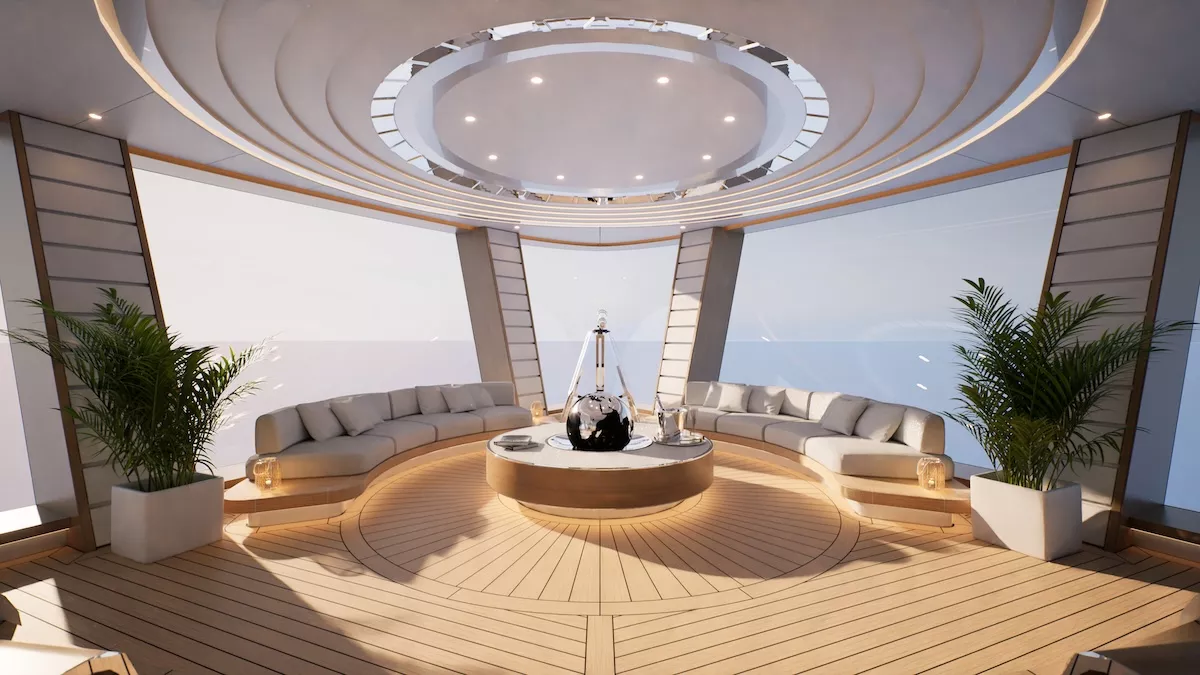
Binder and Øino were careful to distinguish Ulyssia from a cruise ship. Despite its 323-metre length and 122 private residences, it is being designed to combine the standards of a luxury yacht with the space and privacy of a permanent home.
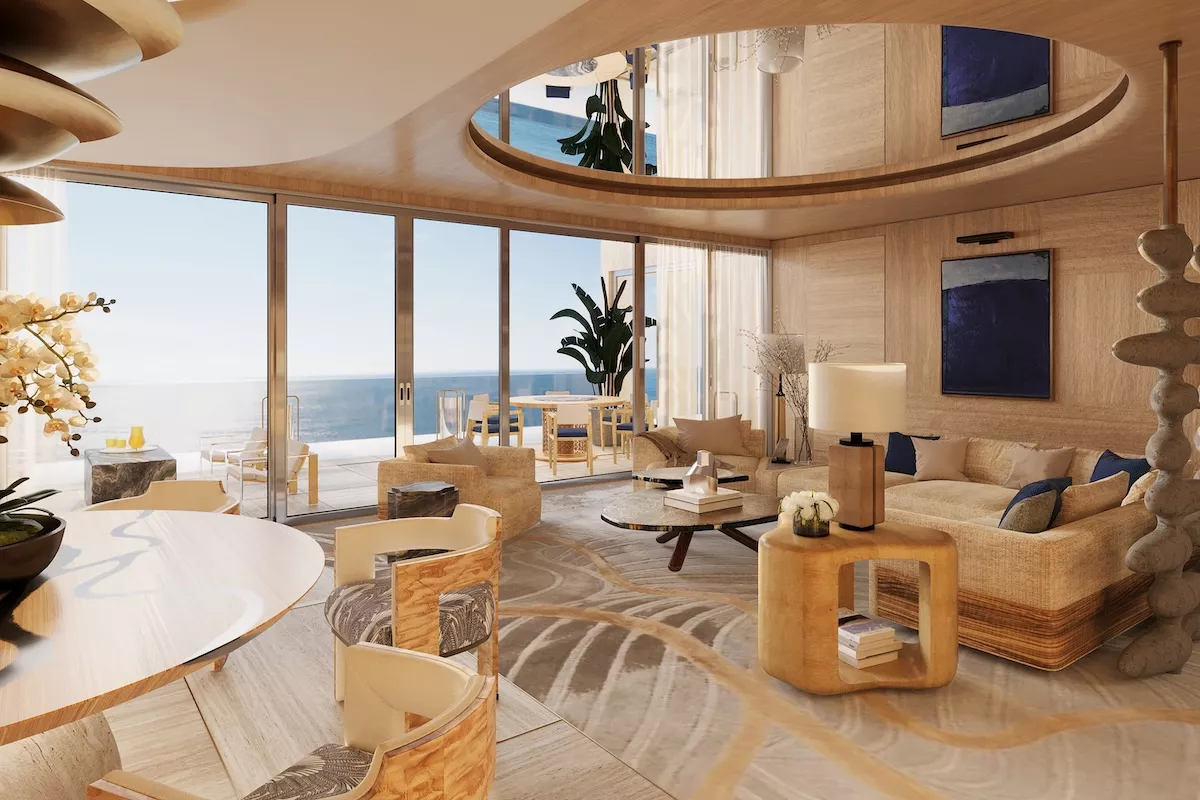
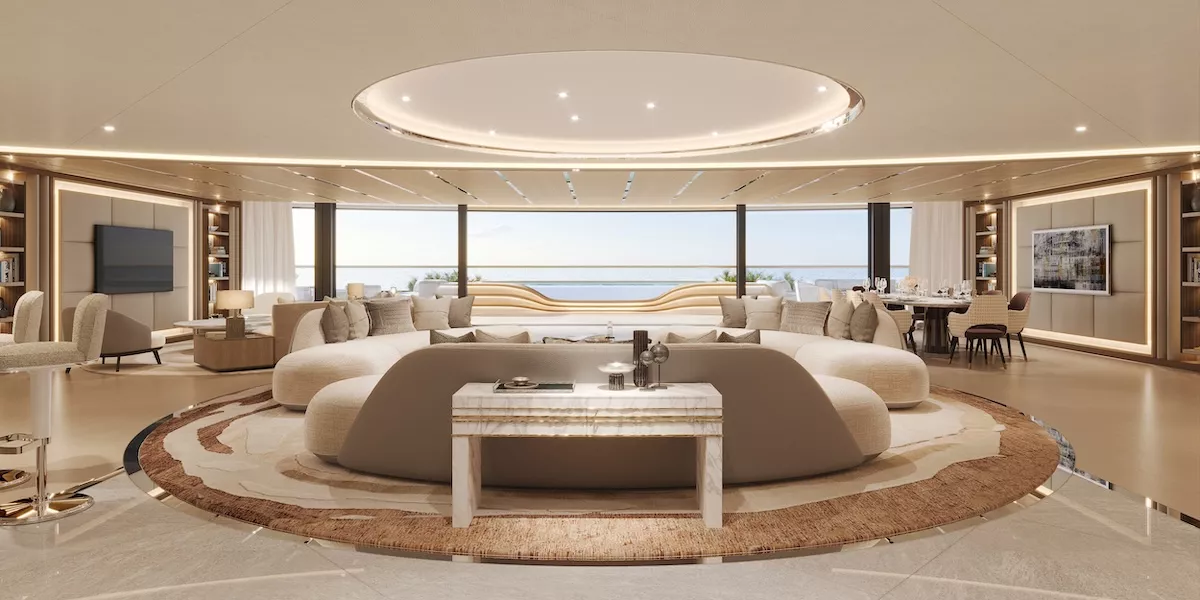
Residences will range from 110 to 953 square metres, with one to six bedrooms, private terraces and fully equipped living spaces. He compared the experience to owning an apartment in Monaco’s Tour Odéon – but one that travels. Residents will have everything they need within their own homes, rather than relying on large communal areas for space.
“The number of people aboard at any one time will be far lower than on a conventional ship of a similar size,” Øino said. “The challenge is therefore also to ensure that the public spaces do not feel oversized or empty.”
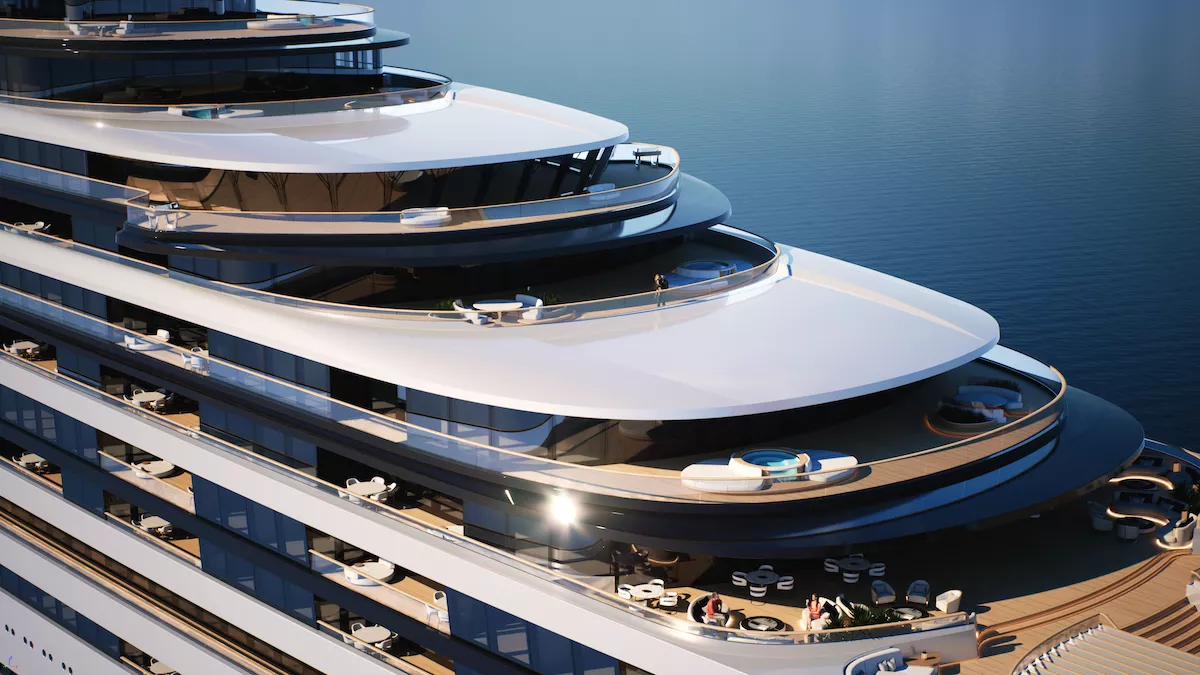
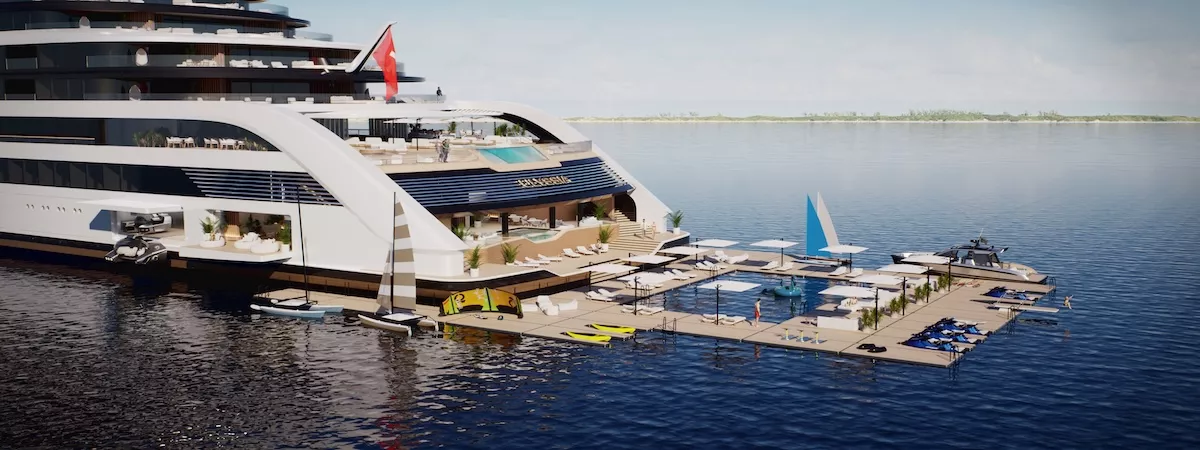
The exterior, meanwhile, has been designed to reduce the visual impression of its height. “Every second deck has a dark line, so what looks like one deck from a distance is, in reality, two,” Øino said.
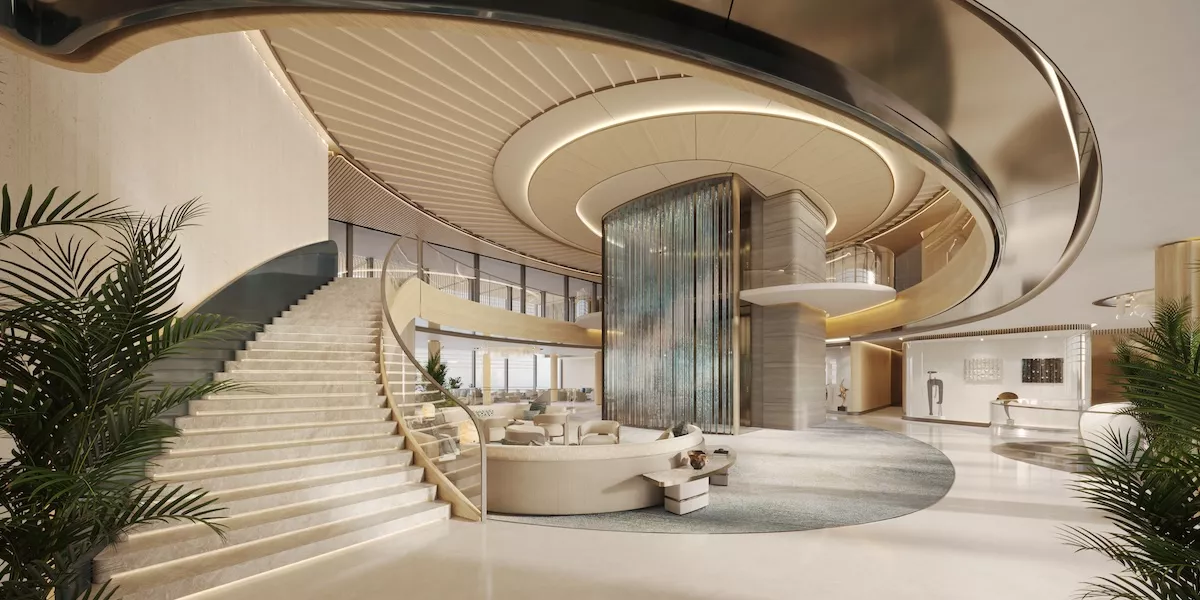
Inside, private or semi-private lobbies will replace long cruise-ship corridors. “When you step out of a lift, you arrive directly within your own small neighbourhood and then enter your home,” revealed Øino.
Credit: FM Architettura
The concept is partly aimed at people who could buy a yacht but would prefer not to manage one. Binder estimated that a private yacht can cost around 10% of its value each year to operate, while Ulyssia’s annual charge is currently projected at about 3.5% of the residence’s purchase price, covering food, fuel, marina fees, maintenance and scheduled refits.
The ship will carry seven restaurants, a two-level Chenot spa, a marina and dive centre, two helicopters and two Triton submersibles. It will also be the first vessel, the company says, to give every crew member — from dishwasher to captain — a single cabin, part of a two-to-one crew-to-resident ratio meant to keep service familiar and turnover low.
Borrowing from The World, the residential ship launched in 2002, owners will suggest destinations and vote on a professionally planned itinerary; what they will not do, Binder insisted, is rush: “We take our time. We’ll stay in one place for a while, rather than rushing from one sight to the next.”
Credit: Espen Øino International
Monaco at the centre of the project
Ulyssia’s hybrid-electric propulsion system will use generators to produce electricity for its motors and is being designed to accommodate sustainable fuels. The configuration should also allow components to be replaced as cleaner technologies become commercially viable.
The move to CMCS has reset the project’s timetable, but it now has a defined route forward: the build contract scheduled for November, approximately four-and-a-half to five years of construction and delivery in 2031.
The remaining test is whether Ulyssia can convert its reservation agreements into binding sales and build the carefully selected international community Binder envisages. The company says interest is strong and expects the residences to sell out before delivery.
The World proved that a privately owned residential ship can sustain a permanent community at sea. Ulyssia intends to take that model much further, combining it with the design, service and finish of a superyacht on an unprecedented scale. At 323 metres, it would dwarf even the largest yachts gathered in Port Hercule this week before setting out on its maiden voyage from Monaco.
Monaco Life is written by qualified journalists, writing original content. Sign up for our free newsletter, listen to our podcasts on Spotify, and follow us across Facebook, Instagram, LinkedIn, and Tik Tok.
Main image credit: Espen Øino International
All the headlines and highlights from Monaco, direct to you every morning