The Braderie de la Mairie de Monaco is returning to the Principality on Saturday 26th September. The free-to-enter event will take place at Parc Princesse Antoinette from 10am to 4pm.
Throughout the day, visitors will have the chance to browse clothing, books, home décor, toys, and various accessories offered for sale by individuals. Held around the back-to-school period, the event gives unwanted items a second life while encouraging reuse, in line with Monaco’s wider sustainability objectives.
Beyond the opportunity to pick up second-hand finds, the annual braderie offers residents a simple way to participate in the circular economy while also bringing the local community together.
For renowned French contemporary sculptor Laurence Jenkell, establishing an ephemeral concept store on the Croisette in Cannes marks a profound full-circle moment. Running from early May through to 31st October, the extensive 400-square-metre pop-up represents the first time the artist has been able to assemble such a vast concentration of her works under a single roof.
For Jenkell, who arrived in Cannes at the age of 20 and previously worked just next door at the legendary Carlton Hotel, the location carries deep personal resonance.
Run closely alongside her daughter, Kelly De Clercq, and dedicated assistants, the concept store operates within a welcoming, family-style ecosystem. As Kelly explained to Monaco Life during an exclusive tour of the store, acquiring one of her mother’s sculptures goes far beyond simple decoration: “When you buy a work of art, you buy a part of the artist’s life. For me, it is really essential to know her history, because we can truly understand the deeper meaning behind why she chose to create a specific piece in that exact way”.
Rather than competing with international galleries like the Opera Gallery, which frequently showcases her pieces globally, this temporary space fosters intimate, direct exchanges with both seasoned collectors and newcomers discovering her iconic style for the first time.
Laurence Jenkell with her daughter Kelly De Clercq. Photo credit: Virginia D’Umas, Monaco Life
From family to fame: The origin of the name Jenkell
Behind the vibrant colours and oversized wrappers lies a deeply personal choice of identity. Early in her career, Laurence made the decision to adopt a singular artistic pseudonym, signing her sculptures simply as Jenkell. This distinctive name is actually a creative blend born from the names of her daughters, Jenny and Kelly, bringing her family history directly into her art.
Dropping her first name allowed her to establish a memorable, unified presence in the global contemporary art world, turning a name rooted in motherhood into a globally recognised symbol of modern pop art.
Photo credit: Virginia D’Umas
From kitchen remnants to global iconography
Jenkell’s signature candy sculptures trace their origins back to a simple childhood restriction. Because her mother disliked commercial sweets and chemical additives, young Laurence was rarely allowed store-bought candies, instead watching her mother melt sugar into pans and cool it onto spoons. Decades later, while raising her own daughters and growing frustrated with constant sweet consumption around the house, Jenkell decided to take their bonbons, melt them in the oven, and add resin.
When studio ants began invading her sugary compositions, she improvised with protective plexiglass boxes. This sparked a revolutionary material breakthrough. Around 25 to 30 years ago, she began experimenting with putting small pieces of plexiglass into the oven. Wearing protective gloves against the intense heat, she modelled the material into a spiral configuration.
As the artist said: “I had no idea what was going to come out of it… I just made one twist on the left, another twist on the right and I thought, ‘this looks amazing, it looks like a bonbon’!”
Butterly and robots collections. Photo credit: Virginia D’Umas, Monaco Life
This foundational shape quickly expanded into diverse series. As Kelly explained, each collection shows a new part of the artist’s journey. The Twist Collection focuses on the core torsion of packaging, elevating the simple wrapper into the primary artistic subject. The DNA Collection evolved naturally when Jenkell noticed that combining two spirals creates a double-helix structure resembling genetic DNA. The Butterfly Collection introduced weightless, dreamy wings to offer a sense of oxygen and lightness after the heavy physical labor of twisting complex spirals.
Additionally, her Robot and Light Sculptures feature intricate, manually cut geometric shapes and purple LED lighting built to pay tribute to her grandfather, who frequently envisioned a robot-filled future. Meanwhile, the Bittersweet Collection incorporates everyday objects like coffee percolators, refrigerators, and trash cans crafted from aluminum and bronze to comment on consumerism, poaching, and heavy water consumption.
The collaborative artwork at the Jenkell Concept Store. Photo credit: Virginia D’Umas, Monaco Life
An immersive experience and interactive workshops
Unlike traditional white-cube museums or silent galleries where children are often discouraged from speaking loudly, Jenkell’s concept store invites multi-generational engagement. Reflecting on her own childhood museum visits, Kelly said: “Let’s be honest, growing up I was bored to death in museums – there was no colour, and we weren’t even allowed to run.”
At the Croisette space, children enter wide-eyed, examining oversized candy sculptures, and even contributing directly to community projects.
The collaborative spirit extends directly to specialised creative workshops hosted at her permanent creation workshop in Valbonne and during gallery sessions. Participants receive a transparent plexiglass plate to paint and decorate under guidance. Jenkell then transforms the plate under their eyes, shaping it into a signature 40-centimetre four-handed sculpture complete with a signed certificate of authenticity.
These interactive sessions have quickly evolved into deeply personal experiences that go far beyond standard gallery visits. As Kelly explains, visitors have the unique opportunity to personalise the candies by embedding different meaningful objects inside them before they are cast. “You can put whatever you want inside,” Kelly said, highlighting how collectors can customise the sculptures with personal tokens or keepsakes. This custom approach has led to unforgettable moments, with upcoming workshops even featuring a romantic marriage proposal where a custom candy is crafted specifically to conceal an engagement ring.
Shared moments and sweet intentions: Sharing good vibes with the world
Visitors to the ongoing exhibition can also participate in an interactive installation where they unwrap a real candy, enjoy a tasting, and write a personal message to slip inside a collaborative artwork. The completed collaborative canvas will be auctioned off on 31st October, with all proceeds donated directly to a children’s charity association.
Whether crafting custom corporate golf trophies for the Ryder Cup, creating personalised memory capsules filled with children’s memories, or displaying historical pieces from the early 2000s, Laurence Jenkell continues to share her vibrant energy with the world.
As the artist concluded: “Everybody needs a bonbon in life… it’s all very positive, gives you good vibes and great energy, and you just want to spread it all over the world”.
Monaco Basket Association has unveiled its lineup for the Ligue Féminine 2 2026-2027 season alongside its main partner, Monte-Carlo Société des Bains de Mer (SBM), at the Casino de Monte-Carlo.
During the reveal at the Casino de Monte-Carlo on Thursday, Founder Éric Elena and SBM President Stéphane Valeri discussed the team’s ambitions for the season ahead and long term, while also introducing the roster looking to achieve these objectives. The location of the event was intentional, marking another ceremony for the team held at the Casino, which has become somewhat of a tradition.
In 2024, SBM finalised its partnership with MBA as part of its commitment to investing in the Principality and Monegasque sport. Shared values have remained a key part of the partnership, including the pursuit of excellence, commitment, team spirit, and the fight for gender equality.
Looking towards the future, Valeri said that SBM had set a three-year benchmark for the project, with the ambition of seeing MBA represent the Principality in Ligue Féminine 1. Following last season, the team, its leaders, and partners have learned and adjusted to better prepare for the season ahead.
With a new coach, Emmanuel Body, and new additions to the roster, the team is aiming to bring additional strength to the squad this season. MBA also continues to build upon partnerships within the Monegasque community, with those involved remaining ambitious and passionate about the project.
Changes have also been made behind the scenes. This season, MBA created two new positions, with Lysa Millavet appointed general manager and Élise Cammas as sporting director.
Team captain Maud Stervinou spoke about her optimism for the season ahead, reflecting on the success the team has found throughout preseason. However, she also acknowledged that humility will be vital in maintaining their progress and ultimately achieving their goal.
The current downfall of the Roca Team, Monaco’s men’s basketball team, was also addressed during the press conference. In a matter of months, the team has fallen from national champions and EuroLeague playoff contenders to being ineligible to compete at the highest level nationally. MBA announced its intention to offer Roca Team season ticket holders season tickets for MBA games, with objectives to attract new fans and compete at Salle Gaston Médecin this season.
The women’s team will take part in their Coupe de France match on 17th September, followed by their first regular season game on 26th September. With ambitious goals for the 2026-2027 season, MBA will seek to maintain consistency, develop teamwork, and continue working towards promotion.
The European Commission is preparing a major overhaul of product import rules that would place greater responsibility on online marketplaces and introduce new charges on goods entering Europe, as Brussels intensifies its response to the huge volume of low-cost products arriving from China.
The proposed legislation, known as the European Product Act, is expected to be formally presented on 6th October and is designed to close loopholes that allow unsafe or non-compliant products sold online to reach European consumers. According to a draft obtained by Euronews, the reforms would introduce greater liability for online marketplaces, strengthen EU-level enforcement and create a new market surveillance fee on imported goods.
While the draft does not specifically target China, it comes amid mounting concern in Brussels over the enormous growth of e-commerce imports from Chinese platforms and the safety of some products entering the European market.
The issue has become increasingly significant as Europeans turn to online marketplaces for everything from cosmetics and electronics to toys and clothing. In 2025, almost six billion low-value items were shipped directly into the EU from third countries, while more than 90% of e-commerce parcels entering the bloc originated in China.
Why this matters for Monaco
Although Monaco is not an EU member state, it is treated as part of France for EU customs and VAT purposes, meaning EU customs rules apply in the Principality. This makes the continuing overhaul of European import controls directly relevant to consumers ordering goods into Monaco.
The latest proposal would require an economic operator established in the EU to be legally responsible when an imported product fails to comply with European standards. Where a manufacturer is outside the EU, responsibility would have to fall to an importer or an authorised representative.
Online marketplaces would also be required to verify that products carry either a Digital Product Passport, containing key information about their identity and compliance, or another responsibility record identifying the manufacturer.
Platforms notified about an illegal or non-compliant product would have to remove it and prevent it from reappearing. In certain circumstances, marketplaces that fail to meet those obligations could themselves become legally responsible for the product.
Safety concerns behind the crackdown
The scale of non-compliance identified by European authorities is significant. During coordinated checks carried out across the EU in 2025, authorities examined products including cosmetics, toys, small electronics, food supplements and personal protective equipment bought online from sellers outside the bloc.
Among the cosmetics inspected, 65% failed to comply with EU product standards, with Chinese products accounting for 63% of those found to be non-compliant. Some 60% of personal protective equipment inspected also failed compliance requirements, with 91% of those non-compliant products originating in China.
Brussels has already stepped up enforcement against major online platforms. In May, the Commission fined Chinese e-commerce giant Temu €200 million over shortcomings linked to products including dangerous baby toys and faulty chargers, according to Euronews. Shein is also under investigation over the sale of illegal products.
New fee on imported goods
Under the European Product Act proposal, importers would also face a new EU market surveillance fee, designed to help finance the cost of checking imported products. The charge would be linked to the estimated cost of carrying out market surveillance, with goods imported in bulk expected to attract a lower fee than individual parcels sent directly to consumers.
Monaco Life is written by qualified journalists, writing original content. Sign up for our free newsletter, listen to our podcasts on Spotify, and follow us across Facebook, Instagram, LinkedIn, and Tik Tok.
Image by Monaco Life
Diana’s ‘Revenge Dress’ to go under the hammer in December
The black silk evening gown that Diana, Princess of Wales, wore to the Serpentine Gallery in 1994, the dress that entered fashion history as the ‘Revenge Dress’, will be sold at Sotheby’s in New York on 9th December, its first appearance at auction since 1997. Designed by the Greek couturier Christina Stambolian, it carries an estimate of approximately €130,000 to €260,000 and will be offered during the auction house’s Luxury Week.
Diana wore the strapless, figure-hugging dress on the evening of 29th June 1994, arriving at a Vanity Fair fundraising dinner at the Serpentine, one of London’s best-known galleries, to a wall of camera flashes. The image was transmitted around the world within minutes. What gave it meaning was the timing. That same evening, Prince Charles, from whom she had been separated for close to two years, admitted on national television that he had been unfaithful. The revelations had leaked days earlier, so Diana knew that whatever she wore would be read as a response.
She had considered staying away but attended, changing her outfit at the last minute and setting aside a Valentino gown in favour of the Stambolian dress, with its asymmetric hem and chiffon train. According to her stylist at the time, Anna Harvey, Diana simply “wanted to look a million dollars”.
A dress three years in the waiting
Diana had owned the dress for three years before that night, having judged it too daring to wear in public. Stambolian later compared the princess’s choice of black to Odile, the black swan in Tchaikovsky’s Swan Lake, a deliberate turn away from the innocence associated with white. She finished the look with black heels, red nail varnish, a clutch and a choker made from an antique diamond and sapphire brooch that had been a wedding gift from the Queen Mother.
Princess Diana wearing the ‘Revenge Dress’ in 1994. Photo by Jayne Fincher/Getty Images, licensed for editorial use by Sotheby’s
The gown is a version of the little black dress, the silhouette Coco Chanel introduced in 1926 as a break from the fashion conventions of the day. In the decades since Diana wore it, the term ‘revenge dressing’ has entered the fashion vocabulary as shorthand for clothing chosen to project confidence and independence, and the look has been reproduced repeatedly for screen and exhibition.
“Fashion can be a language when words fail or are simply not enough. Princess Diana understood that instinctively,” said Morgane Halimi, Sotheby’s Global Head of Handbags and Fashion. “She walked into a moment in which so much of her story was being told for her and, through what she chose to wear, reclaimed the narrative for herself.”
From the 1997 sale to a global tour
The dress was last sold in June 1997, when Diana auctioned 79 of her gowns to raise money for cancer and Aids charities, a sale that Prince William is credited with suggesting. A numbered copy of the original catalogue, signed by both the princess and the designer, will be offered alongside it. Part of the proceeds this time will go to NHS Lothian Charity on behalf of the Royal Edinburgh Hospital.
The buyers from that 1997 sale are now the sellers. “Princess Diana was walking into the worst night of her life and you would never know it to look at her. It went from a cocktail dress to a statement in the time it took to photograph her,” the consignor said. “Thirty years on, you can say the words anywhere in the world and everyone knows exactly which dress you mean.”
After the 1997 sale the dress was shown at charity events in Scotland and later at Paisley Museum, before dropping out of public view for close to three decades.
Where to see it
The dress will go on public display at Sotheby’s London from 18th to 24th September, during London Fashion Week, before travelling to Hong Kong and Geneva. It will then move to New York, where it will be shown at Sotheby’s Breuer Building from 2nd December ahead of the sale on 9th December.
Monaco Life is written by qualified journalists, writing original content. Sign up for our free newsletter, listen to our podcasts on Spotify, and follow us across Facebook, Instagram, LinkedIn, and Tik Tok.
Main photo by Campbell Addy for Sothebys
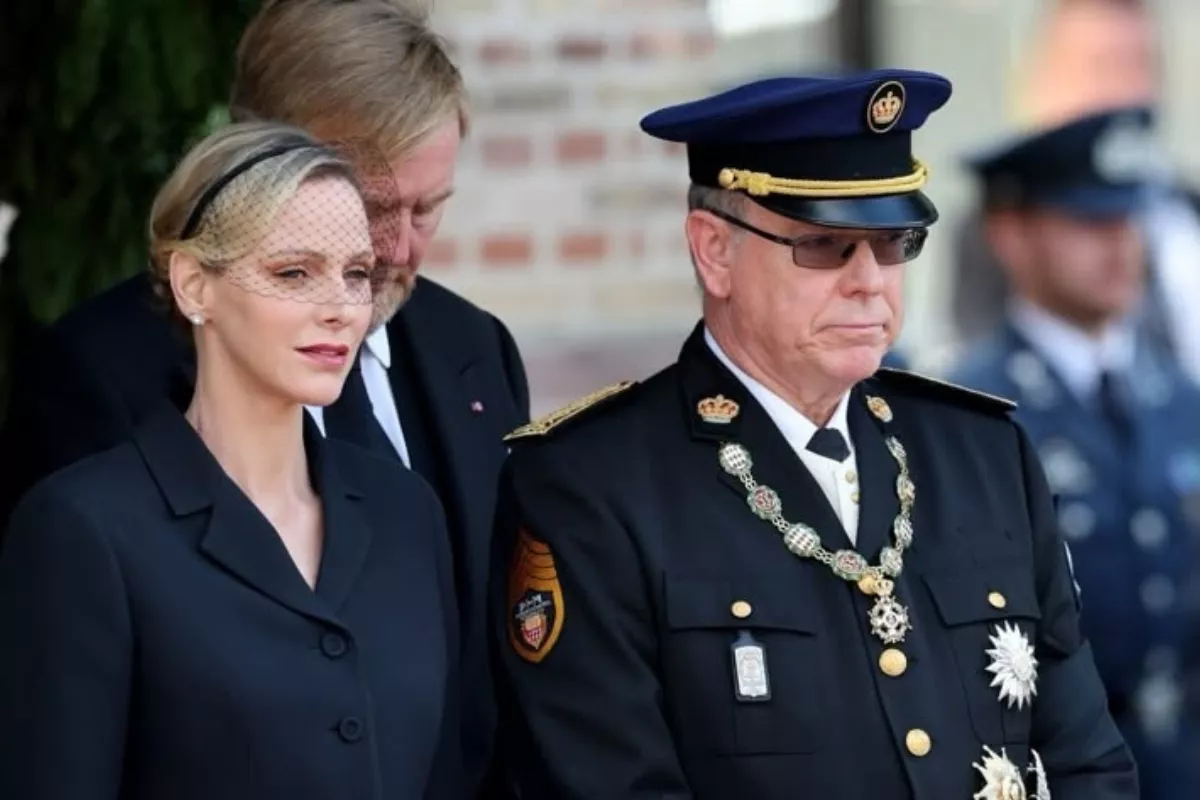
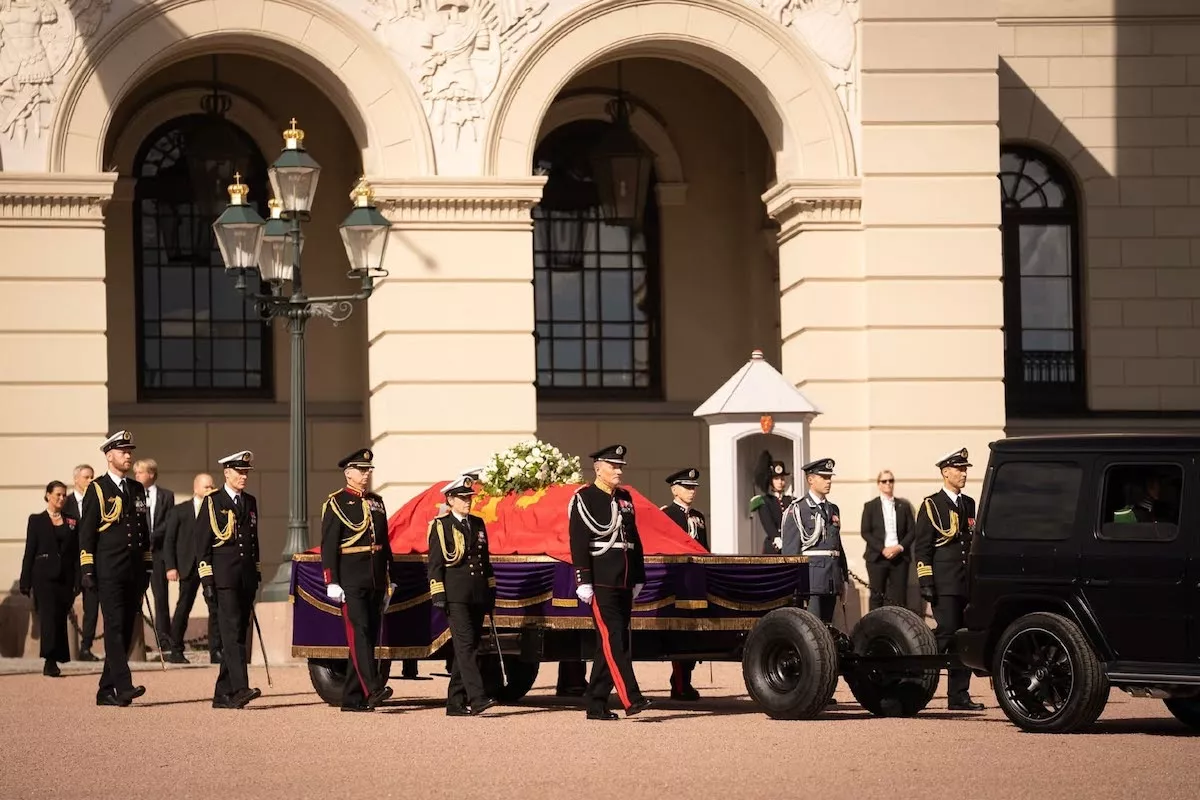
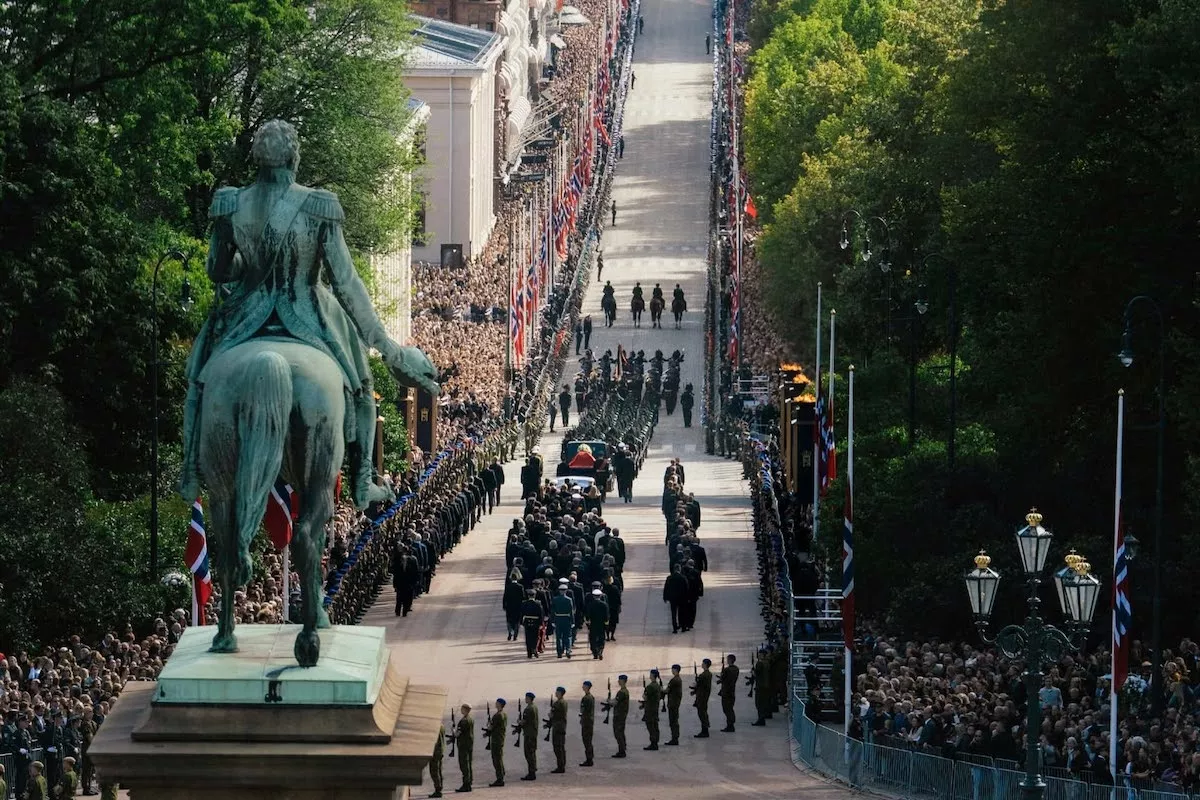
Monaco’s Princely Family bids final farewell to King Harald V of Norway
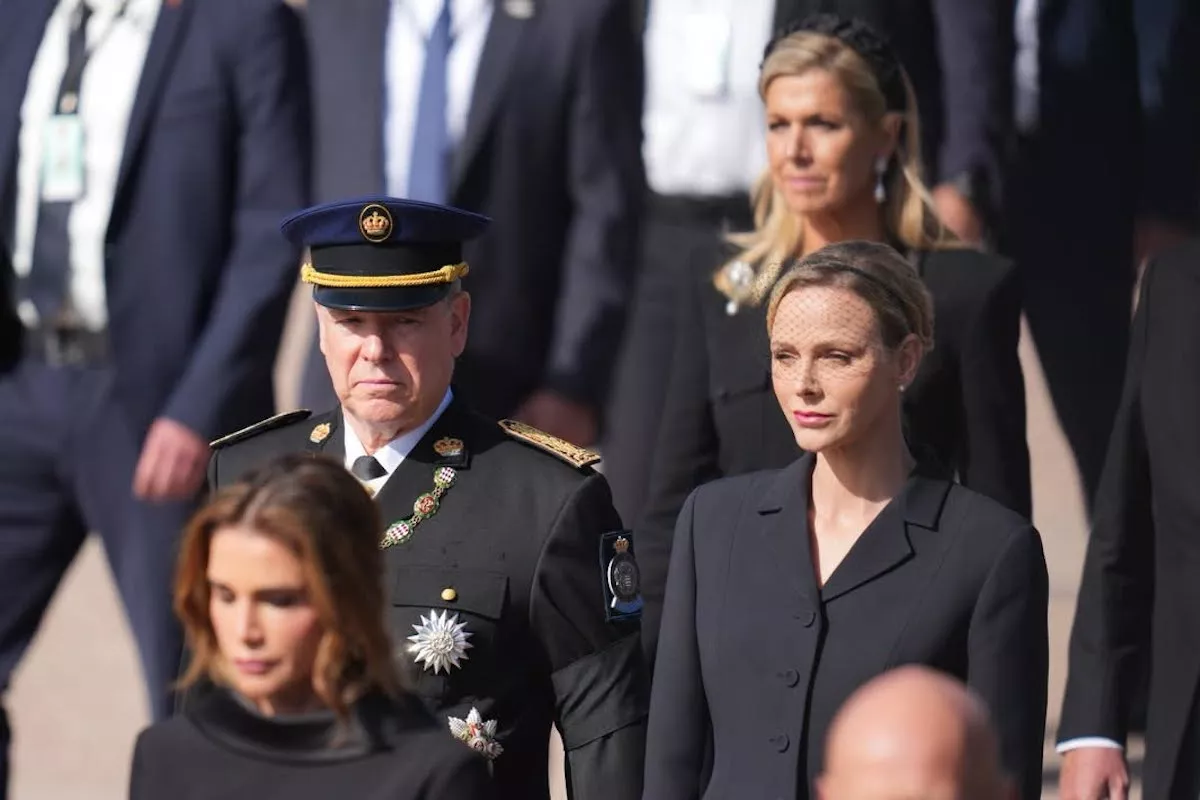
Prince Albert II and Princess Charlene joined European sovereigns and international dignitaries in Oslo on Wednesday 9th September to pay their final respects at the state funeral of King Harald V of Norway.
The prince and princess of Monaco attended the high-security service alongside representatives of global royal houses to honour the late monarch, who shaped modern Norwegian history across his decades-long reign.
Photo Credit: Det kongelige hoff – Getty Images – Chris Jackson – Peter Summers – Published by Palais Princier
Photo Credit: Det kongelige hoff – Getty Images – Chris Jackson – Peter Summers – Published by Palais Princier
Following the ceremony, the Princely Family issued a formal statement expressing their profound sympathy to King Haakon VIII, the Norwegian Royal Family, and the people of Norway.
Photo Credit: Det kongelige hoff – Getty Images – Chris Jackson – Peter Summers
Their attendance highlighted the enduring diplomatic and personal ties between Monaco and the Norwegian royal family, complementing the official tributes issued from the Palace back home on the day of mourning.
Princess Charlene and Prince Albert II and King Harald V’s funeral in Oslo. Photo Credit: Det kongelige hoff – Getty Images – Chris Jackson – Peter Summers – Published by Palais Princier
All the headlines and highlights from Monaco, direct to you every morning