Monaco Telecom has renewed its support of an initiative with the Prince’s Foundation and Terrae to establish organic vegetable gardens in the Principality’s schools.
For the third year, Monaco Telecom is co-funding the project, this year donating €12,118, a direct result of savings the company incurred over the last year by eliminating paper invoices to customers and going digital.
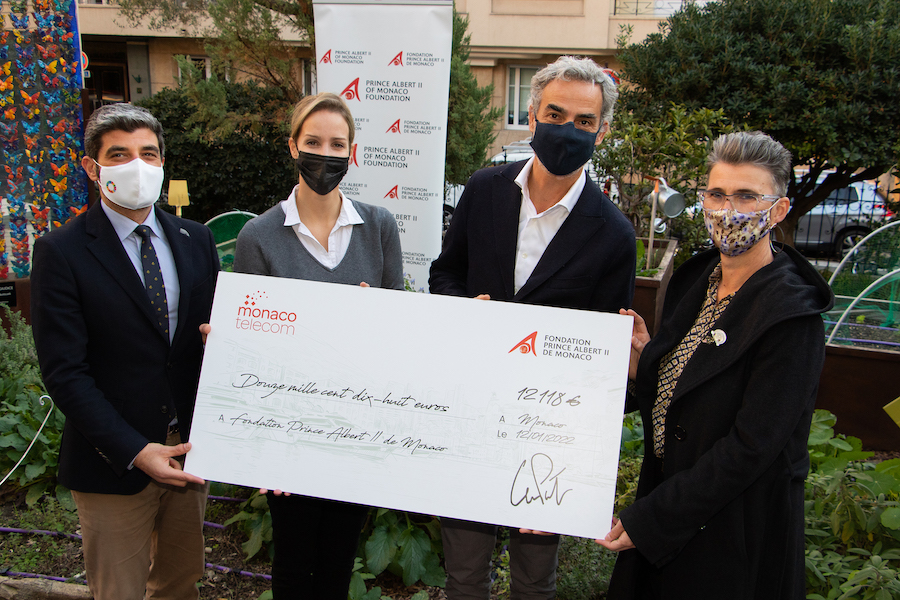
Martin Peronnet, Managing Director of Monaco Telecom, handed over the cheque to the Foundation’s Vice-President and Managing Director Olivier Wenden, as well as Cécile Mouly, Head of Educational and Extracurricular Projects at the Department of National Education, Youth and Sports (DENJS) and Jessica Sbaraglia, Founder of Terrae.
“For the third year, we are continuing our support for the Prince Albert II of Monaco Foundation by donating all the sums collected for printing paper invoices. I am delighted that this year our commitment is materialised by a project anchored in Monaco and dedicated to educational action aimed at the youngest,” said Peronnet in his speech.
Monaco Telecom has long been interested in getting involved in establishing organic vegetable gardens at Monaco schools. The programme, which was started by Terrae, provides many educational activities related to the environment and development of urban organic vegetable gardens.
“We are delighted that Monaco Telecom has chosen to support this project, which is not only about education for healthier food, but also about a desire to establish a new relationship with nature from an early age,” said Olivier Wenden. “We thank them for getting involved with us to promote sustainable development through concrete actions.”
This year’s donation will directly affect the École des Révoires, which will benefit from a new garden “very soon”. The garden will be installed on the roof of the school and will be one of the largest, as it will be divided into large terraces.
Thettransversal pedagogy method will be employed so older students who learnt from the Terrae team will in turn pass on their knowledge to the younger pupils.
Jessica Sbaraglia sees this intergenerational step as hugely important, saying, “A vegetable garden in a school is an ecological echo. It educates children of all ages who leave with their tomato plant, which will pass into the hands of the parents, then will be planted in the grandparents’ garden, but which, in the end, will be eaten by the children.”
As for the children, they will have the opportunity to really get their hands dirty, interact with nature and discover where it is that the food in the supermarket actually comes from. An education on healthy, balanced eating and food choices will also be part of the programme.
The project, which began in Autumn 2020, has already set up vegetable patches in six local establishments, including the Prince Albert II Leisure Centre, l’école du Parc, l’école de Fontvieille, le Lycée Technique et Hôtelier de Monaco and l’école de la Condamine. More than 2,000 students per year are already gardening and harvesting their own produce.
Photo: Vice-President and Managing Director of the Prince Albert II of Monaco Foundation Olivier Wenden, Founder of Terrae Jessica Sbaraglia, Managing Director of Monaco Telecom Martin Peronnet, and Cécile Mouly, Head of DENJS educational and extracurricular projects, by L. Arneodo / Prince Albert Foundation.
The Seaglider – is this the future of coastal transport?
Imagine cruising the coastline between Monaco and Saint Tropez in this high-speed, low-altitude, zero-emission seaglider. It could happen as soon as 2025, and co-creator Billy Thalheimer tells us how.
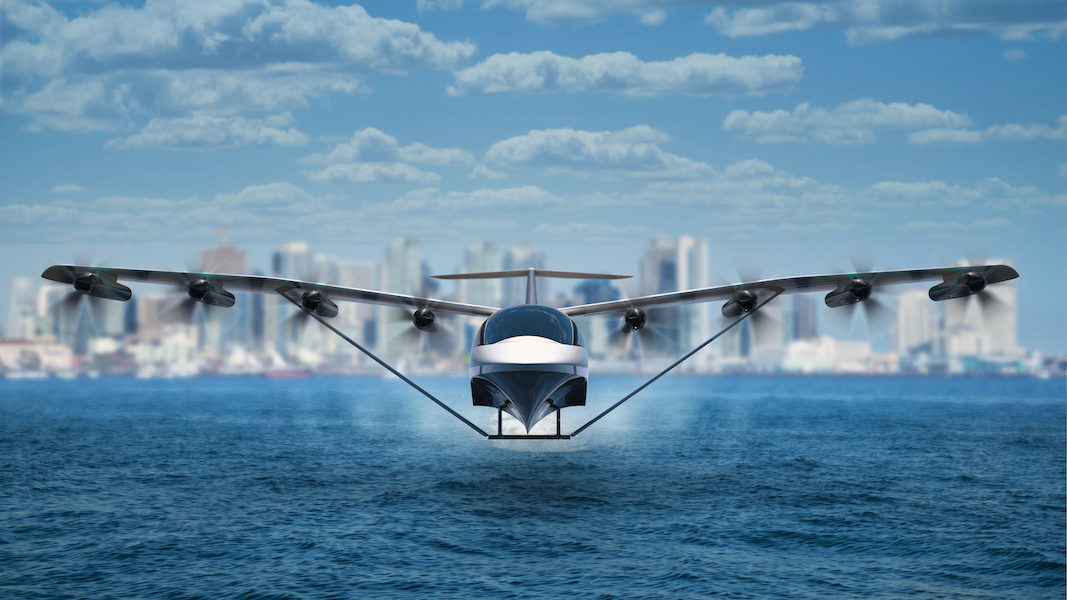
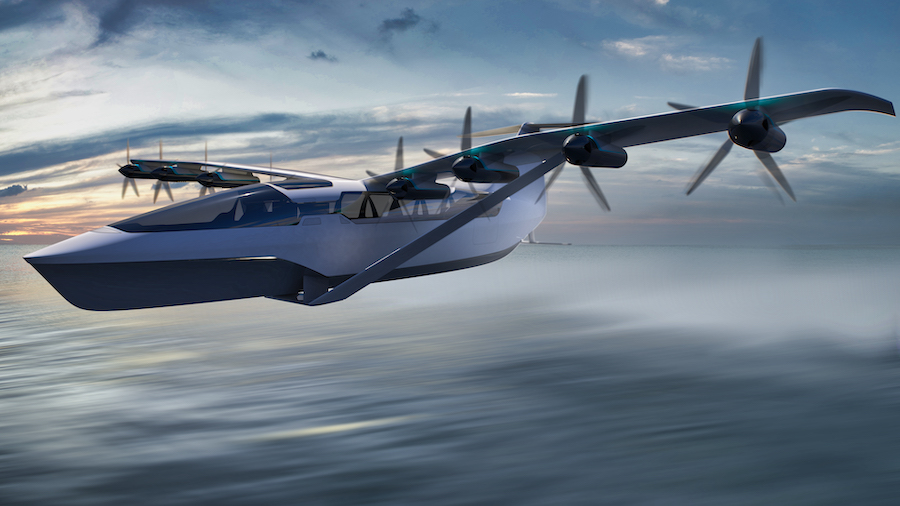
It was during the recent Transition Forum in Nice where Billy Thalheimer, Co-Founder and CEO of REGENT (Regional Electric Ground Effect Nautical Transport), presented his company’s new game changing vehicle. Created by a team of MIT-trained, ex-Boeing engineers, the seaglider is a wing-in-ground-effect (WIG) craft that operates a few metres off the water’s surface and couples the high speed of an aircraft with the low operating costs of a boat.
“All of the heliports in Monaco today are near the water with a harbour right next to them, so you can imagine us fitting in perfectly to that eco-system, eventually supplementing these helicopter fleets with a quiet, completely sustainable, much lower cost of transportation for Monaco,” Billy Thalheimer tells Monaco Life.
It has long been recognised that flight close to the water’s surface is more aerodynamically efficient than flight in the free stream. The first WIG aircraft were developed in the 1960s, mainly for military applications, and since then, Germany, Russia and the United States have carried much of the WIG momentum.
But none have succeeded in taking these vehicles to the mainstream transportation market.
“WIGs have not been adopted historically because of poor wave tolerance, poor harbour operability, and poor safety records,” explains Thalheimer. “However, we now have all of this new technology that has been developed for electric aviation and electric automotive – with electric propulsion and digital flight control systems on eVTOLs (electric vertical takeoff and landing aircraft) and sensors on self-driving cars, we can solve all three of those problems and for the first time unlock the WIG as a commercially viable form of transportation.”
Seagliders are a new type of WIG vehicle that use hydrofoils and distributed propulsion systems. With existing electric batteries, the seaglider can travel at speeds of 300 kilometres per hour, with a range of between 300 and 370 kilometres. That would easily get you from Monaco to Saint Tropez, or at maximum from Nice to Corsica, fast. There is also potential to triple that distance.
“With some of the battery prototypes we are seeing today, we have the possibility to extend that range to around 800 kilometres,” says Thalheimer enthusiastically.
The Seaglider is projected to operate under Coast Guard jurisdiction
That puts a trip from Monaco to Majorca on the cards, travelling at aircraft speeds but with ferry prices. “Our approach is to initially take advantage of this shorter 300km range market because we can connect many routes with existing batteries, then expand that to the 800km range as the batteries come to market over the course of the decade. We are talking about servicing over 30 million people in the Mediterranean alone.”
Brittany Ferries, which operates a fleet of ferries and cruiseferries between France and the United Kingdom, Ireland, and Spain, was first to place provisional orders with Regent for its cross-Channel routes. There’s also been substantial interest from airlines in the United States, notably in the northeast corridor and in the south-east of the country. Nice has also shown strong interest.
“We are starting with a 12-seat vehicle that we expect to get to market by 2025, and moving on to a 50-seater. Some airlines and ferry lines are asking for a 100 to 150 seat class vehicle, which we can bring to market by around 2028, so that will start to replace fast ferries on routes because we will have the capacity to take 100 or more people dock to dock with aircraft-like speeds.”
Thalheimer says his company has so far secured a sales book of over 4.6 billion US dollars from airlines and ferry companies for the first seaglider deliveries. They’ve officially selected their classification society from the International Association of Classification Societies – Bureau Veritas – and are scouting the world for potential uptake locations.
“There are four primary stakeholders that we need to enter a new region: an operator, which is typically an airline or ferry company, the local government for permits, community for acceptance and other local issues, and an energy company who will help us develop the charging infrastructure,” explains Thalheimer.
But with many ports already moving towards electrification, Thalheimer says existing infrastructure is often enough to power a 12-seat vehicle, which requires about half a megawatt to fully charge in an hour.
Billy Thalheimer, Co-Founder and CEO of REGENT, with CTO Mike Klinker
But why WIGs?
Billy Thalheimer never pictured himself developing a fleet of this kind of craft. He actually had aspirations to become an astronaut or fighter pilot. The self-proclaimed “aviation nerd” worked with engineering teams at aerospace companies Blue Origin and Virgin Galactic, then moved into electric aircrafts and helped develop an electric passenger vehicle for Boeing.
“But while the promise of what electric aviation can offer is fantastic – the elimination of emissions, reduced fuel and maintenance costs, and reduced noise – there were two main problems that were preventing us from bringing it to market,” explains Thalheimer. “First, there’s the length and cost of an aviation certification programme. A new aircraft takes about a decade and a billion dollars to certify.
“The other is the limited range of existing battery technology and the need for reserve fuel, which is half an hour’s worth by day, and 45 minutes by night. With only an hour’s worth of electrons in our existing batteries, it is crippling for our business case to say that half of our electrons are relegated to this reserve mission that we actually never expect to use.”
So, Thalheimer dusted off the concept of the WIG vehicle and saw that it solves these two biggest challenges in bringing an aircraft to market.
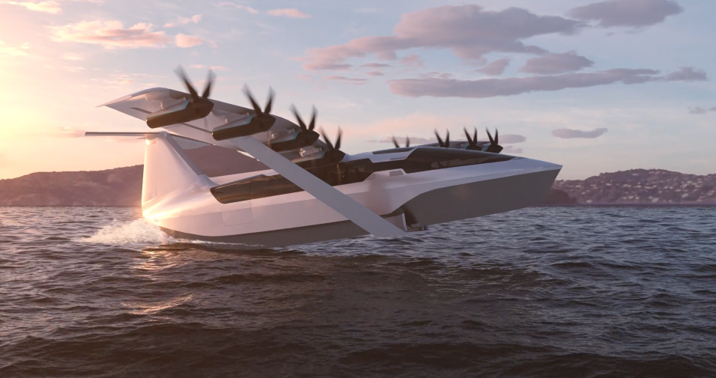
“We are a type A wing in ground vehicle, meaning that we stay within about a wing span of the water, flying at altitudes of between two to 10 metres above the water’s surface. That is what gives us that aerodynamic efficiency but also what allows us to be classified as a maritime vessel as opposed to an aircraft,” he explains. “And because they’re flying on this cushion of air and can always land on the water, they don’t have the same reserve fuel requirements. So, we actually get double the range than an electric aircraft.”
Seagliders are a new type of wing-in-ground-effect (WIG) vehicle that use hydrofoils and distributed propulsion systems
To overcome the problems of poor wave tolerance and poor harbour operability, Thalheimer says: “We will actually step up onto our hydrofoils at very low speeds of between 20 and 40 knots, similar to what you see on America’s Cup boats, which will provide about a two-metre wave tolerance in harbour and make the craft highly manoeuvrable at intermediate speeds. We are a boat where it makes sense to be a boat. Then, once we get to the periphery of the harbour and there is no traffic, we will take off onto our wing and accelerate to 300 kilometres an hour.”
In terms of safety, the Seaglider will have a captain and a digital flight control system that will sense and control its behaviour, as well as tracking radar systems and altitude sensors to detect things like terrain, wave heights, marine animals and other boats.
“Much of this is actually proven technology,” says Thalheimer. “Meanwhile, we are flying radar systems on helicopters at speeds in excess of 200kms an hour, 15 metres over the water, to show not only how we can detect these vehicles, but also how much time we have to avoid them. The water is less crowded than the air.”
With regards to timing, the company is on track for the first flight of its 1⁄4 scale prototype by Q1 2022. The Seaglider is then expected to be delivered for pilot programmes by 2023-24, “to prepare for commercial entry into service by 2025.”
Monaco could very well be part of that pilot programme. Prince Albert has committed that his country will play its part in efforts to stabilise the global warming of the planet by reducing its greenhouse gas emissions by 50% in 2030, and 80% by 2050, by which time the Principality will be carbon neutral.
Zero-emission urban mobility is essential in achieving that goal.
Photos source: Regent. This article was originally published on 15th January 2022.
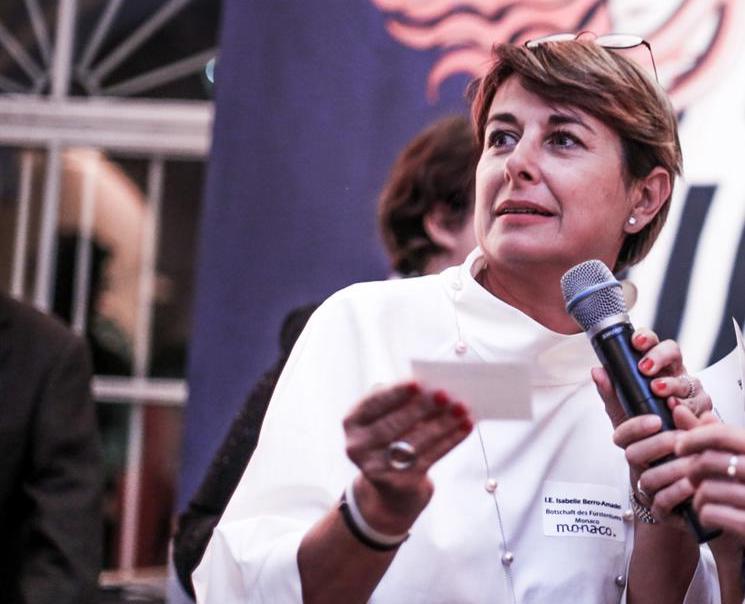
Isabelle Berro-Amadeï is new Minister for Foreign Affairs
Ambassador for Belgium Isabelle Berro-Amadeï has been selected to replace Laurent Anselmi as Minister for Foreign Affairs and Cooperation, as Anselmi takes over as Prince Albert II’s Cabinet Head.
When Laurent Anselmi was named as the Prince’s new Chief of Staff in December, it left a hole that would need to be filled quickly.
Now, just weeks later, the position of Minister for Foreign Affairs and Cooperation has officially been granted to the Ambassador Extraordinary and Plenipotentiary to His Majesty the King of the Belgians, Isabelle Berro-Amadeï, who will take over on 17th January.
Before coming into this post, 56-year-old Berro-Amadeï was an eminent legal figure, serving as judge and then Section President to the European Court of Human Rights. From 2016, she slid into the diplomatic realm where she served as the Principality’s Ambassador to Germany, Austria, Poland, as well as to international organisations in Vienna.
“The legal and diplomatic qualities demonstrated by Madame Isabelle Berro-Amadeï lead HSH the Prince to maintain her responsibility for the continuation of discussions with the European authorities on a draft Association Agreement alongside Sophie Thevenoux and Gilles Tonelli,” said the Prince’s government in a press statement.
Berro-Amadei’s replacement as Ambassador of Monaco to Belgium is expected to be announced soon.
AS Monaco Basketball narrowly beat Bayern Munich 78-83 in an empty Audi Dome on Thursday. A 26-point haul from an on-form Mike James proved the difference.
The hall echoed with the sounds of squeaking trainers and bouncing basketballs, Germany’s latest Covid restrictions preventing anyone attending what was a tight contest in Bavaria. The important win puts them level on wins with the German side in the Euroleague, whilst it reignites hopes that they could yet clinch the all-important eight place that would see them qualify for next year’s competition.
James started imperiously and didn’t relent. His eight points in the opening 10 minutes, combined with some good work from Donatas Motiejunas, gave AS Monaco a slender first-quarter lead.
The game remained close in the second quarter, both teams matching each other blow for blow. James’ spectacular, on-the-buzzer three-pointer on the stroke of half-time sent Monaco into the dressing room with a healthy, but far from comfortable, five point lead.
Bayern quickly set about reducing the meagre deficit and five unreplied points from Deshaun Thomas restored parity soon after the break. There was no stopping James, however; the American point guard continued to impress registering points and assists almost at will.
Having narrowly edged each quarter, Monaco went into the fourth with an eight-point lead. Bayern applied the pressure early-on and incrementally reduced the gap between the sides. But that pressure dissipated when James registered yet another three-pointer to extend their lead back to over seven with just over a minute on the clock.
The lack of fans meant the game ended in muted fashion, but there is no underestimating the importance of the win. Roca team coach Sasa Obradovic said after the match, “This victory means a lot for us, for our confidence and for having faith in our game. We have really improved defensively, but there is still a margin for progression.”
The progress being shown can be attributed in part to the extended break that Monaco have recently had. The side’s two previous Euroleague matches have been postponed due to Covid cases, leaving Obradovic extra time to drill his players.
The Serbian manager will be hoping to build on their progress when they visit Nanterre in the Betclic Elite on Saturday.
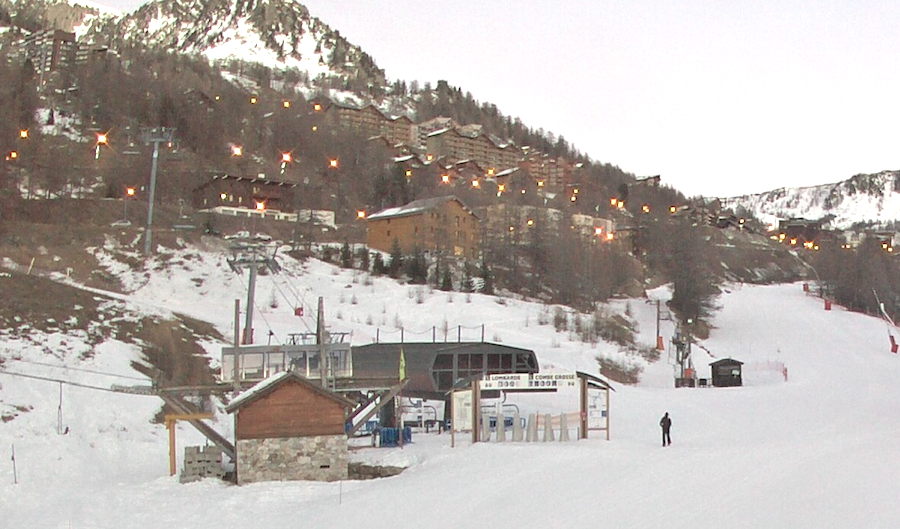
Conditions continue to be mild at the region’s ski resorts, with sunny skies throughout the weekend, no snowfall, and temperatures up to a balmy 12°C.
Isola 2000 – There are 20 ski slopes and 14 ski lifts open at Isola, coupled with 70 to 55cm of snow, however no snow is expected over the weekend. It is forecast to be entirely sunny with highs of 9°C and lows of -4°C. The col de la Bonette and la Lombarde roads are closed until the end of the winter season.
Auron – There are currently 21 ski slopes and 13 ski lifts open at the resort, with around 30cm of standing snow. Sunny skies are forecast for the weekend and highs of 8°C, lows of -1°C. There will also be winds of up to 26 km/h on Friday. In terms of access, Route de la Tinée, Route de la Bonette, Piste de la Moustière, Piste de Demandols all remain closed.
Les Deux Alpes – This resort is boasting 76 ski slopes and 38 ski lifts open. There is already 50cm of standing snow and clear skies are expected this weekend. There will be lows of -6°C and highs of 6°C.
La Colmiane – There are currently 10 ski slopes and 5 ski lifts open at the resort with between 40 and 30 cm of standing snow. As it is throughout the region, it is expected to be sunny over the weekend with winds of up to 40 km/h on Friday. There will be highs of 8°C and lows of -1°C. The resort hasn’t reported any road closures.
Greolieres les Neiges – As usual, this small resort has the least amount of snow in the region, with 20cm and no further snow forecast over the weekend. It will be sunny though throughout the weekend though with a balmy top of 12°C. The resort isn’t reporting any road closures. There are currently five ski lifts open.
Limone Piemonte – There are currently 11 runs open at the resort and 10 ski lifts. There is a minimum of 10cm of snow throughout the resort and a maximum of 45cm in places. Visibility should be good throughout the weekend. It is expected to be sunny with lows of -1°C and highs of 11°C. Passage through the Roya valley currently isn’t possible due to the collapsed bridge at Tende. Drivers must instead pass through Ventimiglia and the journey from Monaco is currently approximately 3 hours.
Valberg – There are 18 ski slopes and 11 ski lifts open. The resort currently has 40cm of standing snow, and it has not snowed since 25th December. It is expected to be sunny all weekend with highs of 10°C and lows of 2°C.
Note: Snow tyres must be worn on the roads up to the ski resorts.
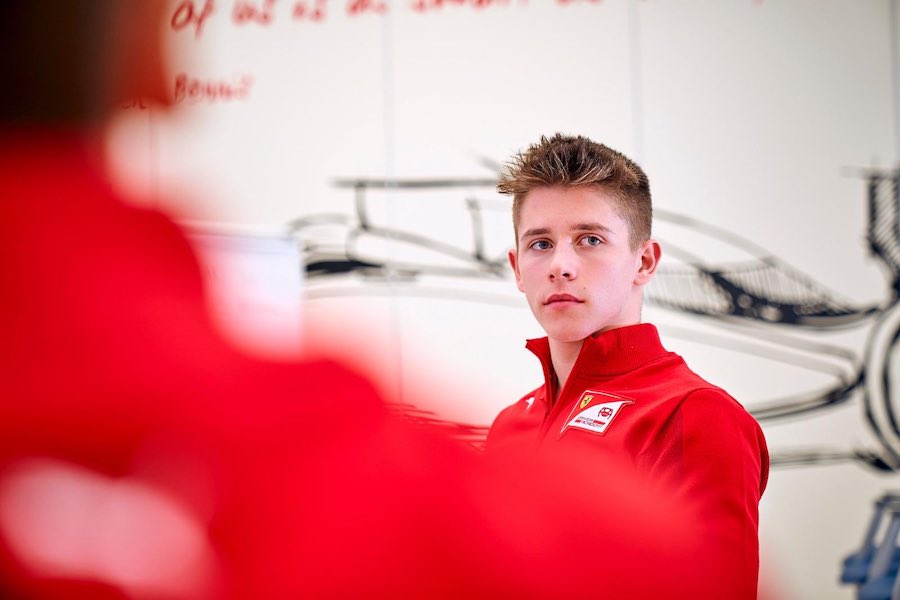
Monégasque driver Arthur Leclerc has signed on for a second year at F3 team Prema, whilst continuing in the Ferrari Drivers’ Academy in 2022.
Leclerc finished 10th in the drivers’ standings in his debut season in F3, registering two victories in the process as well as a pole position and second place in the Hungarian Grand Prix.
Last year’s team-mate Dennis Hauger ended the season as F3 champion and has subsequently found himself a seat in F2 for next season.
The goal this year for Leclerc will be to reach the heights of his former team-mate, and he says he is excited for the start of the season.
“I am extremely happy to continue the work we started with Prema racing,” said the 21-year-old in a press statement. “I think we did a good job last year, and 2022 will be a good opportunity to put together everything we have learned so far. I cannot wait for the start of the season.”
Prema team principal Rene Rosin expressed his delight at retaining Leclerc’s services, adding, “I am sure that he will carry on the progress we saw in 2021 when he showed he had the potential to be a front runner.”
Arthur will be hoping that a positive season will help him progress along the same trajectory as his brother Charles, the current Ferrari F1 driver.
The season gets under way at the same time and place as the F1 season, on 18th March in Bahrain.
Photo source: Ferrari Scuderia Media Centre
All the headlines and highlights from Monaco, direct to you every morning