

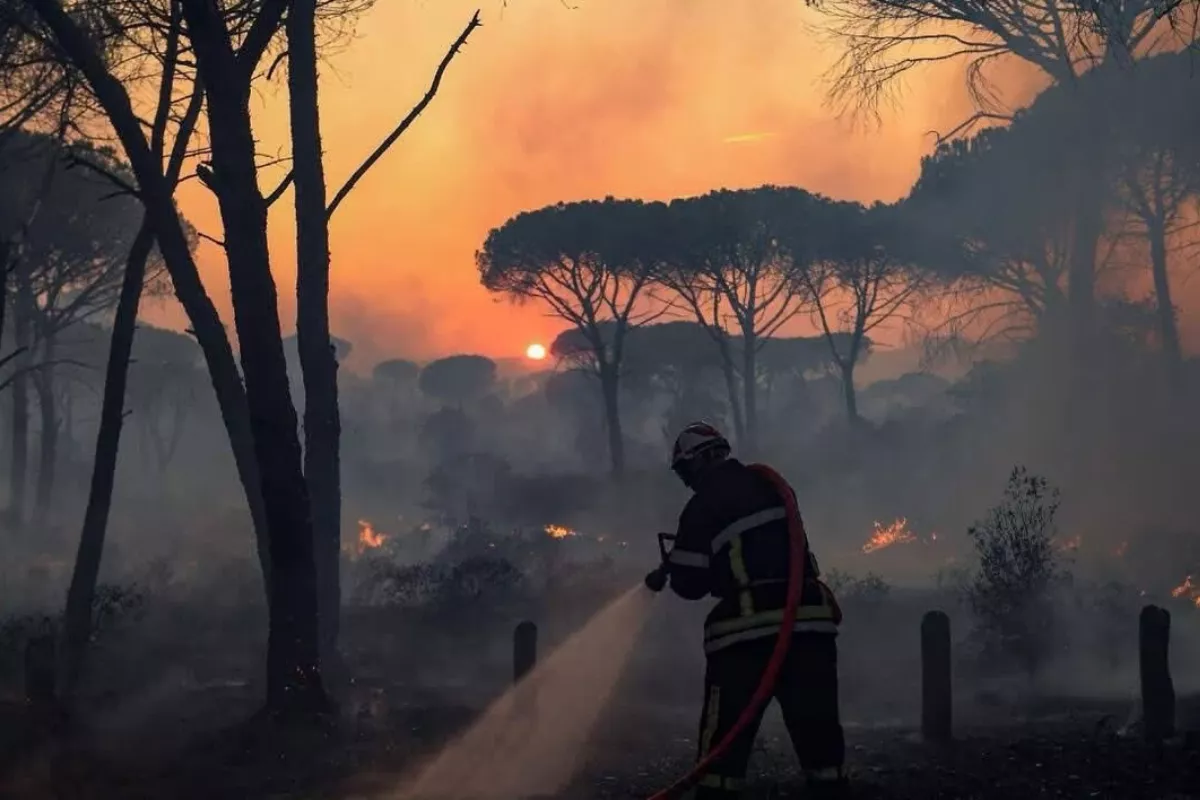
Wildfires reignited overnight in the Var, with flames threatening homes at Correns and evacuation orders still in force across three communes, as Provence-Alpes-Côte d’Azur remains under extreme fire risk and a far larger disaster unfolds in the south-west of France, where two firefighters have been killed and more than 141,000 people forced from their homes.
The fire that began at Pontevès on Tuesday 21st July flared again during the night at Correns, on two separate fronts, one of them threatening houses to the north-west of the village. A fresh flare-up was also recorded at Pontevès itself. Since Tuesday, around 3,250 hectares have burned in the department. Ground crews worked through the night and four water-bombing helicopters were making drops on Saturday morning.
Evacuations still in place across the Var
Evacuation orders remained in force on Saturday for the communes of Correns, Châteauvert and the southern districts of Barjols. Residents of Pontevès and neighbouring communes have been temporarily banned from drinking tap water because of contamination risks, with bottled water being distributed instead. An investigation into the cause of the original fire is under way, with investigators examining whether it was started deliberately.
Some residents had been allowed to return earlier in the week after conditions briefly improved, only for strong Mistral winds to drive the flames forward again. Rain is forecast over the affected area later on Saturday, which the prefecture hopes will help crews on the ground.
Massifs closed, and a warning for the Alpes-Maritimes
Météo-France placed five departments — the Aude, Bouches-du-Rhône, Gard, Var and Vaucluse — on red alert for extreme fire risk this week, following weeks of drought, record heat and strong winds. In the Var, five major forest massifs — the Monts Toulonnais, the Corniche Varoise, the Maures, the Estérel and the Centre-Var — were closed to the public at the highest ‘very severe’ risk level.
The alert stretched into the Alpes-Maritimes, where much of the coastal fringe and the hinterland behind the Riviera was classed at the ‘severe’ level, with access to the massifs strongly discouraged. For Monaco and the wider Côte d’Azur, the immediate risk this weekend is less the flames themselves than the tinder-dry conditions and the possibility of dry thunderstorms sparking new blazes.
An ‘unprecedented’ fire nears Bordeaux
The gravest situation is unfolding some 700 kilometres to the west. Authorities began evacuating suburbs of Bordeaux on Saturday — Le Haillan, Eysines and Mérignac — as an enormous wildfire advanced on the city. Prime Minister Sébastien Lecornu said the fires had reached a level never seen before, and President Emmanuel Macron ordered the military to mobilise.
The blaze, which broke out near Saumos in the Gironde on 22nd July, has burned through as much as 19,000 hectares of pine forest and forced tens of thousands from their homes across the Arcachon basin. The Nouvelle-Aquitaine prefecture described it as worse than the fires of 2022, warning that it moves unpredictably and can leap distances of up to a kilometre. On the Cap-Ferret peninsula, one of the region’s best-known holiday spots, a full evacuation was ordered by land and sea, with around 1,500 people leaving by boat.
Two firefighters were killed on Tuesday while tackling a blaze near Bordeaux-Mérignac airport. Macron has requested emergency assistance from the European Union, drawing in firefighting aircraft from Croatia, the Czech Republic, Slovakia and other partners.
Four times the normal destruction
More than 42,800 hectares have burned across France since January, according to the European Forest Fire Information System, more than four times the average for this point in the year and surpassing the record set in 2022. Forecasters warn that more than 60,000 hectares could be lost if the current conditions persist through the summer.
The crisis extends across the border into Spain, where the government has declared a national emergency in the Madrid region and the province of Ávila, with around 60,000 people evacuated. The president of the Community of Madrid described the fire threatening the region as the worst in its history.
A brief respite is expected over the weekend, with storms forecast to lower temperatures and bring rain to parts of the south, easing the red alerts. Forecasters caution, however, that a fresh heatwave next week is likely to bring high fire risks back to the region.
Stay updated with Monaco Life: sign up for our free newsletter, listen to our podcasts on Spotify, and follow us across Facebook, Instagram, LinkedIn, and Tik Tok.
Photo credit: Philippe Charpentier