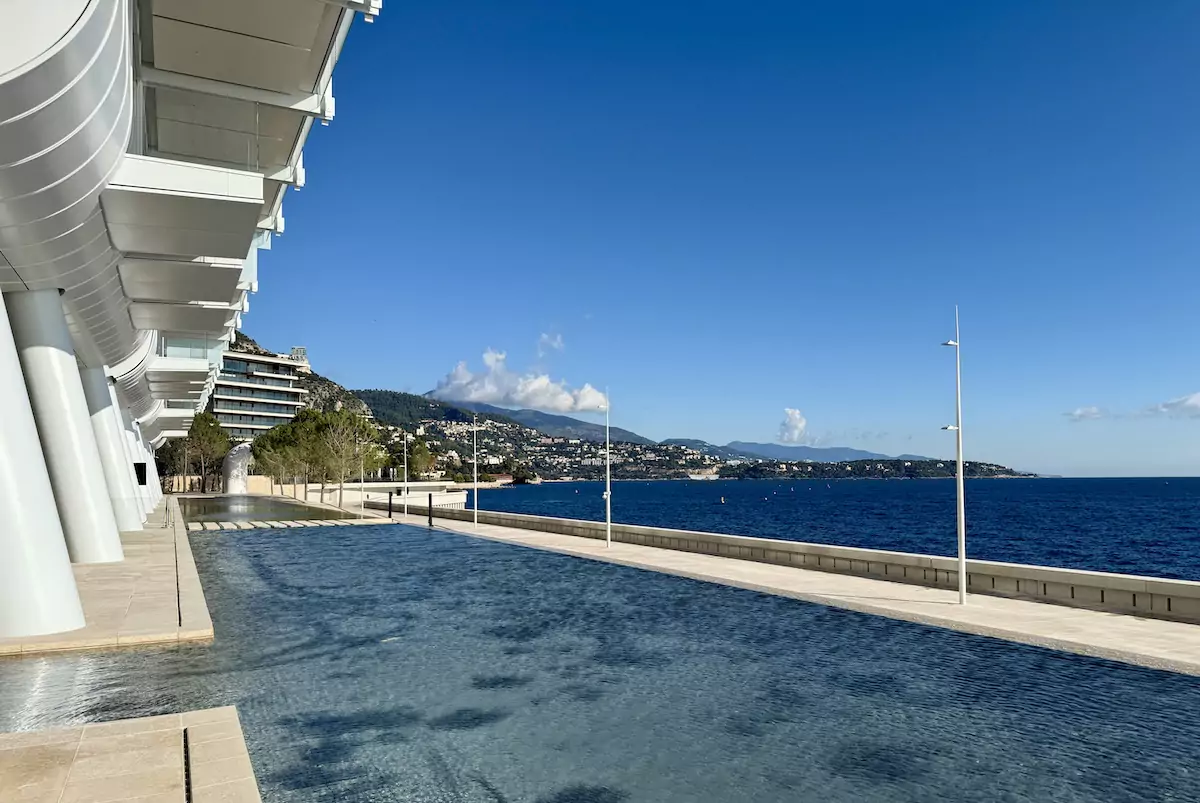
#BougeMonaco: Seven days of sport and solidarity for World Alzheimer’s Day

The Monegasque Association for Research on Alzheimer’s Disease (AMPA) will bring sport and solidarity together for a weeklong campaign from 15th September to 21st September in support of World Alzheimer’s Day as part of #BougeMonaco. The initiative will be held under the High Patronage of Prince Albert II.

World Alzheimer’s Day is observed annually on 21st September to raise awareness and reduce the stigma surrounding Alzheimer’s disease and other forms of dementia.

At the heart of the campaign are seven days of sport and solidarity, offering seven different ways to exercise the brain. Each day will feature a different form of physical activity designed to highlight the connection between movement, brain health, and Alzheimer’s awareness. Research has shown that staying physically and socially active may help reduce the risk of cognitive decline.

The week will begin on Tuesday with cardio and strength training at Port Hercule. The following day will focus on cognition and reflexes through paddleboarding and sea rescue. Afro Jazz at the Yacht Club of Monaco will then bring a focus on rhythm and energy, followed by an aquagym session centred on energy and lightness.

Saturday’s meditation, Qi Gong, Zumba, and yoga will emphasise balance and harmony, while Sunday’s aquathon initiation will showcase coordination and transitions. The programme will conclude on Monday 21st September with movement and endurance during the Alzheimer’s Walk Monaco. Beginning at Place Anne-Marie Campora in Larvotto, the path will take participants between Larvotto and Mareterra before returning to the starting line. Held on World Alzheimer’s Day itself, the walk is free and open to all.

Beyond the sporting elements, the event aims to bring the Monegasque community together around the prevention of cognitive decline through social connection and physical activity. Education is also a key objective, with partnerships focused on awareness sessions in Monegasque schools.

Monaco’s own Valentin Vacherot, currently ranked world No. 23 in tennis, is the patron of this year’s campaign. With local roots and a strong presence in the Monaco community, Vacherot can bring greater visibility and awareness to the cause.

To participate in the campaign, AMPA bracelets can be purchased online from https://ampa-monaco.com/ for €15. The funds raised will benefit the Rainier III Centre, an essential partner in the campaign whose teams are also involved in its awareness and prevention initiatives. Participants can then reserve places for their chosen activities before collecting their bracelets and taking part. Wearing the bracelet is mandatory for participation.

Stay updated with Monaco Life: sign up for our free newsletter, listen to our podcasts on Spotify, and follow us across Facebook,  Instagram, LinkedIn, and Tik Tok. 

Photo credit: Cassandra Tanti / Monaco Life
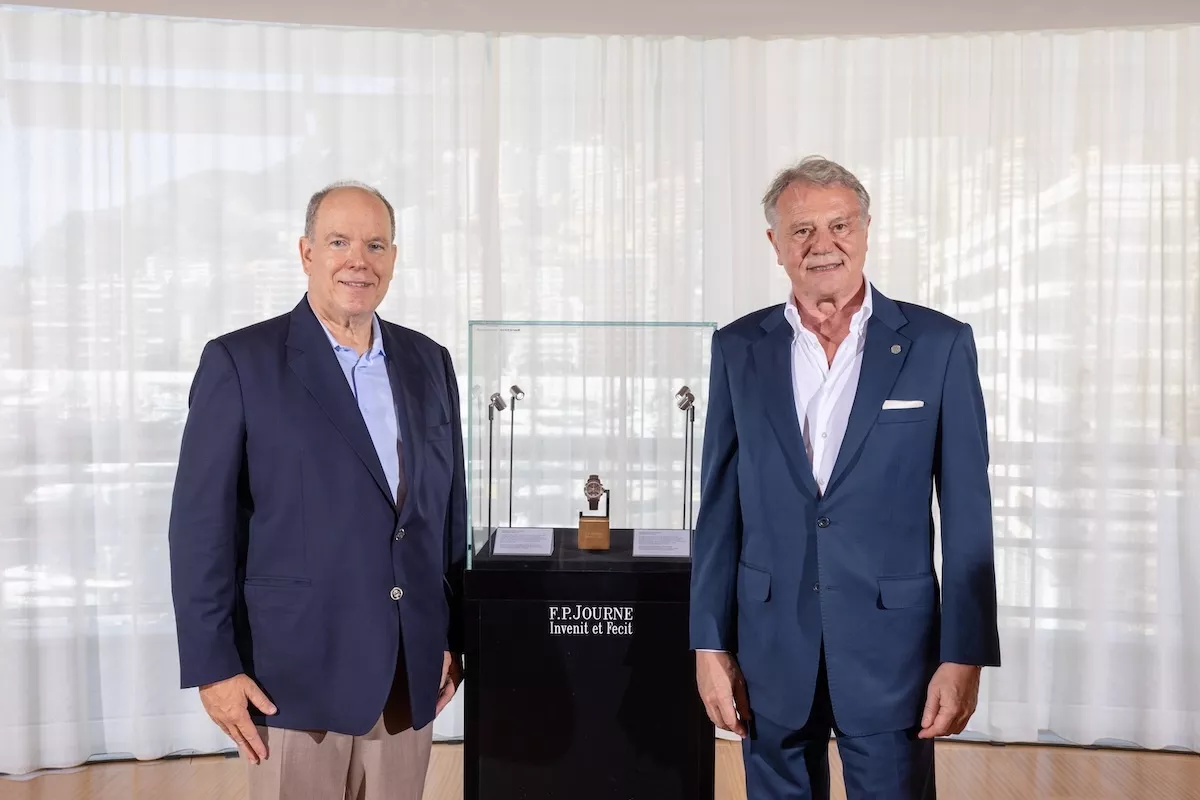
Unique F.P.Journe watch to be auctioned for Prince Albert II Foundation

A unique F.P.Journe chronograph will be auctioned in Singapore this November to raise funds for the Prince Albert II of Monaco Foundation, after being unveiled at the Monaco Yacht Club on Monday by the watchmaker François-Paul Journe in the presence of Prince Albert II.

The one-off timepiece — a classic chronograph from the Geneva-based manufacture, created specially in support of the Foundation’s environmental work — will go under the hammer at the Foundation’s ‘Voyage Extraordinaire’ gala dinner on 25th November. F.P.Journe said it had wanted to place haute horlogerie at the service of philanthropy, in support of the Foundation’s efforts to protect the environment.

A gala in Singapore

The auction forms part of the outreach led by the Foundation’s Singapore branch, chaired by Jacky Deromedi, which works to rally supporters and partners across the region. Established by Prince Albert II in 2006, the Foundation supports projects worldwide focused on endangered species, freshwater ecosystems, the sustainable blue economy and younger generations.

A watch made for the cause

The Foundation welcomed the gesture, describing the watch as a meeting of craftsmanship and a shared commitment to the planet. “We would like to express our most sincere gratitude to François-Paul Journe and his Manufacture for this exceptional creation, designed in support of the Foundation,” said Romain Ciarlet, Vice-Chairman and CEO of the Prince Albert II of Monaco Foundation. “This support highlights the importance attached to our commitments and will help strengthen the work we carry out, alongside our partners, to protect the environment.”

Monaco Life is written by qualified journalists, writing original content. Sign up for our free newsletter, listen to our podcasts on Spotify, and follow us across Facebook,  Instagram, LinkedIn, and Tik Tok. 

Photo source: Prince Albert II of Monaco Foundation

Fairmont Monte Carlo to host charity pilates on the rooftop for Make-A-Wish 

To mark Childhood Cancer Awareness Month this September, the Fairmont Monte Carlo is joining the international ‘Move for Wishes’ campaign by hosting a charity pilates class on its rooftop pool deck on Tuesday 22nd September.

Running from 8:15am to 9am beside the Amù pool, the 45-minute session is open to all fitness levels, with every cent of the proceeds going directly to Make-A-Wish. Participants will also enjoy a complimentary wellness break following the workout, with mats provided.

A global movement for wellness and charity 

The initiative forms part of a broader global rollout by Fairmont Hotels & Resorts, with over 90 properties worldwide participating in the campaign to raise funds while championing the brand’s ‘Wellness Without Walls’ philosophy. The effort builds on Fairmont’s ongoing global partnership with Make-A-Wish, which includes year-round options for ALL Accor loyalty members to donate reward points to the charity.

Granting life-changing wishes

Founded in 1980, Make-A-Wish is the world’s leading children’s wish-granting organisation, having fulfilled more than 650,000 wishes across nearly 50 countries. With a child diagnosed with a critical illness every 25 seconds, these experiences help restore a stolen childhood and support physical, psychological, and emotional well-being. Powered by generous donors and over 27,000 volunteers globally, the organisation helps families experience the transformative power of a wish when they need it most. 

Places for the morning workout are strictly limited, and those wishing to secure a spot can do so with a €35 donation via Eventbrite or by emailing spa.montecarlo@fairmont.com.

Stay updated with Monaco Life: sign up for our free newsletter, listen to our podcasts on Spotify, and follow us across Facebook,  Instagram, LinkedIn, and Tik Tok.

Photo Credit: Rene Strgar – Pexels

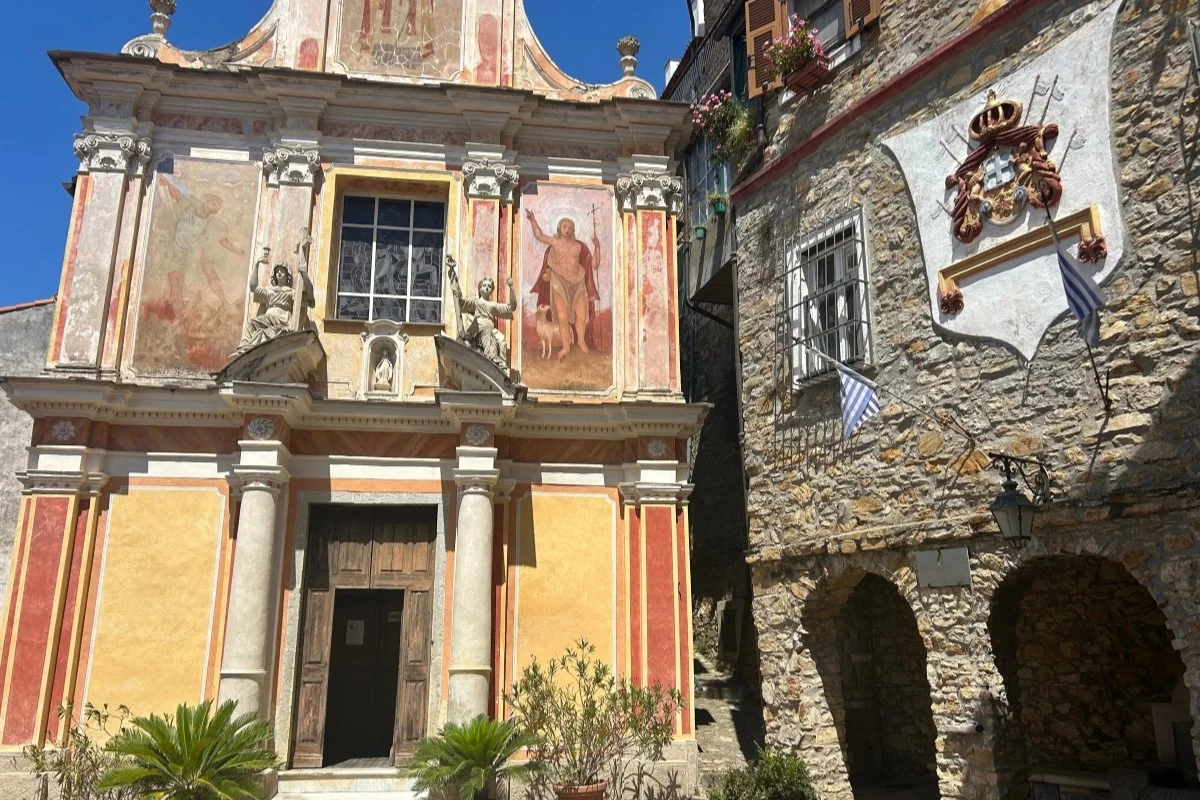
Seborga, the self-styled principality overlooking Monaco, calls November election

Seborga, the hilltop village on the Italian Riviera that has styled itself an independent principality for more than 60 years, has begun the process of choosing its next head of state, with Princess Nina calling elections for Sunday 22nd November as her seven-year mandate draws to a close.

Perched in the hills above Bordighera, a few kilometres from the French border and with views over Monaco, the village of around 300 residents will go to the polls to elect a prince — or princess — in a tradition its people trace back to the Middle Ages. The principality issued the call this week, opening an electoral process that will run until the November vote.

A principality born of an old argument

For centuries, Seborga was a fief of the Cistercian abbots of Lérins, off the coast of Cannes, who held the title of Prince of Seborga, used in particular from the 17th century. Its modern incarnation, however, dates to the 1960s, when a local mimosa grower, Giorgio Carbone, immersed himself in the village’s archives and concluded that Seborga had never been legally absorbed into the Kingdom of Sardinia, nor later into a unified Italy — and so, he argued, remained sovereign.

Carbone persuaded his neighbours, who acclaimed him prince in 1963. He minted a currency, the luigino, drew up a constitution, chose a coat of arms and an anthem, issued stamps and set up a small ceremonial guard, taking the title His Serene Highness Giorgio I. He reigned until his death in 2009. Italy has never recognised any of it: Seborgans pay Italian taxes and vote in Italian elections like any other citizens.

From Giorgio I to Princess Nina

After Carbone’s death, the businessman Marcello Menegatto was elected Prince Marcello I in 2010 and re-elected in 2017, before abdicating in 2019. He was succeeded by Nina Menegatto, who in November 2019 became the first woman elected to the role, defeating Laura Di Bisceglie, a daughter of Giorgio I, by 122 votes to 69.

German-born and a graduate of the International University of Monaco, where she took an MBA, Princess Nina had served as the principality’s councillor for foreign affairs from 2010 and has since worked to raise Seborga’s profile abroad. When Monaco Life interviewed her, she spoke of her ambition to “put Seborga on the map”, and of her determination to preserve the trappings of Carbone’s principality, from the luigino to the honour guard.

November’s vote

The election on 22nd November will decide who leads the self-proclaimed principality for the next seven years. Under Article 7 of Seborga’s Law on the Prince, an outgoing head of state who seeks another term is admitted automatically to the election. For now, however, Princess Nina’s intentions remain officially undeclared.

See also: 

Princess Nina: “I want to put Seborga on the map”

Monaco Life is written by qualified journalists, writing original content. Sign up for our free newsletter, listen to our podcasts on Spotify, and follow us across Facebook,  Instagram, LinkedIn, and Tik Tok. 

Photo by Monaco Life


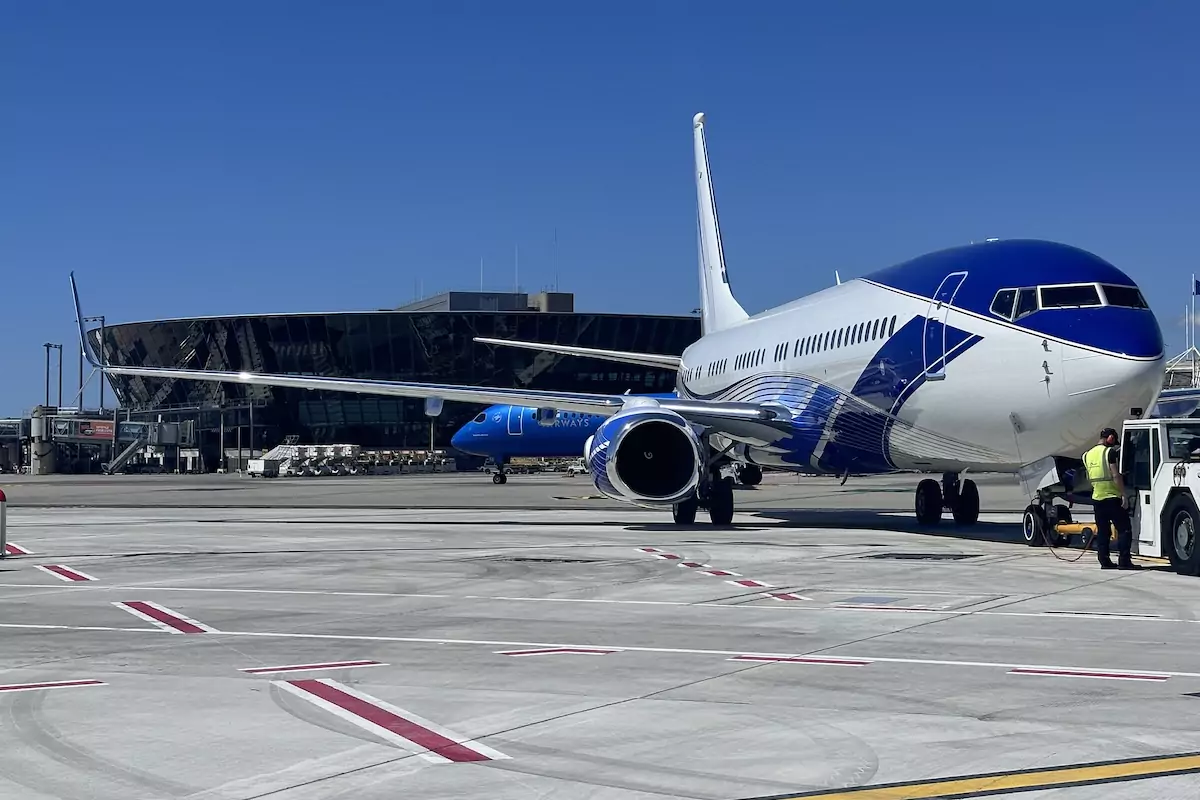
French Riviera airports prepare to fuel the first hydrogen business jets

The French Riviera is preparing to build the fuelling infrastructure for a new generation of zero-emission business jets, in one of the first concrete moves to ready an airport network for hydrogen-powered flight.

The plan comes under a partnership, announced on 3rd September, between the French aircraft developer Beyond Aero and Aéroports de la Côte d’Azur, Europe’s second-largest airport operator for business aviation, which runs Nice Côte d’Azur, Cannes-Mandelieu and Golfe de Saint-Tropez. After nearly three years working together, the two are now mapping out a phased rollout of hydrogen infrastructure timed to the first aircraft expected in the early 2030s.

Why business aviation goes first

There is a logic to starting here. Private aviation is among the most carbon-intensive ways to travel — by Beyond Aero’s reckoning it produces roughly ten times more CO2 per passenger than a commercial flight — which makes it an obvious target for cleaning up. It is also, counter-intuitively, a sensible place to begin: the volumes are small next to commercial aviation, so the fuelling infrastructure can be modest, targeted and scaled gradually, rather than the vast build-out an airline fleet would demand.

A jet that emits only water

Toulouse-based Beyond Aero, founded in 2020, is developing ‘One’, a six-to-eight-seat aircraft whose electric propulsion is driven by hydrogen fuel cells — a design that emits only water vapour in flight. The company says it has completed France’s first crewed hydrogen-electric flight and gathered more than $900 million in letters of intent for over 100 aircraft. If it meets its timeline, ‘One’ would be among the first hydrogen-electric business jets to enter service, in a category so new that European regulators are still writing the rules for it.

The infrastructure problem

The harder half of the equation is on the ground. A hydrogen aircraft is useless without somewhere to refuel, yet few will build fuelling stations before the aircraft exist — a chicken-and-egg problem that has slowed cleaner aviation for years. The Riviera partnership is an attempt to develop both in step, working through how hydrogen would be sourced, stored, distributed and pumped into aircraft, and what it would cost.

“Infrastructure preparation must keep pace with aircraft development,” said Eloa Guillotin, co-founder and CEO of Beyond Aero. “Working with Aéroports de la Côte d’Azur, we are basing our plans on concrete scenarios tailored to business aircraft volumes and utilising currently available technologies. This phased approach is essential to ensure safe, realistic operations from the moment the first aircraft enter service.”

A pragmatic first step

The preferred approach relies on compressed gaseous hydrogen, using technology already available at industrial scale. It would be produced off-site near the airports and trucked in by tube trailer to a distribution station — supply that could also feed other regional needs and help seed a local hydrogen ecosystem. Two refuelling methods are under study: a fixed point beside a dedicated parking area, and a mobile vehicle to transfer hydrogen to the aircraft, both meant to hold down early costs while capacity grows. Cannes-Mandelieu, a busy business-aviation hub, has emerged as the likeliest first site.

“Our role is to anticipate the needs of future operators while ensuring the safety, performance, and cost-efficiency of our infrastructure,” said Franck Goldnadel, Chairman of the Executive Board of Aéroports de la Côte d’Azur. “This partnership enables us to translate our environmental ambitions into concrete, phased operational solutions.”

Monaco Life is written by qualified journalists, writing original content. Sign up for our free newsletter, listen to our podcasts on Spotify, and follow us across Facebook,  Instagram, LinkedIn, and Tik Tok. 

Photo credit: Cassandra Tanti

Venturi Space unveils astronaut-driven Alta Luna for future Moon bases

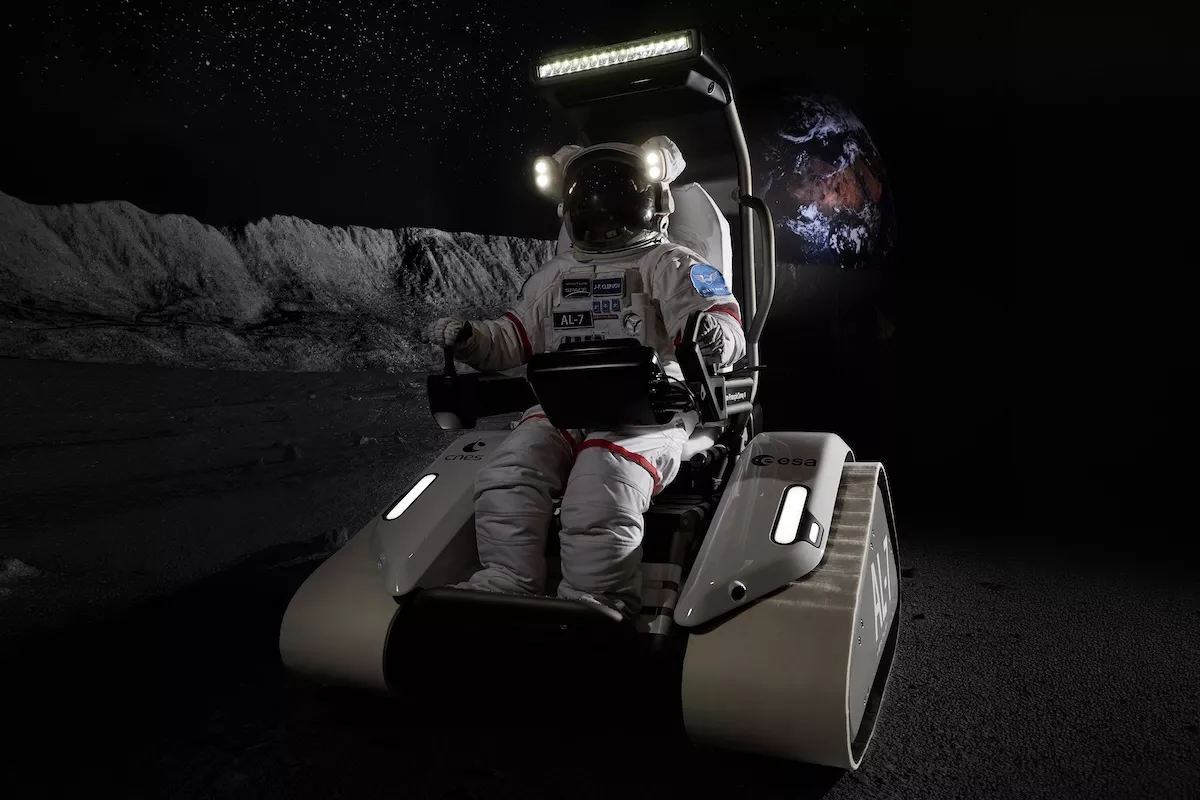
Astronauts working around future Moon bases could soon have their own compact utility vehicle, capable of carrying them across the lunar surface before continuing the job autonomously. Monaco-based Venturi Space has unveiled Alta Luna, a single-seat tracked rover designed to support the practical realities of living and working on the Moon.

Presented at the International Space Summit in Paris on 9th and 10th September, the vehicle is intended to operate close to lunar habitats, transporting astronauts and equipment, preparing terrain and carrying out essential construction work.

Led by Monégasque entrepreneur and Venturi Space president Gildo Pastor, the project offers a glimpse of what daily movement on the Moon could eventually look like: an astronaut climbing aboard a compact tracked vehicle, driving across difficult terrain and receiving real-time information about both the mission and the surrounding space environment.

Built for astronauts to drive on the Moon

Weighing a targeted 300kg, Alta Luna is substantially smaller than Mona Luna, the 750kg exploration rover unveiled by Venturi Space 15 months ago. Its compact dimensions are intended to make it highly manoeuvrable around lunar bases, where astronauts will need to move between habitats, equipment and work sites.

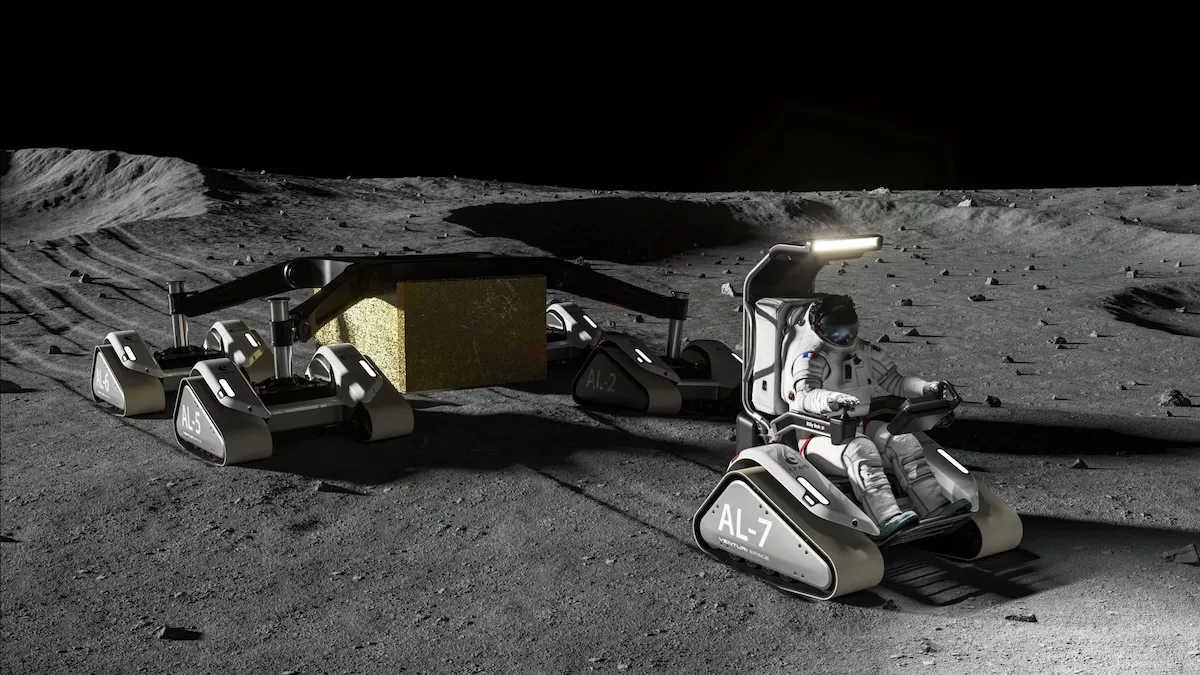
For the first time in one of its lunar programmes, Venturi Space has replaced wheels with tracks. The design is intended to give Alta Luna greater traction and allow it to climb steeper slopes across the Moon’s uneven surface.

The rover can be driven directly by an astronaut or operate autonomously. While its single-seat layout places the astronaut firmly at the controls, artificial intelligence can assist with navigation and other driving functions.

When no astronaut is aboard, Alta Luna can use LiDAR, stereo cameras and AI to navigate independently. It could excavate and grade terrain, prepare routes, help establish basic infrastructure and transport payloads between sites.

Multiple vehicles could also operate as a coordinated fleet, combining their capabilities to complete larger tasks around a lunar settlement.

Alta Luna · Payloads transport. Source: Venturi Space

A rover that can bring its driver home

Alta Luna has also been designed to watch over the person driving it. Its electronics can connect with an astronaut’s spacesuit to monitor their health during a mission.

If the astronaut becomes unwell or incapacitated, the vehicle is designed to take control and return them autonomously to base. Its interface can also deliver mission information and warn the driver of hazards in the wider space environment, including an approaching solar storm.

This combination of manual driving, autonomous navigation and health monitoring positions the rover as both a working vehicle and a safety system for astronauts operating outside their habitat.

The rover uses the battery and battery-management technology developed by Venturi Space. The same technology has been integrated into Venturi Astrolab’s Flex lunar vehicle, which was selected by NASA for development under its Lunar Terrain Vehicle programme for the Artemis missions.

Preparing for everyday life beyond Earth

Rather than being conceived for long-distance exploration alone, Alta Luna is designed around the routine tasks that will become necessary if humans establish a sustained presence on the Moon.

“I enjoy designing vehicles for extreme environments, but above all I like to see them prove their value in real-world conditions,” said Gildo Pastor. “I will therefore devote all the necessary energy to ensuring that Alta Luna supports the first inhabitants of the Moon in their daily lives.”

Antonio Delfino, director of Venturi Space, said future lunar activity would require many of the same systems that support industrial development on Earth.

“On the Moon, we will need to build, develop sites, transport, maintain and connect,” he said. “We will face challenges similar to those of industrialisation on Earth: transport routes, habitats, infrastructure and logistics.”

According to Delfino, meeting those needs will require a range of specialised vehicles able to work individually or as part of a fleet.

The unveiling comes five years after Venturi Space was created and ahead of the planned launch of FLIP, an American lunar rover equipped with Venturi batteries. The vehicle is due to travel to the lunar South Pole aboard Astrobotic’s Griffin-1 lander by the end of the year.

Monaco Life is written by qualified journalists, writing original content. Sign up for our free newsletter, listen to our podcasts on Spotify, and follow us across Facebook,  Instagram, LinkedIn, and Tik Tok. 

Main photo source: Venturi Space