Interview: “The car is silent, but you still feel the speed” — Antoine Dufilho on his Monaco masterpiece

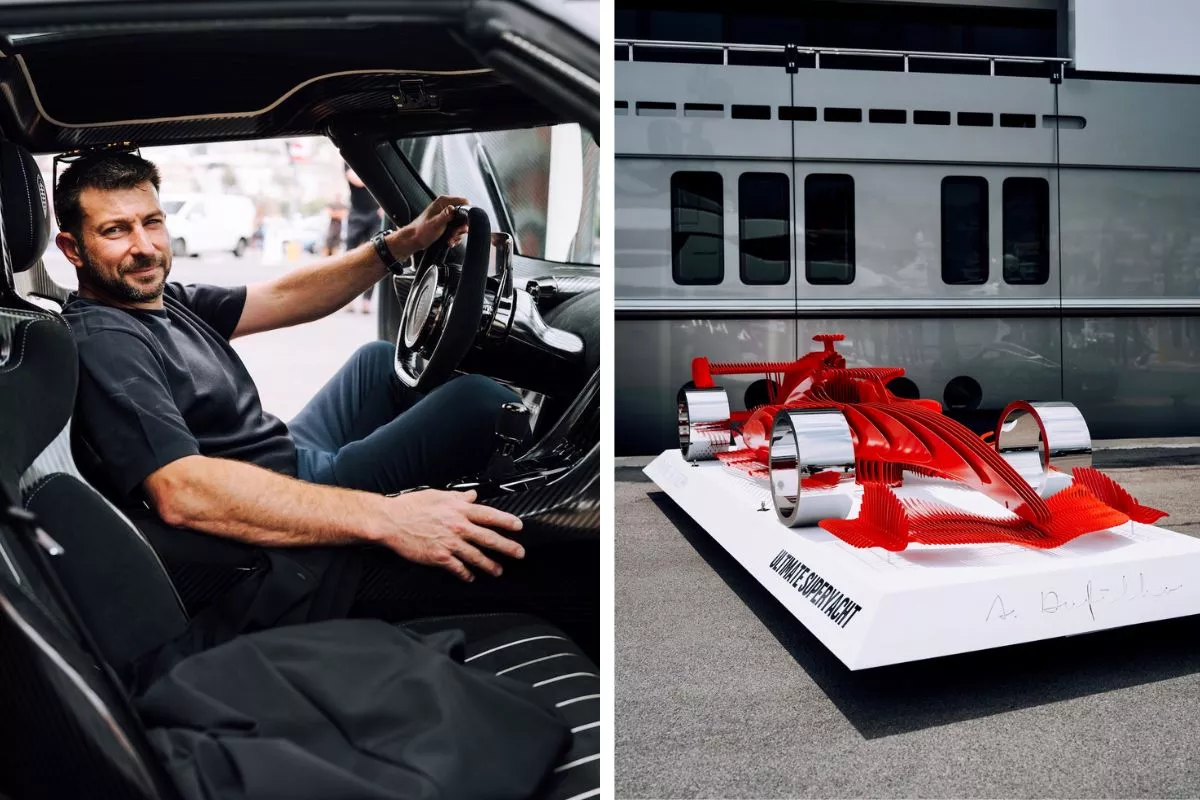
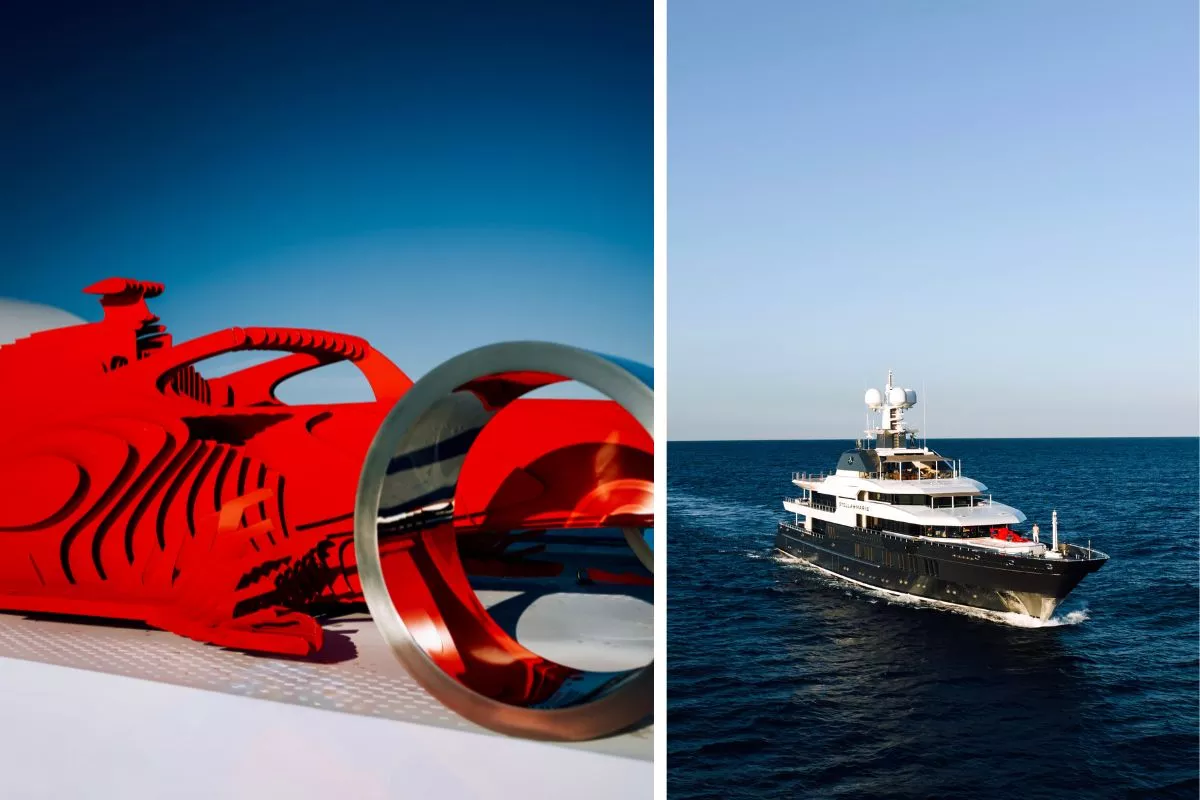
French sculptor Antoine Dufilho has unveiled Formula One, a life-size kinetic sculpture installed on the bow of the superyacht Stella Maris in the port of Monaco for the duration of the Formula 1 Louis Vuitton Grand Prix de Monaco 2026.

The work — red, built entirely from aluminium, and the full dimensions of a Formula 1 monopost — deconstructs the car into successive layers of metal, alternating solid and void so that, though completely still, it reads as movement. The effect changes depending on where the viewer is standing.

Dufilho, who has been developing this approach with automotive subjects since turning to sculpture full-time in 2012, describes the tension between stillness and speed as central to what the work is doing. “The sculpture does not move, but the rhythm of the metal, the voids, the lines and the reflections suggest speed and motion,” he told Monaco Life’s Cassandra Tanti. “A Formula 1 car is normally associated with noise, power and acceleration. Here, it is silent and still, but the viewer can still feel the energy. That contrast is exactly what makes the image so strong.”
From a crane in Italy to the harbour in Monaco

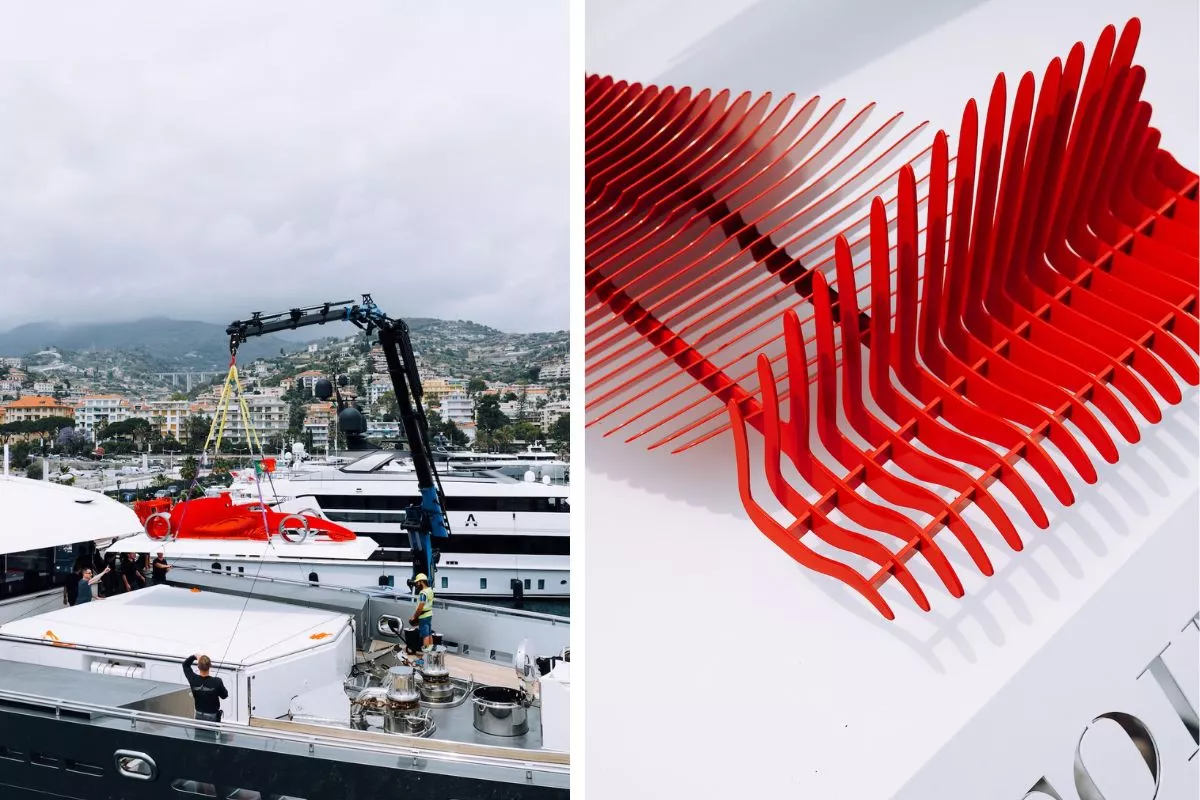
Getting the sculpture onto the Stella Maris was not a straightforward process. It was lifted by crane onto the yacht in Italy before the vessel made the journey to Monaco by sea — an arrival conceived, in Dufilho’s words, as the cinematic opening of the event.

Watching the work go up was, by his account, something close to nerve-wracking. “When a full-scale sculpture leaves the ground, suspended above a yacht, you suddenly become very aware of its weight, its fragility, and all the work behind it,” he said. “Seeing it finally installed on the Stella Maris, floating towards Monaco, was almost unreal. It was the moment where the sculpture entered a completely different dimension.”

Voids as material

The layering technique Dufilho uses on Formula One is the same he has applied to Bugatti, Ferrari and Porsche bodies in earlier works — but at full scale, the effect is more confrontational. Asked what he is trying to reveal that a conventional representation of a car could not, he says: “I’m trying to show something normally invisible: the rhythm of the form, the flow of air over the body shape, the tension of the lines. The voids are just as important as the metal. They allow the viewer to mentally reconstruct the car, but also to feel its speed and presence in a different way.”

The parallel with the circuit itself is one Dufilho draws readily. Monaco, where barriers are centimetres from the cars and the margin for error is almost non-existent, is a context he understands. “My work requires a high level of precision. Each element has to be positioned carefully, because the rhythm only works if the lines are right. A few centimetres can change the balance of the whole sculpture. There is a real parallel with motorsport: precision, tension, control and risk.”
Art in a non-art context

‘Formula One’ is not in a gallery. It is on the water, in the middle of one of the most concentrated social events on the sporting calendar, visible to racing fans, yacht guests and tourists who may never set foot in a contemporary art space. Dufilho sees that as an opportunity rather than a complication.

“In Monaco, during the Grand Prix, many people will first approach it through emotion, curiosity or passion for racing,” he says. “The work has to speak immediately, even before any explanation. It has to create a reaction from people who may not be collectors, but who understand beauty, speed, engineering and emotion. For me, that connection with a wider public is very important.”

He came to sculpture through a family connection to the art world — his great-uncle, the actor and collector Jacques Dufilho, introduced him to the visual arts — and studied architecture and landscape at the École de Lille before committing to sculpture full-time. In July 2022, he exhibited a monumental work at the French Formula 1 Grand Prix at the Circuit Paul Ricard.

Throughout the Grand Prix weekend, a selection of smaller works is on display aboard the Stella Maris and in the VIP suites. A private Art Night is being held on board on Friday 5th June.

Stay updated with Monaco Life: sign up for our free newsletter, listen to our podcasts on Spotify, and follow us across Facebook,  InstagramLinkedIn, and Tik Tok.

Photos courtesy of Antoine Dufilho
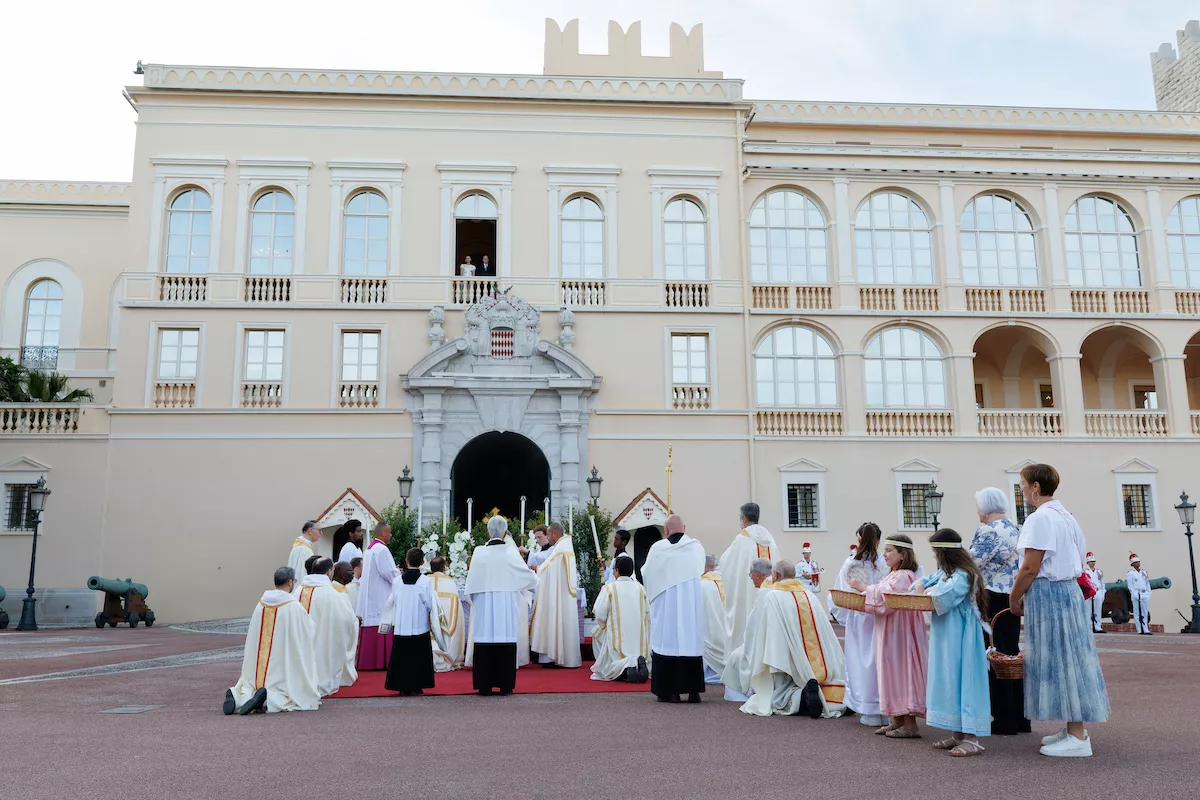
Monaco celebrates Corpus Christi with the Order of the Holy Sepulchre

The streets of the Principality were filled with a spirit of devotion and purpose on Wednesday 3rd June as the faithful gathered to celebrate Corpus Christi, the Feast of the Body and Blood of Christ. Though traditionally held on a Thursday, the celebration was rescheduled to accommodate the constraints of the Grand Prix, bringing together a diverse community to honour the real presence of Jesus in the Eucharist.

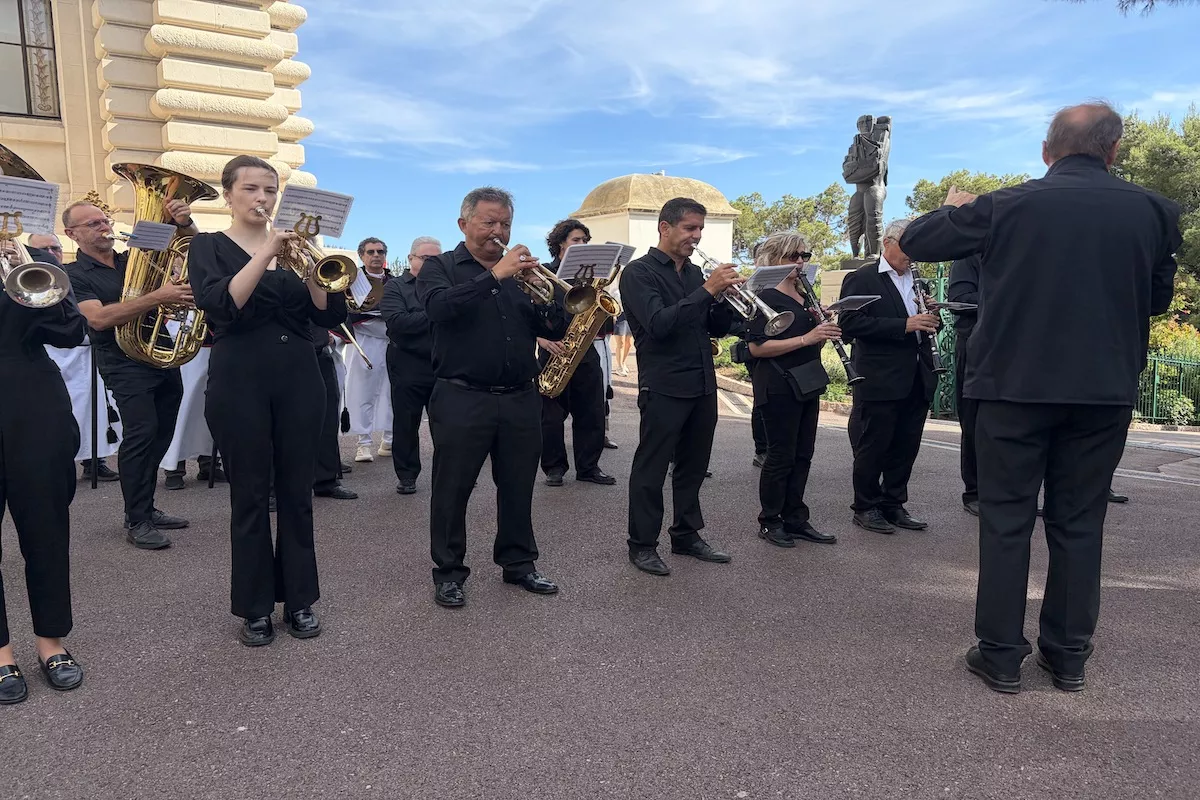
The celebration served as a ‘Feast of the Diocese’, inviting the faithful to gather for a time of sharing, praise, and enrichment. The programme began in front of the Oceanographic Museum, where attendees enjoyed a welcome featuring testimonies from the sisters of the Sacred Heart parish, the Knights of the Holy Sepulchre, and members from the diocesan service for Christian initiation of adults (SICA). The event was further enlivened by the presence of the Monaco Municipal Orchestra.

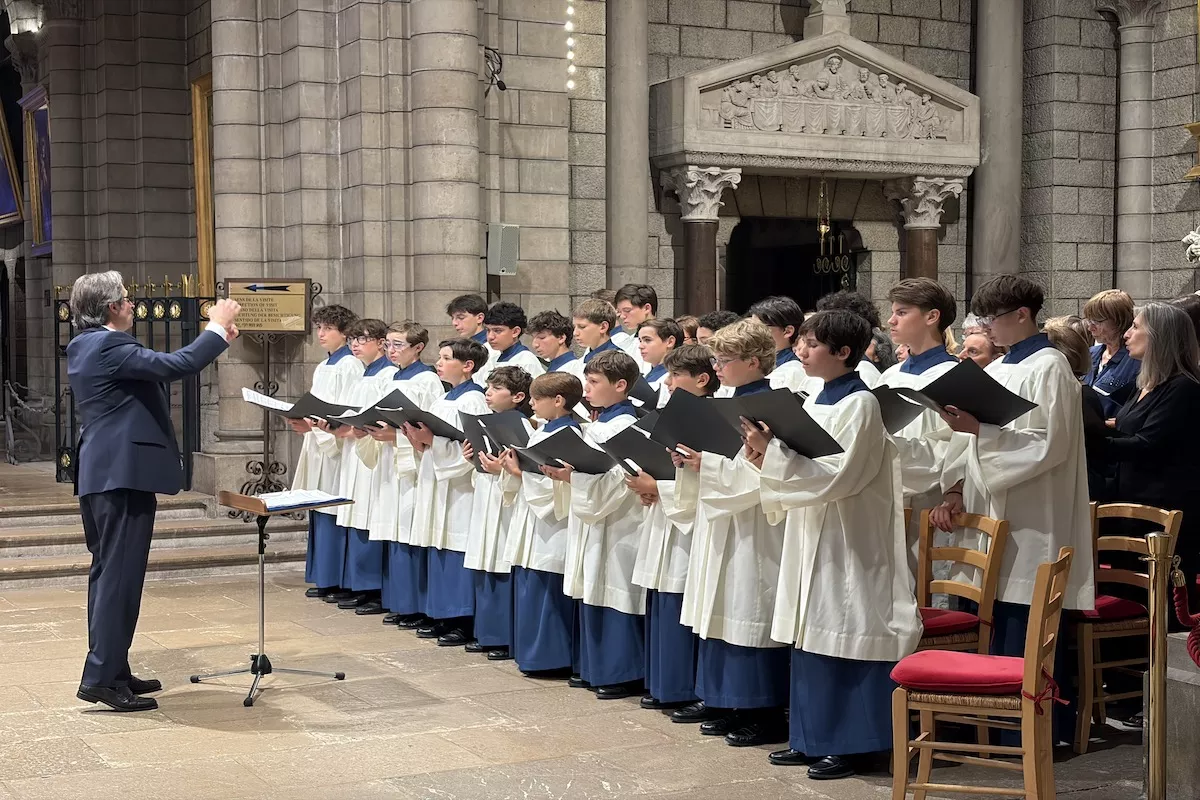
“This feast honours the belief of the faithful in the real presence of Jesus in the Eucharist,” explained Karine, a representative from the Diocese of Monaco, to Monaco Life. The event featured a Pontifical Mass at the Cathedral, followed by a solemn Eucharistic procession through the streets of ‘The Rock,’ complete with moments of adoration and blessings for the residents and businesses of the area.

For Karine, the procession serves as a profound act of evangelisation. “We carry the people around us in our prayer, to transmit to them the peace and the blessing of God, so that many leave this evening from Monaco a little happier, by having had the testimony of our joy.” She reminded Monaco Life of the words of Pope Leo XIV during his visit to the Principality: “The Church in Monaco is called to bear witness, by living in the peace and the blessing of God”.

Photo credit: Virginia D’Umas, Monaco Life

A historic procession on ‘The Rock’

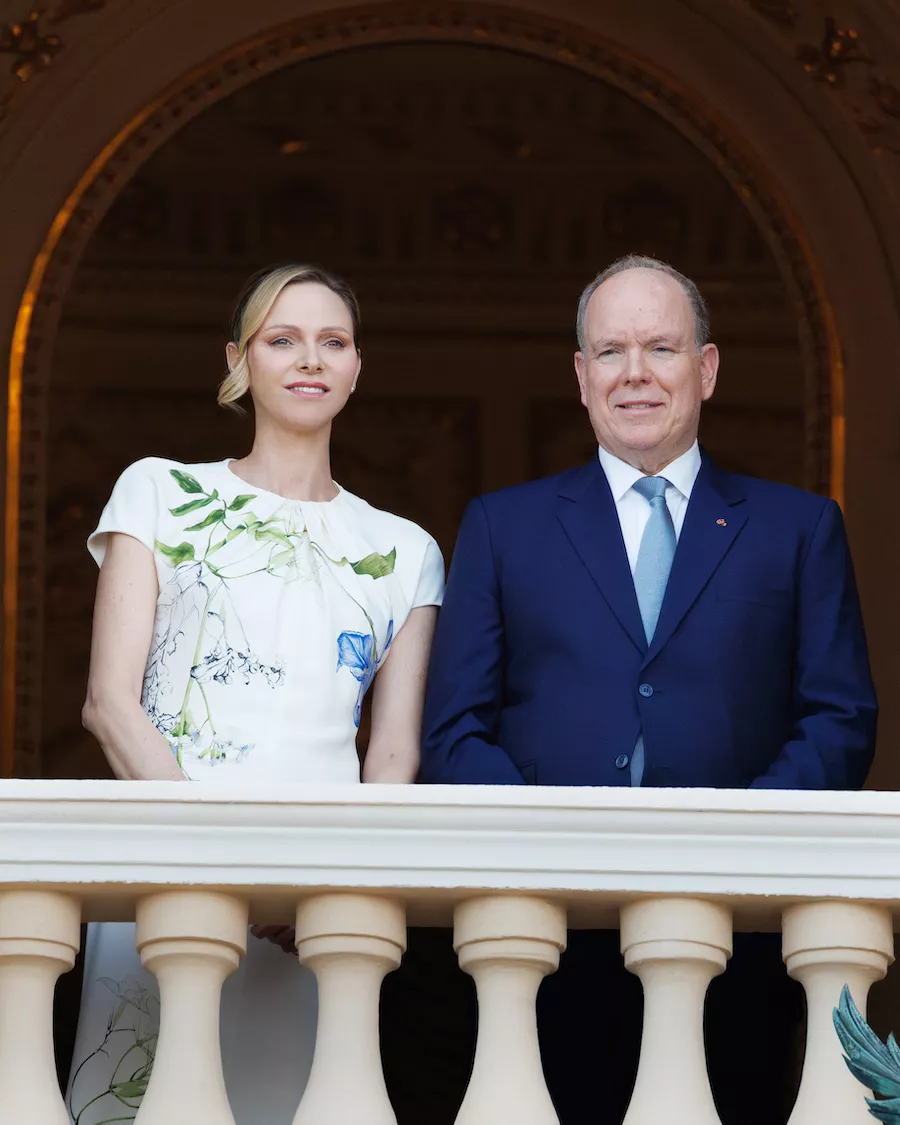
During the procession, the priest carried the Eucharist in a monstrance beneath a canopy, a tradition reflecting the history of the feast when streets were once elaborately decorated with drapes and garlands. In Monaco, the procession holds special significance, moving from the Cathedral toward a repository at the Place du Palais—where Prince Albert II and Princess Charlene were waiting at a window to greet the procession—before continuing to a second repository at the Place de la Mairie. The Archconfraternity of the Penitents of Mercy actively accompanied the procession, with music sustained by the Monaco Municipal Orchestra.

For those unfamiliar with the significance of the day, a dedicated team was available throughout the procession to offer explanations, ensuring the event remained an open and welcoming tradition for all to discover.

A vital link to the holy land

The celebration highlighted the essential work of the Lieutenancy of the Order of the Holy Sepulchre of Jerusalem in Monaco. The Order, which traces its roots back to the First Crusade and the protection of the Holy Sepulchre, remains deeply committed to supporting the Christian communities in the Holy Land—Israel, the Palestinian territories, Cyprus, and Jordan.

With approximately 60 members, the Monaco Lieutenancy is small but highly active. Led by Lieutenant Hubert Perrin, the Order’s mission rests on three pillars: vivifying the Catholic faith in the Holy Land, supporting Church institutions such as schools and hospitals, and deepening the spiritual life of its own members through charity.

“Concretely, the Order is the main financial support of the Latin Patriarchate of Jerusalem,” a representative noted. “We finance schools, parishes, hospitals, and charitable works for the benefit of the Christian communities in the region.” In recognition of this dedication, Prince Albert II was invested as a Knight of the Collar in 2021.

Photo credit: Virginia D’Umas, Monaco Life

Personal journeys of faith

The event provided a platform for members to share their deeply personal paths to the Order.

For one member, a Knight of the Order, the ceremonial habit is not merely clothing, but a silent testament to his faith. “Wearing this habit in the street is saying without a word: ‘I believe.’ It is a testimony even before opening one’s mouth,” he shared. He emphasised that the Order acts as a “living chain” that has endured for centuries, ensuring that the memory of Christ in Jerusalem is never extinguished.

Another member, Sister Yves Charbel Octave Bamba from the Institute of the Sisters of Our Lady of the Incarnation, shared her transformative journey from a modest Muslim family in Ivory Coast to her religious life in Monaco. Her path was defined by a profound “inner conviction” and the support of spiritual guides, eventually leading her to serve the youth and the Church.

Similarly, Simon, a member of the service for Christian initiation for adults, spoke of his own discovery of faith at the age of 40. “I encounter the Lord, I discover faith,” he said, reflecting on his work assisting adults seeking baptism or confirmation. He noted that the service welcomes anyone with curiosity, regardless of their background, aiming to foster free individuals who “live with love”.

Main photo credit: Michael Alessi, Prince’s Palace

A global solidarity

As the procession concluded, the message remained one of unity. Whether serving through the catechumenate or providing aid to the Holy Land, the members of the Monaco community underscored that faith is not a private matter, but a shared journey.

“We are a solidarity that crosses borders, centuries, and cultures,” the Knight reflected during the procession. Through their prayers, pilgrimages, and concrete support, the faithful of Monaco continue to offer a lifeline of hope to those facing immense hardship in the Middle East, reminding them, in the words of the faithful: “You are not alone”.

The evening concluded at the FANB school with a diocesan aperitif, where young people preparing for the upcoming World Youth Day served the community, marking a final moment of conviviality and prayer to close the feast.

Stay updated with Monaco Life: sign up for our free newsletter, listen to our podcasts on Spotify, and follow us across Facebook,  Instagram, LinkedIn, and Tik Tok.

Main photo credit: Michael Alessi, Prince’s Palace


Sun, silence and sustainable seafood: Elsa Marcel Ravin returns for 2026

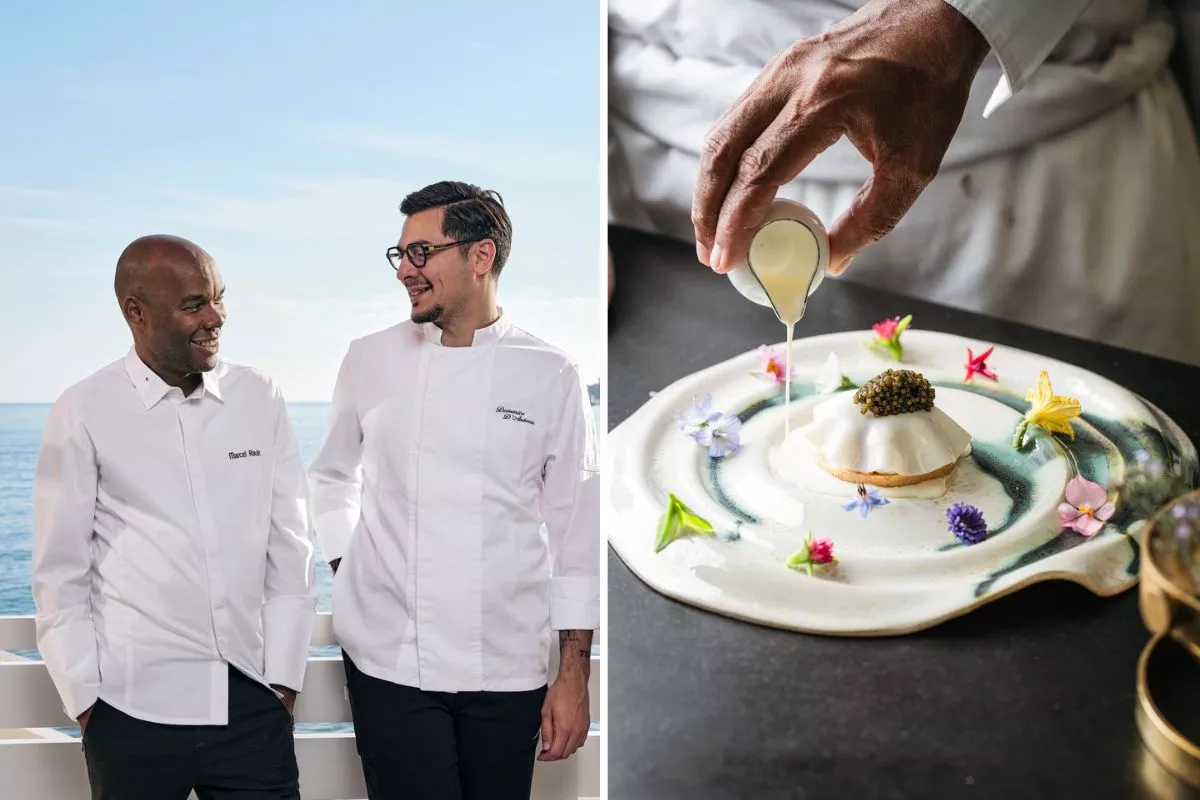
Elsa Marcel Ravin has returned for the 2026 season at the Monte-Carlo Beach in Roquebrune-Cap-Martin — Michelin-starred, committed to the sea in ways that go well beyond the view, and this year presenting a new menu built around the Jardin Marin concept. Quieter than Monaco proper, set above the coastline in a protected nature corridor where birdsong competes with the sound of the waves, it is – overwhelmingly – the oasis in Monaco’s bustling dining scene.

The restaurant reopened on 14th April under its new official name, Elsa Marcel Ravin — a rebranding that formalises the fact that two-starred Chef Marcel Ravin has well and truly taken over the kitchen. It is clear that this is his restaurant now, shaped by his vision, his roots in Martinique, and his deep, almost philosophical relationship with the sea.

What the sea dictates

The Jardin Marin menu, developed by Marcel Ravin and Chef Domenico D’Antonio, is built around a principle that sounds simple but is anything but in practice: cook what is caught. The menu changes according to what the local fishermen bring in that day, which means the seafood on your plate is not only fresh but often unfamiliar — species that rarely appear in restaurants precisely because they are not always available, not always in demand, and not always caught in sufficient numbers to be commercially attractive.

Two Michelin starred Chef Marcel Ravin and Chef Domenico D’Antonio. Photo source: Monte-Carlo Société des Bains de Mer

And that is the point. Ravin and D’Antonio are making a pointed argument about how we eat from the sea — that the lesser-known, less-fished species are often the most interesting, and that chefs have a responsibility to show diners what they are missing and why it matters. It is a more sustainable relationship with seafood, and one the restaurant has been advocating for years, certified by the Mr. Goodfish label of the World Ocean Network.

The result on the plate is daring in the best sense. Tuna Rossini, iodised celery with plankton, sauces built from marine flora, steaming with seawater — these are not gimmicks but genuine expressions of  culinary intelligence. Ravin and D’Antonio describe their menus as designed “to resonate with the ecosystem like the mermaids’ bewitching siren song, mysterious and captivating”. The poetry is not misplaced.

Vegetables come from the Domaine d’Agerbol on the heights of Roquebrune-Cap-Martin, the produce arriving at the kitchen with a lineage as considered as the fish.

The setting does a lot of work

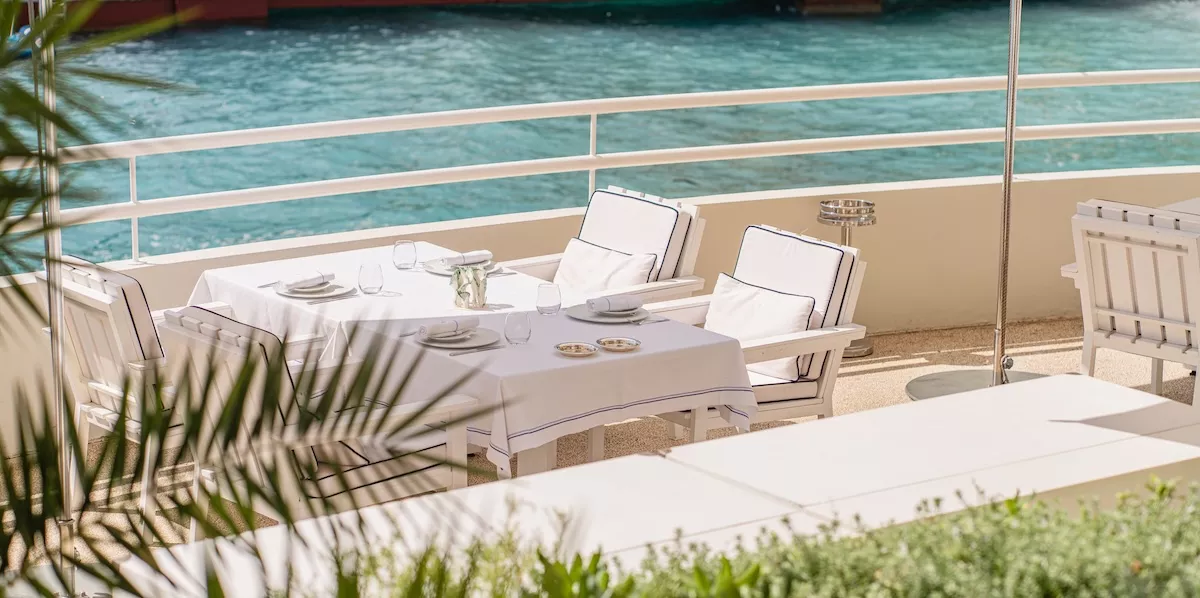
The dining room, designed by India Mahdavi and inspired by the 1930s aesthetic of the Monte-Carlo Beach hotel, is inviting in its azure tones and soft light — but it is the sun-drenched terrace, elegant in its white simplicity, that draws you back, with nothing between you and the Mediterranean.

It is, in the best possible way, a complete escape from the Principality’s usual pace — and a reminder that Marcel Ravin, one of SBM’s most celebrated chef, continues to earn every accolade that comes his way. Few chefs working in Monaco today match his commitment to sustainable produce and fresh, ethically sourced seafood, and fewer still combine that conviction with an imagination that shows no sign of running dry.

Elsa Marcel Ravin is open Tuesday to Saturday, from 12.15pm to 1.30pm and from 7.15pm to 9.30pm.

Stay updated with Monaco Life: sign up for our free newsletter, listen to our podcasts on Spotify, and follow us across Facebook,  InstagramLinkedIn, and Tik Tok.

Photo source: Monte-Carlo Société des Bains de Mer

Marlow named among the world’s most beautiful restaurants at Prix Versailles 2026

Marlow, the British-inspired restaurant at the heart of Monaco’s new Mareterra district, has been named on the Prix Versailles 2026 list of the world’s most beautiful restaurants — just over a year after opening its doors.

Marlow joins a list that spans Hong Kong to Los Angeles, Helsinki to Cape Town — sixteen restaurants selected by the Prix Versailles jury for the harmony between their design, their setting, and what they put on the plate. As secretary general Jérôme Gouadain put it, these are places where “the art of hospitality meets the art of creating the unforgettable.”

A fictional character and a cabinet of curiosities

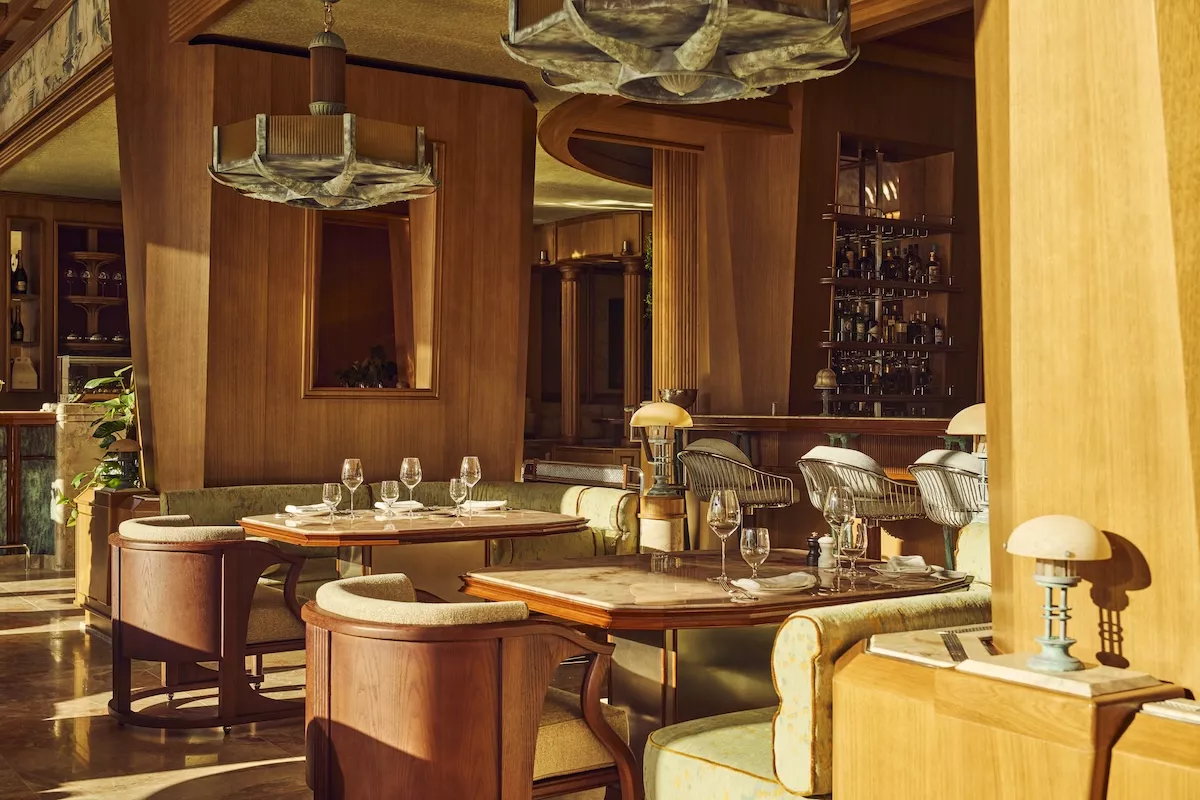
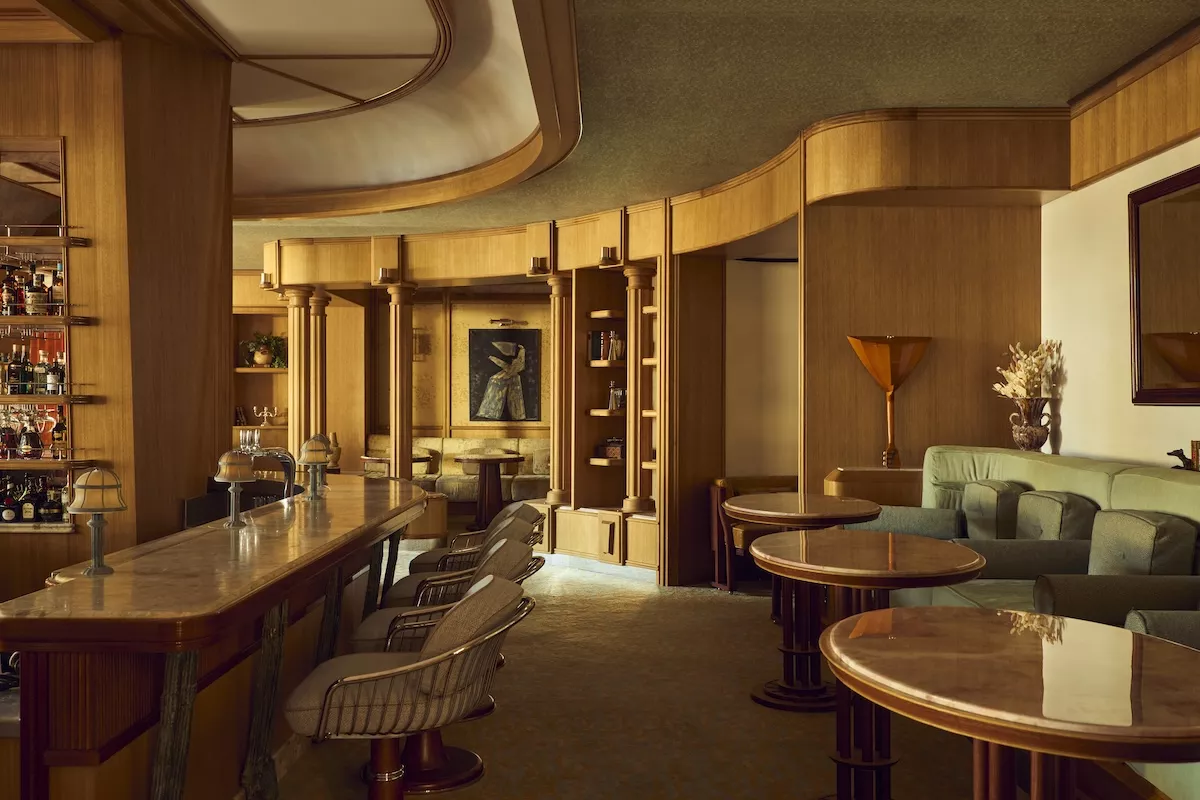
Opened in January 2025 as part of the Monte-Carlo Société des Bains de Mer portfolio, Marlow was designed by artist and interior architect Hugo Toro, whose concept draws on a fictional British character — a nod to the long history of English visitors on the Riviera from the mid-18th century onwards.

The Prix Versailles jury described the result as “warm and sophisticated, almost eccentric,” noting that the spaces arranged around a sculptural central bar function as so many cabinets of curiosities. Custom furniture brings different eras into dialogue, while the menu reinterprets British classics within that same sensibility. “The restaurant Marlow seems to have always been there,” the jury wrote, “like an anchor, a meeting point for residents and visitors.”

Photo source: Monte-Carlo Société des Bains de Mer

UNESCO-backed recognition

Supported by UNESCO, the Prix Versailles recognises contemporary achievements in architecture and design across the restaurant, retail and campus sectors, assessing projects on the quality of their design, creativity, relationship to their environment, and the coherence between space and menu.

Marlow’s inclusion on the 2026 list makes it eligible for one of three global titles to be awarded later this year: the Prix Versailles, the Interior Mention, or the Exterior Mention.

To see all the remarkable restaurants who made this year’s list, click here.

See also: 

Why Marlow is Monaco’s new must-try dining destination

Stay updated with Monaco Life: sign up for our free newsletter, listen to our podcasts on Spotify, and follow us across Facebook,  InstagramLinkedIn, and Tik Tok.

Photo source: Monte-Carlo Société des Bains de Mer

Ronaldinho, Sainz and Gasly headline star-studded Racing Stars Football Cup in Monaco

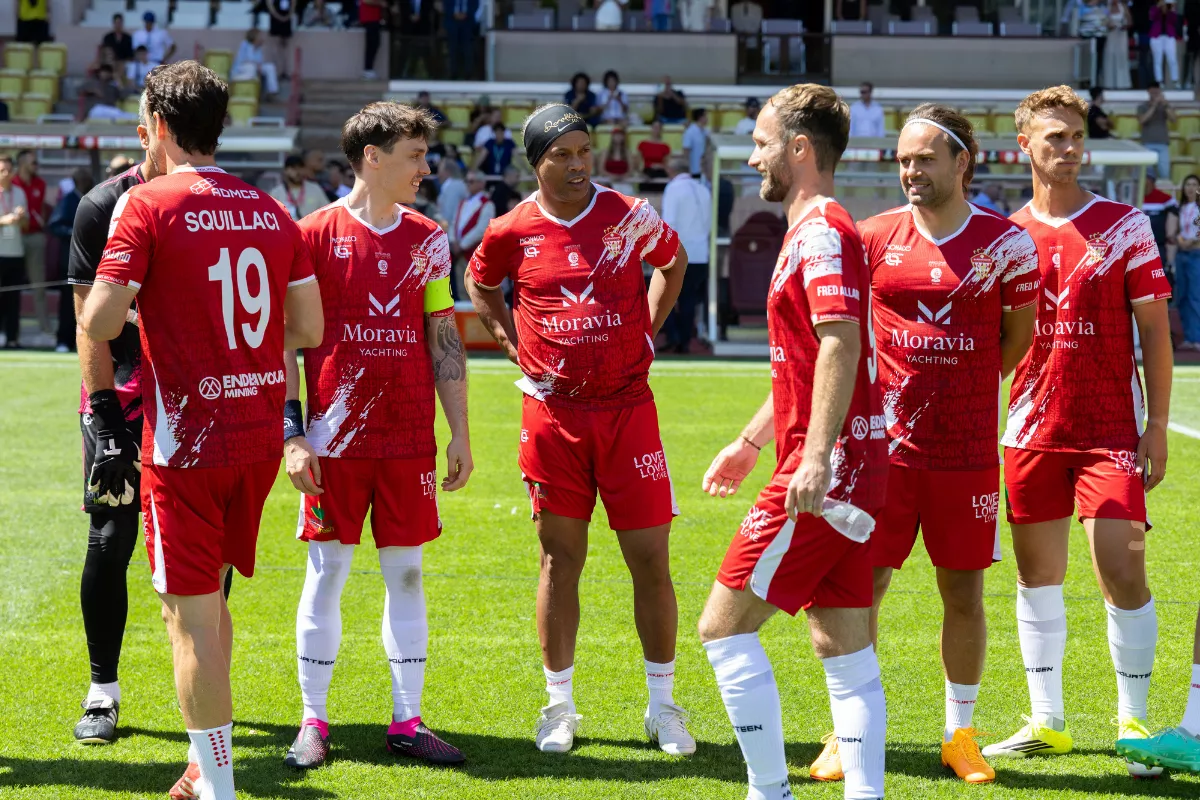
The second edition of the Racing Stars Football Cup returned to Stade Louis-II on Wednesday 3rd June, bringing together the Barbagiuans Monaco, led by President Louis Ducruet, and a team of drivers consisting of Formula 1, Formula 2, Formula 3, and other international motorsport stars. Alongside professional footballers and international personalities, the teams faced off in front of an enthusiastic crowd.

Held ahead of the Monaco Grand Prix weekend, the event once again brought together motorsport and football personalities in support of charitable causes. The event’s impact goes beyond sport, supporting charities worldwide. This year, funds raised will be donated to Mercy Ships, an organisation operating hospital ships to provide free surgical care across Africa, and Les Soins de l’Espoir, a charity that supports underprivileged individuals in Vietnam by funding surgical procedures, medical care, and the development of healthcare facilities.

Fans filled the stadium in anticipation of an exciting weekend ahead. Formula 1 drivers Carlos Sainz, Pierre Gasly, and Isack Hadjar all committed to their roles on the pitch, while Kimi Antonelli made an appearance, greeting fans with autographs and photos despite not competing. They were joined by Clarence Seedorf, Paul Aron, Norman Nato, and other motorsport personalities.

On the other side of the pitch, Louis Ducruet was joined by football legend Ronaldinho, French influencer Tibo InShape, French MMA personality GregMMA, Mr. Thank You, and more. The Barbagiuans secured a 6-2 victory over the pilots, with camaraderie displayed throughout the afternoon.

Following the match, fans had the opportunity to receive autographs from participants and take photos with them from the stands. Among those in attendance was Prince Albert II.

The event served as an energetic start to the Monaco Grand Prix weekend, bringing fans closer to some of motorsport’s biggest names in a different setting.

Stay updated with Monaco Life: sign up for our free newsletter, catch our podcasts on Spotify, and follow us across Facebook,  InstagramLinkedIn, and Tik Tok.

Photo credit: Frédéric Nebinger / Prince Palace of Monaco

Monaco set to spend big on rail to ease its busiest commuter corridor

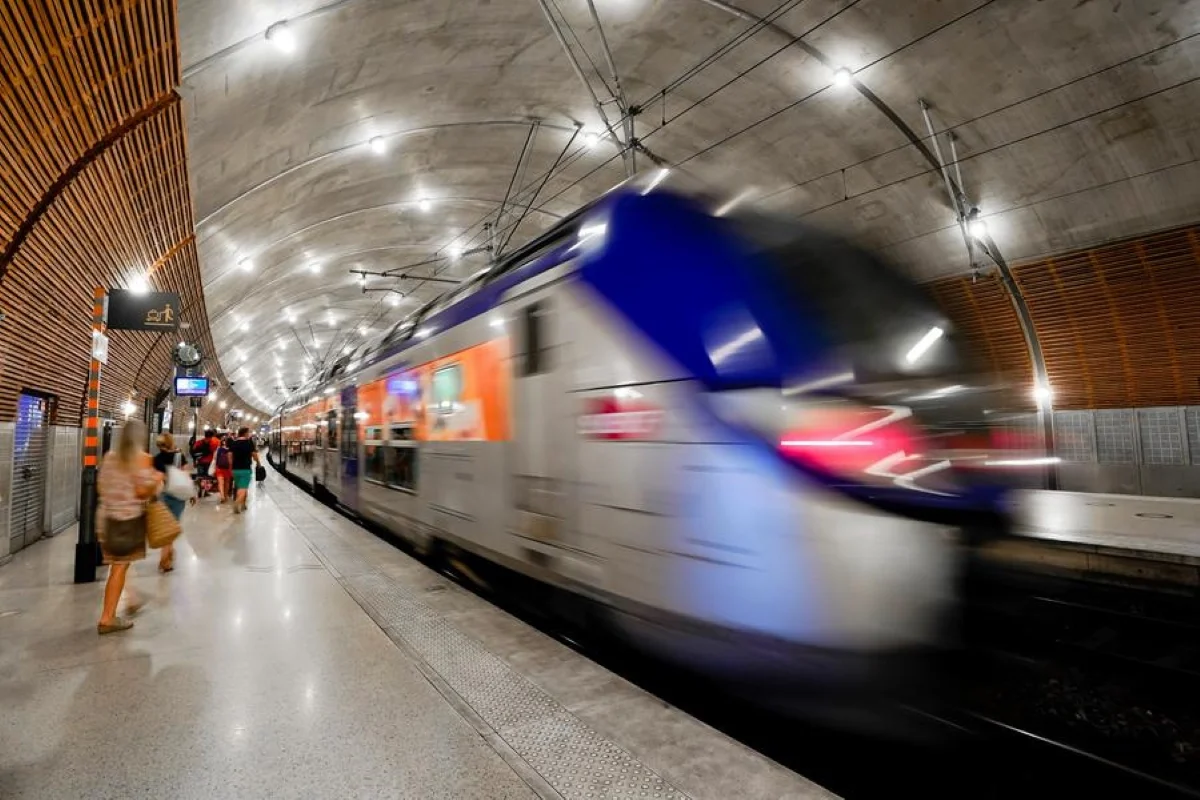
Monaco has signed a new agreement with rail operator SNCF Sud Azur to fund the acquisition of four additional TER trains, in an investment of €67.9 million aimed at significantly increasing capacity on the line serving the Principality.

The new trains are expected to enter service in the first half of 2028 and will join a fleet that Monaco has been steadily building for nearly two decades. The Principality previously funded five trains in 2008 and placed an order for two further trains in 2024, which are due to enter service in 2027. Once all Monaco-funded trains are operational, the Principality will have financed close to 30% of the total rolling stock serving the line.

A train every ten minutes at peak hours

The immediate impact of the new trains will be felt through increased capacity, with more services able to run in long formation — double sets — during peak periods. A second and more significant improvement will follow once the European Rail Traffic Management System (ERTMS), to which Monaco is also contributing financially, comes into operation. At that point, the combination of new rolling stock and improved signalling is expected to make it possible to run a TER service every 10 minutes between Nice and Monaco during peak hours.

The projected effect on daily passenger numbers is substantial. The current capacity during peak hours stands at around 12,000 passengers per day between Nice and Monaco. With the new trains and the increased frequency made possible by ERTMS, that figure is expected to rise by approximately two thirds, to around 20,000 passengers per day.

Monaco’s busiest transport corridor

Monaco-Monte-Carlo station is among the most frequented regional rail stations in the Provence-Alpes-Côte d’Azur region, with nearly 9.4 million passengers recorded in 2025, up from 9.3 million in 2024, 8 million in 2023, and 6.5 million in 2022. The line serves a mix of daily commuters, residents, and visitors, making it one of the Principality’s most critical transport links.

Céline Caron-Dagioni, Government Councillor-Minister for Infrastructure, Environment and Urban Planning, said: “Improving daily travel to and from Monaco is a priority. By funding new TER trains, the Principality is taking concrete action to sustainably strengthen rail services and meet growing mobility needs.”

Stay updated with Monaco Life: sign up for our free newsletter, listen to our podcasts on Spotify, and follow us across Facebook,  InstagramLinkedIn, and Tik Tok.

Photo source: Government Communications Department