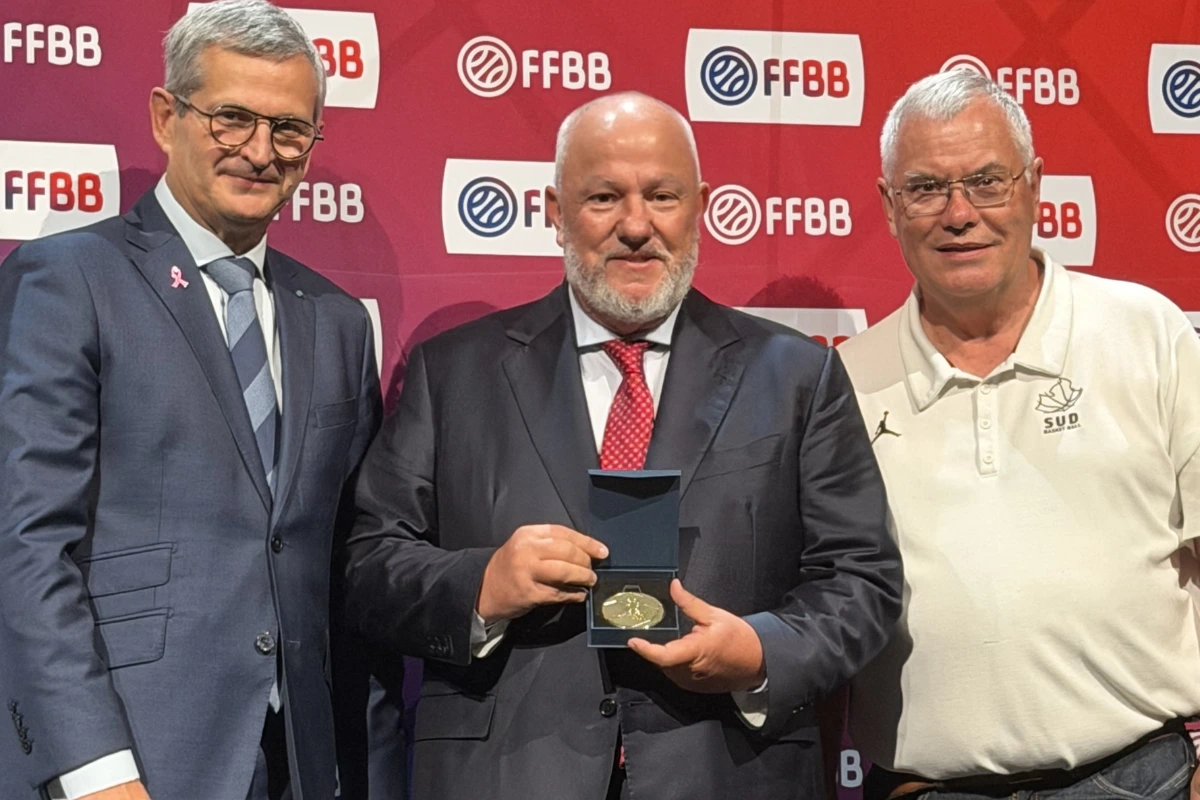
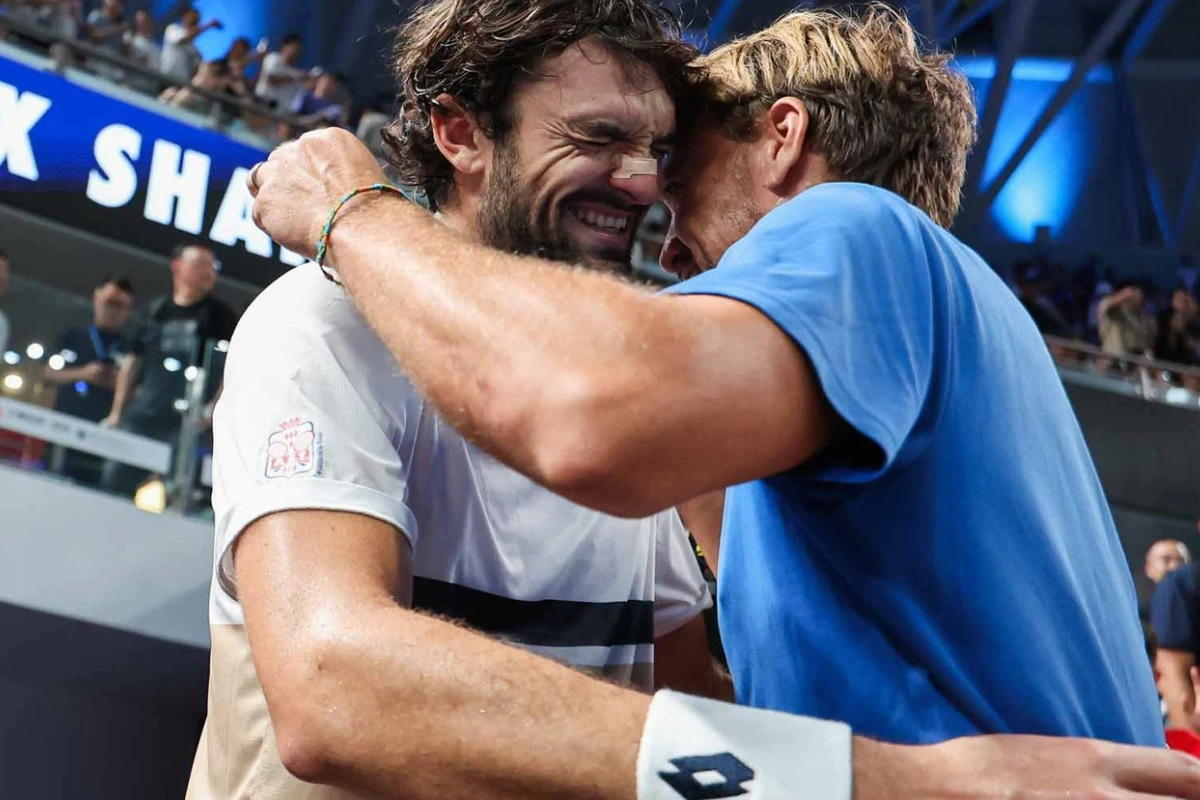
Éric Elena has been awarded the Gold Medal of the French Basketball Federation (FFBB), acknowledging 17 years spent developing women’s basketball in Monaco.
The founder and co-president of Monaco Basket Association (MBA) received the honour from FFBB president Jean-Pierre Hunckler during the federation’s General Assembly in Lyon on Saturday, 3rd October. Elena becomes the second MBA executive to receive the FFBB Gold Medal, after Stéphan Maggi several years ago.
The recognition comes at an important moment for the club Elena has worked to build, with MBA now competing in Ligue Féminine 2 (LF2) and aiming to reach the highest level of French women’s basketball. Over the past 17 years, MBA has grown and established itself within French women’s basketball, with its development extending beyond results on the court to player development, sporting structures, and the wider promotion of the women’s game.
For Elena, the Gold Medal represents a collective effort rather than an individual achievement. “This Gold Medal represents for me a recognition of the work accomplished collectively over the past 17 years. It is a great source of pride for Monaco Basket Association, for the colours of the Principality, for Monaco sport and, more broadly, for women’s basketball in Monaco,” said Elena.
He also highlighted the significance of MBA’s relationship with the FFBB throughout that journey, describing the relationship as one built on “respect and trust.” He extended the recognition to institutions and partners that have contributed to MBA’s development over the years.
This recognition now adds another milestone to the club’s development, as MBA looks to turn its growing presence in French women’s basketball into success at the highest level.
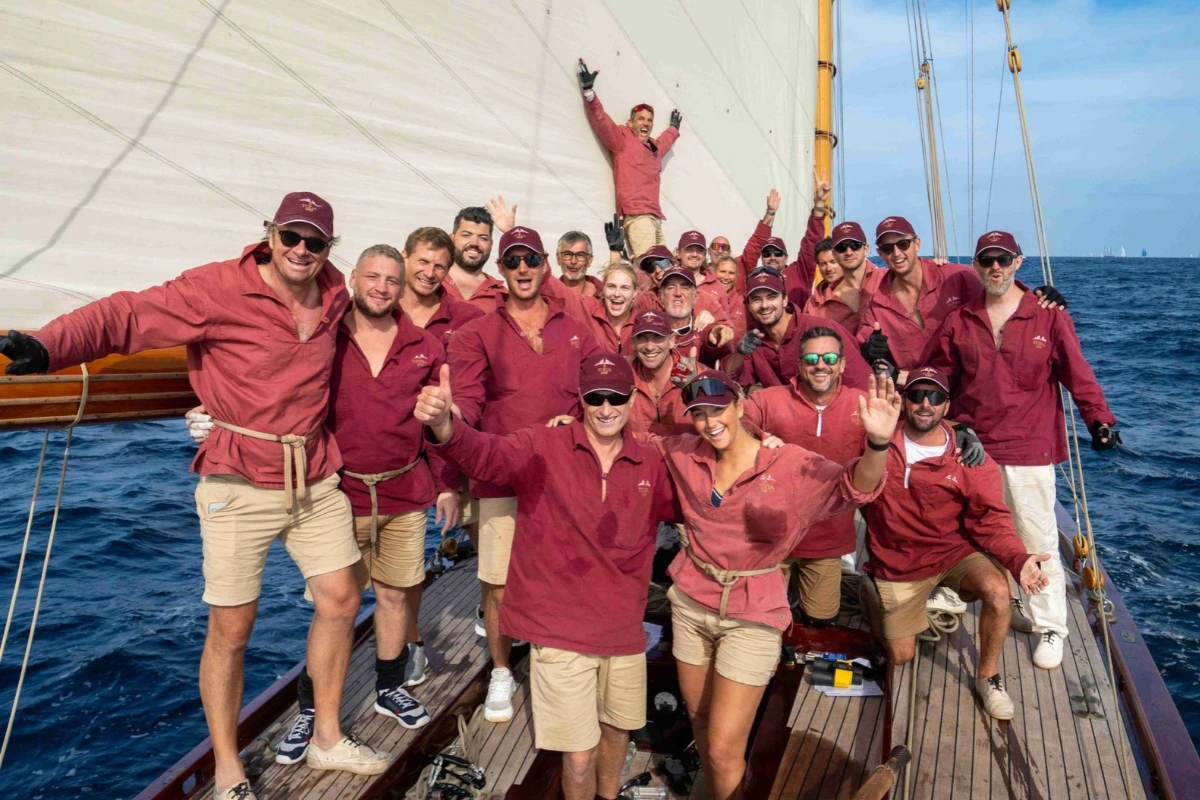
Pierre Casiraghi has led the Yacht Club de Monaco’s historic yacht Tuiga to victory at Les Voiles de Saint-Tropez, securing first place in the Tradition category alongside a crew featuring some of the biggest names in sailing.
The 1909 yacht took the top spot at the 28th edition of the event, which brought together over 250 modern and classic yachts from 26th September to 4th October. Skippered by Yacht Club de Monaco Vice-President Pierre Casiraghi, Tuiga’s crew included two-time America’s Cup winner Jimmy Spithill and German offshore sailor Boris Herrmann. For the final day, French sailor Loïck Peyron joined the crew, taking charge of tactics.
Casiraghi celebrated the team’s performance, saying, “I had never seen a better crew on Tuiga. What a crew, what a week. Everything went exactly as I had imagined.”
Tuiga remained among the leading boats throughout the week, finishing second on Tuesday and Wednesday. On Thursday, it took second place behind Kismet in the Centenarians Trophy, a race featuring 18 yachts over 100 years old, before securing the overall victory in its category on Saturday.
Several other Yacht Club de Monaco members secured podium finishes in Saint-Tropez. Karel Komarek finished second in Maxi 1 aboard V and won the overall 2026 IMA Mediterranean Maxi Inshore Challenge, while Benoît de Froidmont took third in Maxi 3 aboard Wallyño. Peter Harrison’s Rainbow and Giovanni Lombardi Stronati’s Hanuman finished second and third, respectively, in the J Class.
Tuiga’s victory marks the end of a notable 2026 season for the historic yacht, following its voyage along the East Coast of the United States earlier this year.
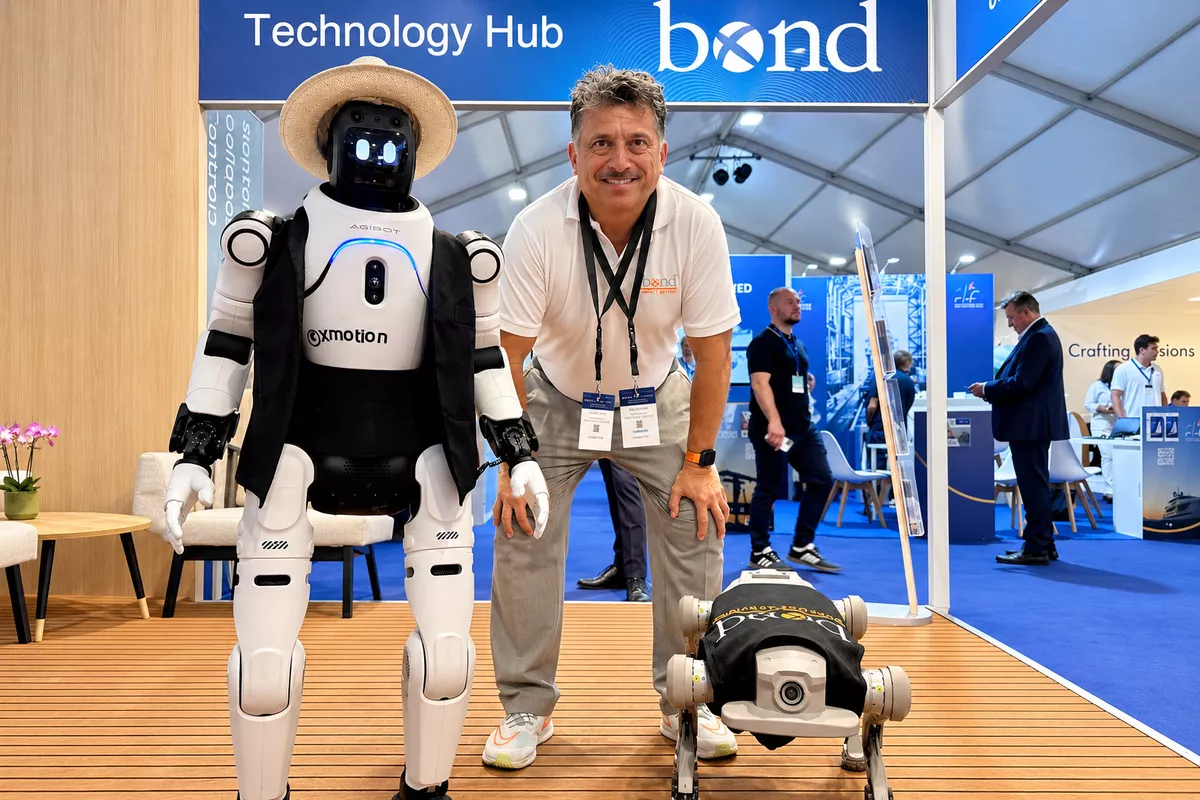
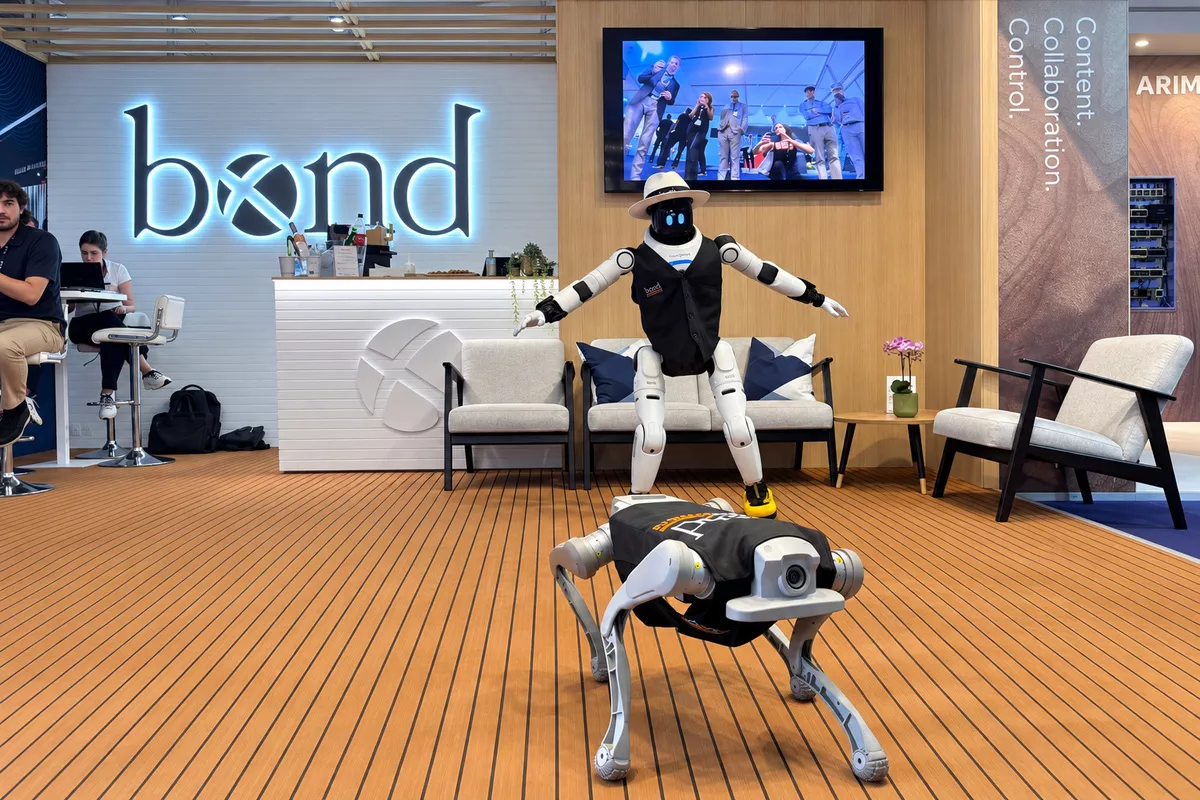
At a show where extraordinary yachts compete for attention, two of the biggest crowd-pullers were considerably smaller. A humanoid robot and a robotic dog drew visitors to Bond Technology Management’s stand throughout Monaco Yacht Show 2026, with phones raised for videos and people gathering for selfies. But behind the spectacle was a serious question: what could these machines actually do aboard a superyacht?
Inside the Quai Albert Ier tent, Bond’s stand became a gathering point for visitors curious to see the robots up close. The company had brought them to Monaco to explore how robotics could support onboard technical teams — a direction it had already begun investigating before the show.
I spoke to Will Faimatea, Bond’s founder and director, about the reaction and why a company established in yacht technology was putting robots in front of owners, captains and crew.
“We knew the robots would attract attention, but that wasn’t the primary reason for bringing them,” he tells Monaco Life. “We wanted people to think beyond the novelty and consider where robotics, AI and automation might genuinely improve operations, efficiency and safety within the yachting sector over the coming years.”
From selfies to serious questions
For Faimatea, robotics represents a potential next chapter in Bond’s work helping clients understand emerging technologies before they become mainstream. The interest at MYS suggested the industry was ready to discuss it, even if visitors approached the machines with very different expectations.
Captains wanted to know about practicality and reliability. Engineers saw possibilities for inspections and monitoring. Crew asked whether robots might replace them, or relieve them of repetitive and physically demanding work. Owners also shared their thoughts, although Faimatea prefers to keep those conversations private.
What began with people stopping to film quickly developed into enquiries about costs, operational benefits and how the technology might be adopted.
“What I noticed was that people would initially stop to look at the robots, then return later with thoughtful questions,” he says. “That suggests the conversation is moving beyond curiosity and towards genuine consideration.”
The humanoid’s appearance made it an obvious attraction, but its potential onboard roles are more restrained than the spectacle might suggest: providing guest information, assisting with inventory management or supporting security. Complex interactions with guests remain a much harder proposition.
“What I don’t see changing anytime soon is the importance of human hospitality,” says Faimatea. “The superyacht experience is built around the crew, and I don’t see a robot replicating that yet or in my lifetime.”
The attention-grabbing robots at the Bond stand during MYS 2026. Photo credit: Cassandra Tanti, Monaco Life
Why the robotic dog could prove useful first
The less human-looking machine may have the more immediate working future.
Faimatea sees potential for robotic dogs to undertake inspection rounds, monitor machinery spaces, carry thermal-imaging equipment, support the testing and commissioning of systems, and carry out security patrols.
These applications build on work already happening on land. Boston Dynamics, for example, offers industrial inspection systems that use its Spot robot to read gauges, capture thermal images and detect air leaks, with documented deployments involving infrastructure and energy operators.
“The robotic dog may actually have more immediate applications than a humanoid robot, in my opinion,” says Faimatea. “Inspection rounds, machinery space monitoring, thermal imaging, testing and commissioning systems, security patrols and accessing challenging areas are all practical use cases where robotics could potentially add value.”
The distinction is between a machine that looks capable and one that performs a useful, repeatable task. Inspection and data collection have already found commercial applications; sophisticated autonomous decision-making and guest interaction still require considerable development.
A much tougher test at sea
A yacht presents difficulties that a demonstration stand does not. Saltwater, humidity, confined spaces, changing weather and the movement of the vessel all complicate deployment.
“There is a huge difference between operating in a controlled environment and operating aboard a yacht underway,” Faimatea acknowledges.
He points to a recently released IP67-rated version of the robotic dog as an encouraging development for marine use. But greater resistance to water and dust addresses only part of the challenge: moving safely through a working yacht and delivering dependable results remain essential.
Privacy and cybersecurity are equally important. A robot gathering images or operational information would become another connected system aboard a vessel where discretion is often paramount. Faimatea acknowledges that these issues still need addressing, with any deployment expected to meet the standards applied to onboard communications, IT and security.
His focus is on how the technology could help the people already doing the work.
“The opportunity lies in using technology to remove repetitive, physically demanding or routine tasks, allowing crew to focus more on service, safety and guest experience,” he says.
Already finding their way aboard
Bond has been investigating robotics for around 18 months, although Faimatea stops short of announcing a dedicated yacht robotics service.
During the show, he also learned that two robots were aboard Leviathan, the 111-metre Oceanco yacht delivered in 2025 and the largest vessel on show at this year’s Monaco Show. For him, the discovery was a small confirmation that the technology on Bond’s stand was already finding its way into yacht projects.
He does not expect robots to appear on every yacht soon. Nor does he subscribe to the idea that they are either imminent replacements for everyone aboard or simply expensive toys. Their value will depend on the task, the environment and whether they can perform consistently.
The crowds in Monaco demonstrated their ability to attract attention. Their next test will be earning a place in the working life of a yacht.
“The interesting question now isn’t whether robotics will become useful,” says Faimatea, “but which applications will reach maturity first within sectors such as yachting.”
Monaco Life is written by qualified journalists, writing original content. Sign up for our free newsletter, listen to our podcasts on Spotify, and follow us across Facebook, Instagram, LinkedIn, and Tik Tok.
Main photo credit: Cassandra Tanti, Monaco Life
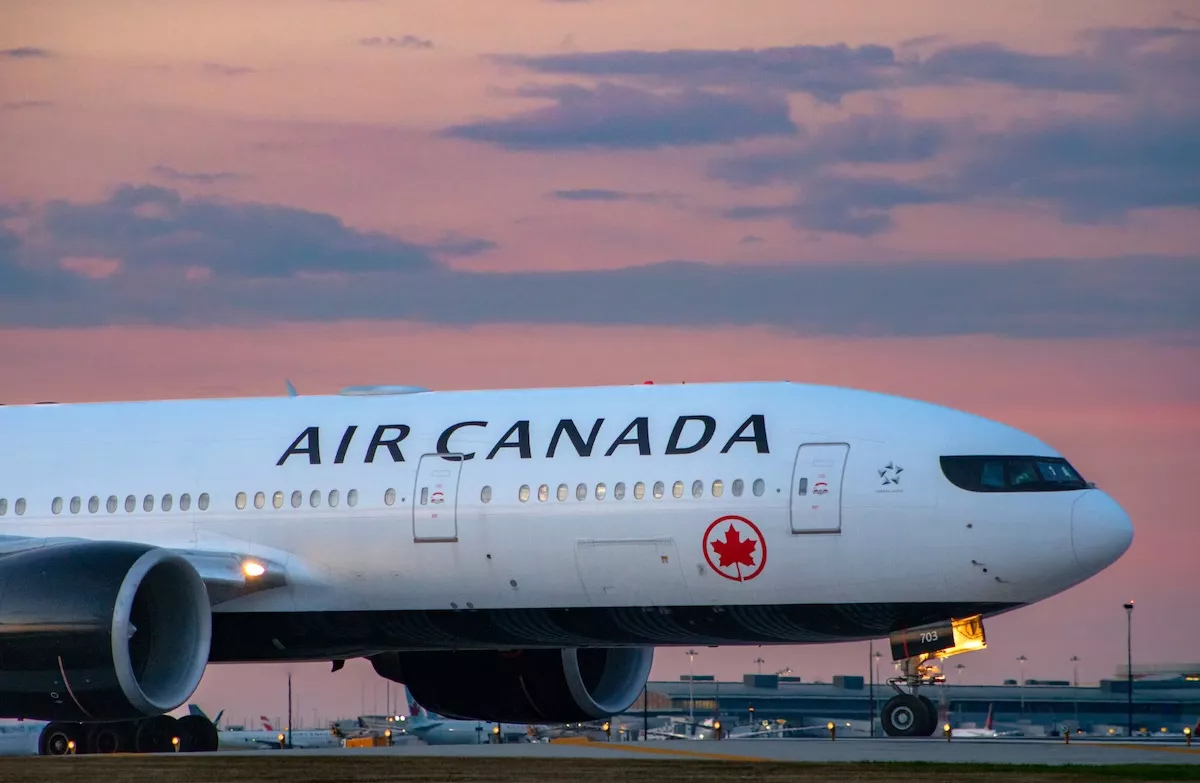
Air Canada to launch direct Nice–Toronto flights in summer 2027
Travellers from Monaco and the French Riviera will have a new direct connection to Canada next summer, when Air Canada launches twice-weekly flights between Nice Côte d’Azur Airport and Toronto on 16th June 2027.
The seasonal service will run on Wednesdays and Saturdays until 23rd October, using Airbus A330-300 aircraft. Together with Air Canada’s existing Montreal route, the addition will provide a combined daily service between Nice and Canada during the summer season, according to the airline.
For passengers, the route will offer a direct journey to Toronto and another gateway for onward travel across North America.
A new gateway through Toronto Pearson
Toronto Pearson is Air Canada’s largest hub, serving more than 150 destinations in Canada and internationally. The airline says the new Nice service has been designed to provide convenient connections through the airport.
Jean-François Raudin, Air Canada’s representative for France, said adding Toronto would give passengers direct access to another of the airline’s key hubs, alongside Montreal, and widen their options for onward journeys across Canada, the United States, Latin America and the Caribbean.
The A330-300 will offer three cabin classes: Air Canada Signature, Premium Economy and Economy.
Nice expands its North American network
Announced on 3rd September, the service will become Nice Airport’s third direct route to Canada, bringing its announced long-haul network to 18 routes, including 11 to North America. These are route totals rather than separate destinations.
Franck Goldnadel, Chairman of the Executive Board of Aéroports de la Côte d’Azur, said the expansion continued a relationship with Air Canada dating back to 2014 and supported the airport’s aim of improving direct connections between the region and North America.
Tickets are already on sale through Air Canada and travel agents for the summer 2027 service.
Monaco Life is written by qualified journalists, writing original content. Sign up for our free newsletter, listen to our podcasts on Spotify, and follow us across Facebook, Instagram, LinkedIn, and Tik Tok.
Teachers and school staff have been called to strike alongside pupils on Tuesday 6th October, threatening further disruption to Riviera schools after a week of protests marked by violence, arrests and threats against education staff. A demonstration is planned in Nice, while 28 lycées across the Alpes-Maritimes switched to remote teaching on Monday.
The national mobilisation could extend disruption beyond schools affected by blockades, with the SNES-FSU, SNEP-FSU and SNUEP-FSU unions calling for strike action in support of pupils’ demands for greater investment in public education. The extent of participation in individual Riviera establishments has not yet been confirmed.
In Nice, L’Union Étudiante has announced a gathering at Place Garibaldi at 2pm on Tuesday. The parents’ federation FCPE has also called on members to demonstrate alongside pupils.
Violence and threats during last week’s protests
The renewed mobilisation follows serious disturbances around several schools in the Alpes-Maritimes and Var.
According to prefecture figures reported by Les Petites Affiches, 29 people were arrested in the Alpes-Maritimes on Friday 2nd October, including following the throwing of fireworks and other projectiles, and damage to property. That followed 72 arrests on Thursday.
No injuries were reported on Friday, but the prefecture counted 14 national police officers and four municipal officers injured since the movement began.
Nice academy rector Emmanuel Roux condemned the violence while distinguishing it from pupils’ right to protest peacefully. He also reported threats against headteachers, teachers and other education staff, including death threats on social media. Those incidents have been referred to judicial authorities, with protection provided to affected staff.
Remote lessons could continue on Tuesday
The number of Alpes-Maritimes lycées placed in remote teaching rose from 24 on Friday to 28 on Monday. The additional establishments were Lycée Goscinny in Drap, the Centre International de Valbonne and Cannes’ Jules-Ferry and Les Côteaux lycées.
The arrangements could be extended into Tuesday depending on conditions. Restrictions on stationary gatherings around affected establishments will remain in force until 7pm on Tuesday, while three CRS police sections were brought in to reinforce local officers on Monday.
For families, disruption could therefore come from several directions: continued remote lessons, further blockades and staff absences linked to the strike call.
Calls for answers on school conditions
The protests centre on teaching shortages, timetables and school conditions. Following talks with pupil representatives on Friday, Roux identified four principal concerns: timetables, buildings, educational guidance and the need for more dialogue.
He said timetable issues would be examined with schools, building concerns addressed with Région Sud and pupil councils convened more regularly. A national consultation platform was scheduled to open on Monday 5th October.
The teaching unions, however, are calling for a national response backed by funding.
Monaco Life is written by qualified journalists, writing original content. Sign up for our free newsletter, listen to our podcasts on Spotify, and follow us across Facebook, Instagram, LinkedIn, and Tik Tok.
Photo by Monaco Life
Vacherot’s Japan Open run ends as focus turns to Shanghai title defence
Valentin Vacherot’s impressive run at the Japan Open came to a close on Monday as he fell to Jiri Lehecka in straight sets in the semifinals in Tokyo.
After consecutive victories, including wins over former world No. 3 Stefanos Tsitsipas and world No. 9 Arthur Fils, Vacherot was unable to deliver another comeback as Lehecka secured a 6-4, 6-2 victory.
The two remained evenly matched through the opening stages before Lehecka found an opportunity to break Vacherot at 2-2. Although Vacherot had an opportunity to respond, he was unable to convert, allowing the Czech to protect his lead and finish the set 6-4.
Lehecka’s momentum carried into the second set as he took control early with a 3-0 advantage. Vacherot recovered one of the breaks; however, he was unable to complete the comeback before Lehecka reclaimed control to end the match with a 6-2 set.
This defeat marks the end of a strong performance in Tokyo for Vacherot as he overcame Alexander Blockx, Stefanos Tsitsipas, and Arthur Fils to earn his place in the semifinals. Despite falling short of the final, Vacherot leaves Tokyo having reached a new career high of world No. 14.
Eyes will now be on Vacherot as he returns to the Shanghai Masters as defending champion, following his historic 2025 title run. The main draw begins on 7 October, with Vacherot receiving a first-round bye. With a career-high ranking and an impressive Tokyo performance, the Monaco player will look to continue the momentum in a place that has brought special moments before.