AS Monaco Rugby continued its strong start to the season with a 47-3 victory over Céret Sportif on Sunday 4th October, moving the team into second place in the standings. The first team delivered an impressive home performance, securing a commanding victory.
The weekend was also successful for the club’s Espoirs, who recorded another home victory and now occupy seventh place in the standings. Both senior teams will return to the pitch on Saturday when they travel to Mazamet.
Monaco saw additional success at youth level, with its U16 team winning its derby against Saint-Laurent-du-Var. The U19s were unable to make the weekend a clean sweep for the club, falling to defeat against Grasse. The two will also return to action this weekend.
RUGBY CLUB TRADES THE PITCH FOR PADEL COURTS
Away from the pitch, the club is preparing to host the first edition of its ‘Defender’ padel tournament on Sunday 18 October. The event will bring together 20 corporate teams for a padel competition at the Complexe du Devens.
Attention will then turn back to rugby as participants are invited to head to Stade Prince Héréditaire Jacques for AS Monaco Rugby’s match at 3:15pm.
Patients from Monaco’s Unité de Psychiatrie et de Psychologie Médicale (UPPM) ‘La Roseraie’ facility have completed a four-day therapeutic immersion, running from 2nd October to 5th October at the Tenuta Sant’Egidio estate in Soriano nel Cimino, combining psychiatric care with outdoor and art therapy.
The initiative was supported by the Association de Bienfaisance Eugenio Benedetti Gaglio, a Monaco-based association that has long backed local psychiatric programmes. The participants were accompanied throughout the stay by Dr. Frédéric Comparon, head of the UPPM, and art therapist Monica Di Rocco.
Organisers said that the trip served as a complementary psychosocial rehabilitation activity designed to foster socialisation and personal autonomy alongside ongoing clinical treatment.
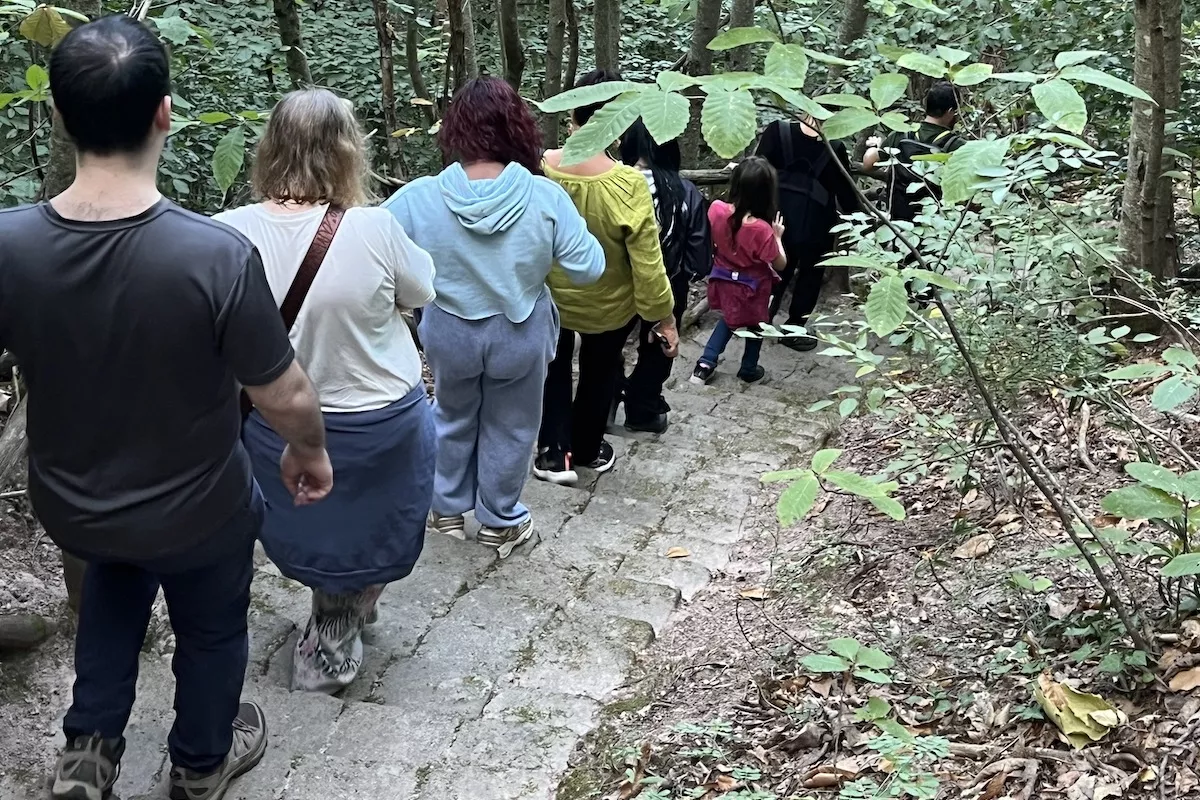
Patients from ‘La Roseraie’ facility walking in the UNESCO-listed beech forest of Monte Cimino. Photo credit: GEA
Outdoor activities and creative workshops
Hosted by the GEA association—managed by Azzurra Benedetti Gaglio and Dr. Gianfranco Pisa, whose scientific backgrounds integrate biodiversity and environmental observation into the estate—the group participated in structured outdoor activities.
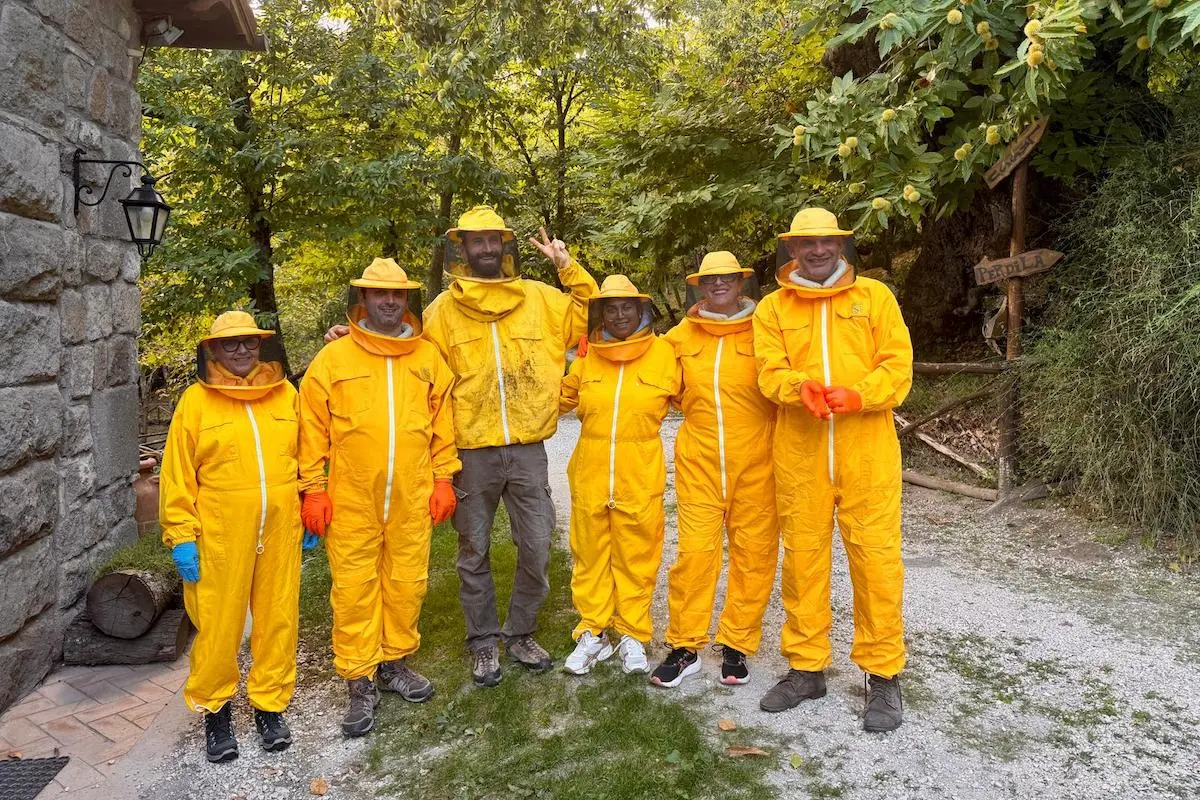
These included walks in the UNESCO-listed beech forest of Monte Cimino, visits to Soriano nel Cimino during its traditional Chestnut Festival, and creative sessions led by Monica Di Rocco. Utilising elements such as trees, soil, and beehives, participants engaged in artistic expression, including working with clay to replicate local animal tracks.
Medicine, nature, and clinical boundaries
Medical professionals emphasised that the retreat was structured to allow nature, art, and psychiatric care to work alongside and interact with one another rather than serving as a replacement for medical treatment. Specialists said that while current scientific evidence regarding nature-based interventions is strongest for symptoms of anxiety, depression, and stress, care must remain tailored to individual psychiatric and psychological conditions, avoiding broad generalisations across different diagnoses.
Accommodation and unique discoveries
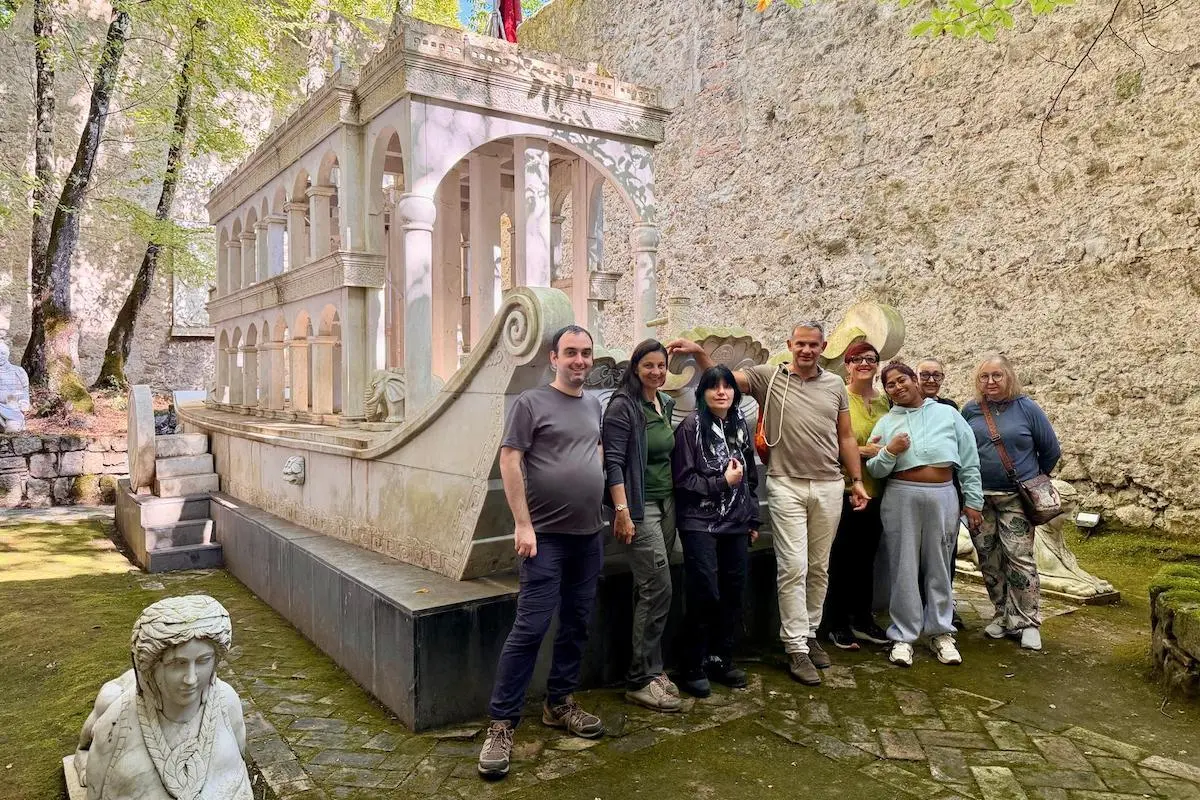
Beyond daytime activities, participants stayed in fully equipped tents on the estate, experiencing overnight immersion in natural surroundings. The grounds also feature historical and cultural points of interest, including buildings restored using stones from ancient monasteries and a 1:3-scale marble reproduction of Empress Cixi’s Chinese Imperial Boat, donated by the Chinese government. These elements are designed to stimulate curiosity and interrupt everyday routines.
Photo credit: GEA
Towards an annual programme
Following the conclusion of the four-day pilot, medical staff and association organisers are exploring the possibility of establishing the Tenuta Sant’Egidio retreat as an annual fixture. Repeating the initiative would allow teams to observe over time what structured nature-based experiences contribute to perceived well-being, socialisation, and the long-term autonomy of patients within a rigorous clinical pathway.
Patients from ‘La Roseraie’ facility standing in front of a 1:3-scale marble reproduction of Empress Cixi’s Chinese Imperial Boat. Main photo credit: GEA
Football: Monaco left with ‘bitter taste’ as points slip against Toulouse
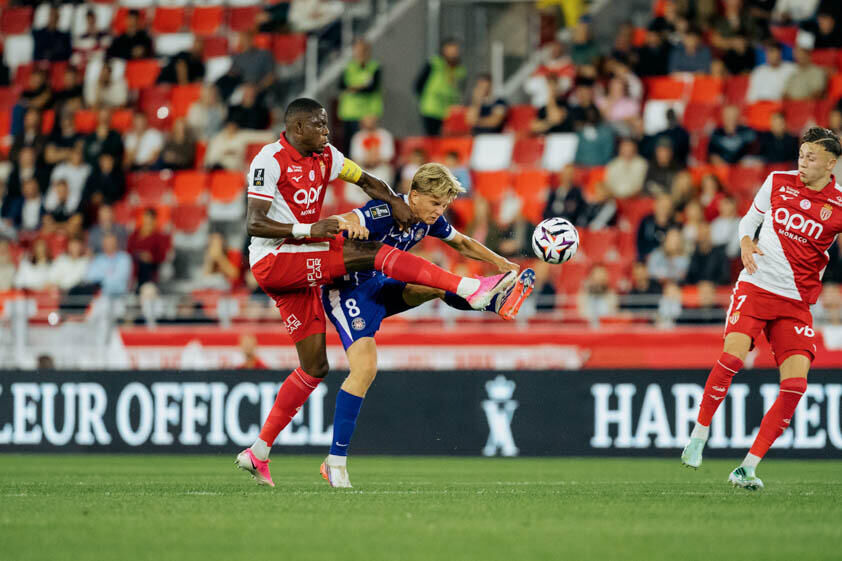
AS Monaco let a two-goal lead slip against Toulouse (2-2), but the draw ensures that Filipe Luís’ side will end the weekend top of Ligue 1.
These were two points dropped, not one point gained. Monaco headed into half-time two goals up. Edan Diop had got the Principality club up and running with a header from an Aleksandr Golovin cross, and it was a moment of brilliance from Matthis Abline that gave his side a cushion.
It was a simple pass from Diop to Abline, who, 25 yards out, back to goal, used one touch to flick the ball up, his second to keep it in the air, and then another to, on the swivel, volley into the bottom corner of the Toulouse goal. Quite the way to open your account as a Monaco player. “I think that I’m a player who doesn’t think. When it comes to me, I like to do crazy things. That’s why I try things like that,” said the Frenchman, who was the marquee signing of Monaco’s summer transfer window.
An ‘uncomfortable’ second half for Monaco
But rather than savour the moment, Abline came into the mixed zone post-match to say that Monaco needed to “quickly move on” after a second half much less successful than the first. A drop in intensity and a more conservative attitude on the ball put Monaco into “uncomfortable” positions, in the words of Filipe Luís.
Nazinho found himself in one when he brought down Mark McKenzie in his own box. Casper Tengstedt, one of the in-form forwards in Ligue 1, stepped up to convert the penalty and make it four goals in four games. Monaco didn’t come out of their shell and continued to play within themselves, inviting the pressure and ultimately conceding the second goal.
Midweek trip to Bulgaria awaits
It came courtesy of the head of Sion Oppong, who caused Monaco plenty of problems off the bench. Jens Berthel Askou said that he had to “wake [his] side up” at the break, and in the adjoining dressing room, Monaco had clearly gone to sleep. And yet, Luís had warned of the threat posed by Le TéFéCé, who were short-changed at the start of the season. Just five points from their first five games didn’t reflect their impressive performances under their new manager.
“It’s a match that leaves me with a bit of a bitter taste,” said Luís late on Saturday night after his side failed to re-establish an advantage and therefore settled for just one point. It is an important point, however, as it keeps them top of the league.
Les Monégasques’ attention now turns to European football. Luís’ side open their Europa Conference League campaign with a trip to face CSKA Sofia on Thursday. It is a competition that Monaco will play to win, and their unbeaten start to the season certainly makes them one of the favourites.
As World Mental Health Day is marked on Saturday 10th October, Monaco Life looks at the particular pressures facing people who have built their lives far from home. Editor in Chief Cassandra Tanti spoke to Lachlan Searle, chief executive of Australia’s R U OK? suicide prevention charity, about why a simple check-in matters even more when family and old friends are hundreds – or thousands – of kilometres away.
For expatriates, the support networks many people take for granted, including parents, siblings and childhood friends, are often replaced by newer relationships built in a constantly shifting community. Monaco is an extreme example. According to the Monegasque Institute of Statistics and Economic Studies (IMSEE), the Principality had 38,857 residents at the end of 2025, representing 144 nationalities. Most of the 65,000-plus people employed in Monaco live outside the country, meaning many of the friendships formed at work do not extend to the neighbourhoods where people go home at night.
The wider expat picture reflects the same strain. InterNations’ Expat Insider 2026 survey of 7,786 expats found that 40% find it hard to make local friends and 37% say their friends are mostly other expats.
Searle, who has lived in the UK and, most recently, Abu Dhabi, knows the terrain. “I have had a couple of stints doing the expat thing, and it is tricky. You can be whoever you want to be in a sense, because you are new,” he said. “But it is also a transient world: you build connections and then people move on. Sometimes you do not necessarily want to invest in those relationships.”
“Part of the challenge anywhere is building real connections and authentic relationships. It is probably a little more challenging in an environment where you are not going down to the shops and bumping into someone you went to school with, with that history where you can pick up a conversation from 10 years ago,” he added.
One approach that has stayed with him came from a young R U OK? ambassador. “He told me that he starts relationships with vulnerability now. He goes straight to vulnerability because he thinks it is a strong way of testing whether a relationship is worth investing in,” said Searle.
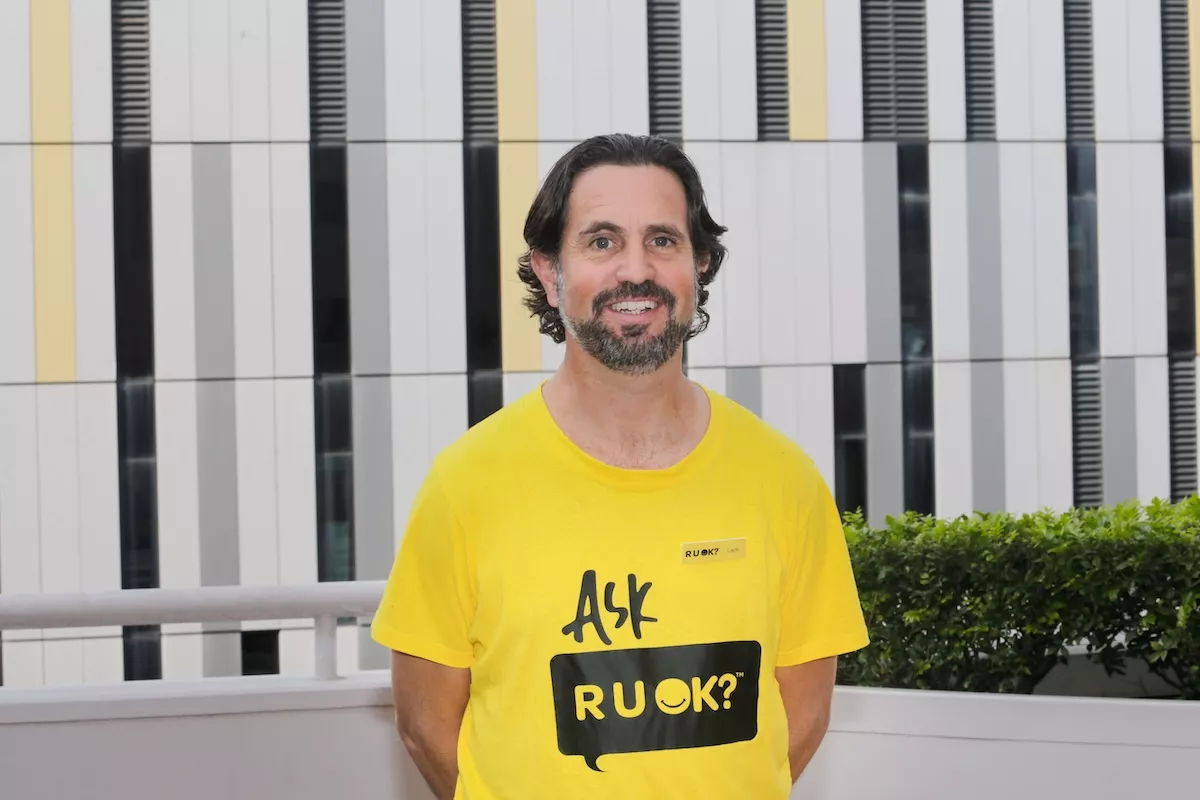
Lachlan Searle, chief executive of Australia’s R U OK? association
Lessons from Australia
Lachlan Searle became chief executive of R U OK? in December and led his first R U OK? Day at the helm across Australia on Thursday 10th September. The charity was founded in 2009 by Sydney advertising executive Gavin Larkin, whose father, Barry, died by suicide in 1995. Larkin developed the campaign with Janina Nearn and died of cancer in 2011, weeks after the third R U OK? Day. His family remains involved in the organisation today.
“He was at a leadership conference where they were given the task of coming up with an idea that would resonate with all Australians. This had been gnawing away at him for a while, and he eventually wrote on a Post-it note: ‘Are you OK? A conversation could change a life,'” said Searle.
Research conducted by Verian for the charity in 2026 found that nine in ten people who had been asked whether they were OK felt grateful, cared about and supported, yet one in four people might still hesitate to ask, even when they suspect someone is struggling.
The stakes remain high. In Australia, there are around nine suicides a day, and seven of those are men. Internationally, the World Health Organisation estimates that 727,000 people died by suicide worldwide in 2021, with men dying at more than twice the rate of women, a gap that widens to more than three to one in high-income countries.
In the European Union, figures published by Eurostat last month show 48,370 deaths by suicide in 2023, of which 76.4% were men. In France, the health statistics agency Drees recorded around 9,200 suicides in 2022, with the rate three times higher among men than among women.
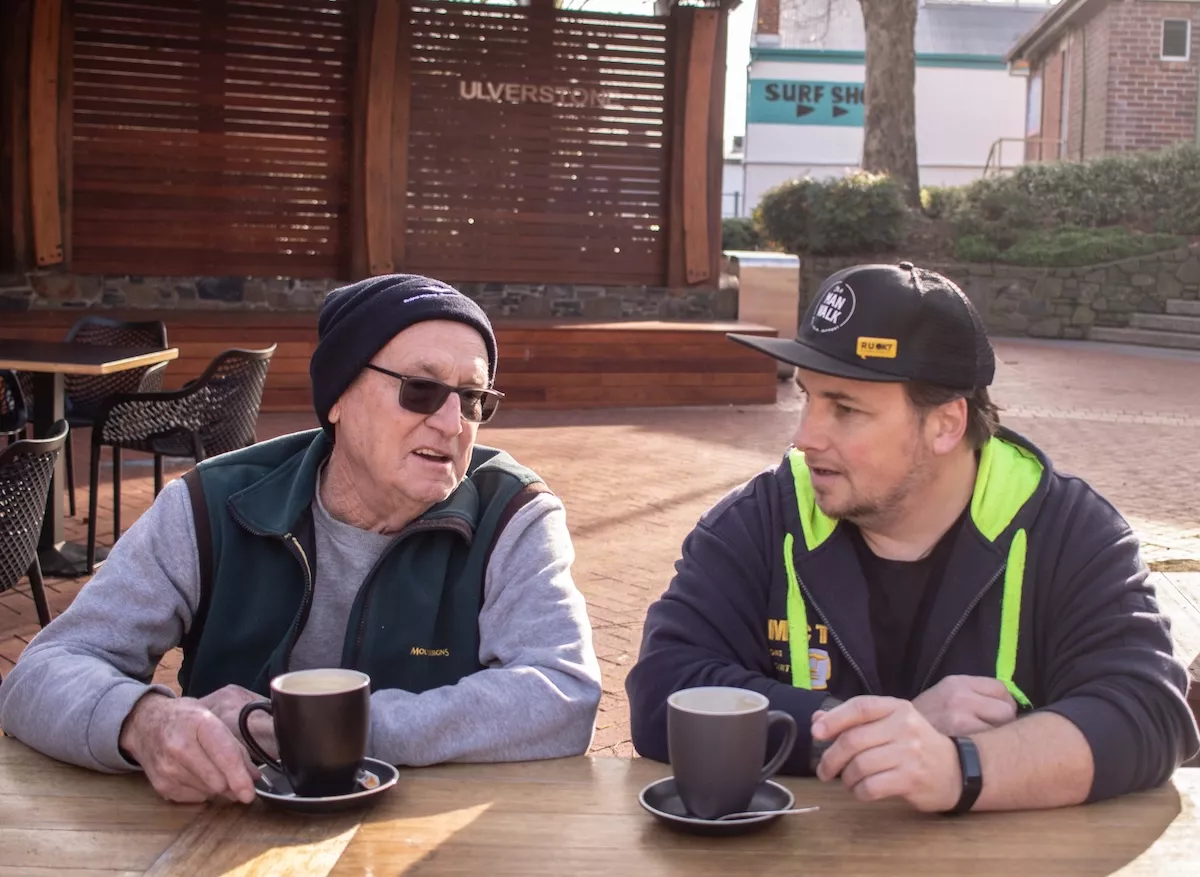
Talking side by side, over a “cuppa”, can be easier for some than face-to-face conversation. Photo source: R U OK?
Ask, listen, encourage action, check in
Searle is clear that R U OK? does not replace professional care but focusses on equipping ordinary people to notice when someone close to them is not themselves. “You spot the signs, trust your gut that you need to check in with someone, and ask the question. We have a framework called ALEC: Ask, Listen, Encourage action and Check in. That is how you have the conversation,” said Searle.
Of those four steps, he places the greatest weight on the second. “Ultimately, an R U OK? conversation comes down to about 90% listening. If you have noticed signs that someone is struggling and ask the question in a nice environment where they feel you are listening without judgement, you will often start to hear things that will really help that person. You might be able to reflect some of that back to encourage action,” he said.
The most common mistake, he said, is turning the conversation inward. “The worst thing you can do is make it about yourself: ‘The same thing happened to me. I’ve had that experience before, and I did this, this and this.’ They can feel you are not listening – because it is not about you.”
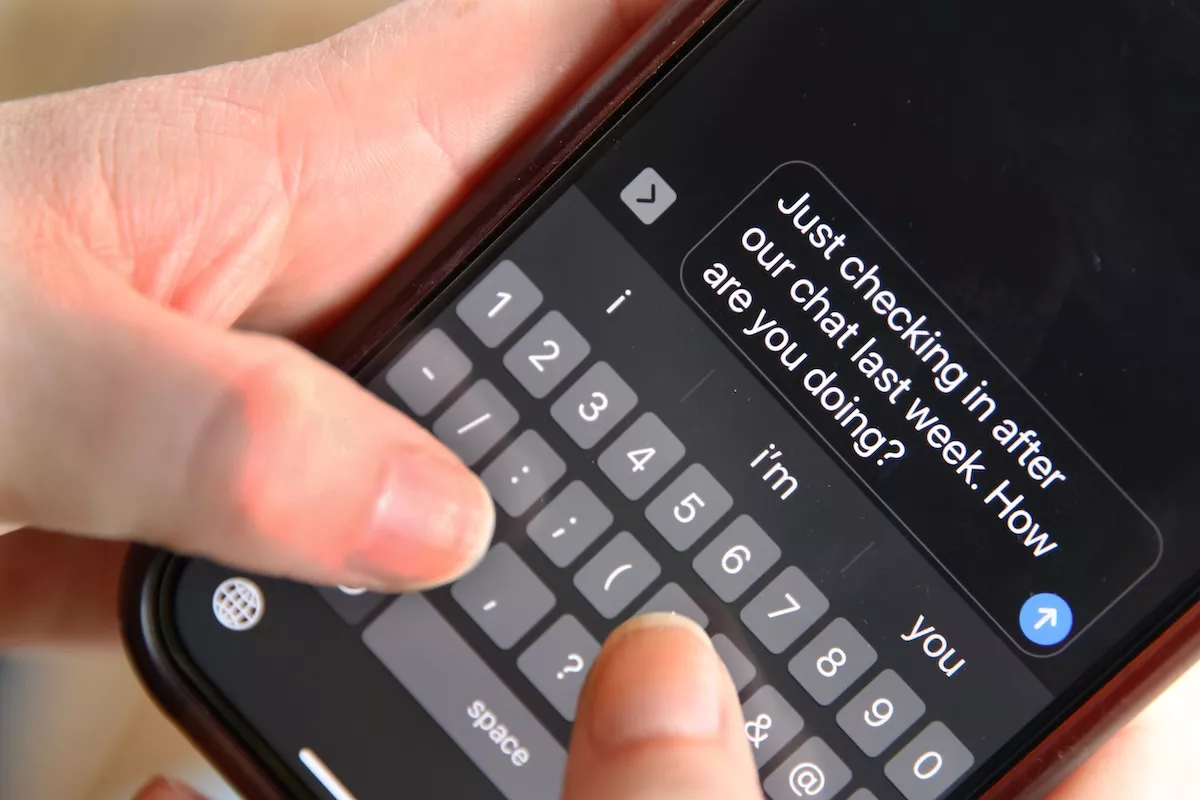
The final step is the one most easily forgotten. “Ultimately, it is about checking back in. If it was an intense, heavy conversation that morning over coffee, you might say, ‘I’m going to give you a call this afternoon and see how you’re going’. If it was less severe, it might be, ‘I’ll call you tomorrow’ or ‘I’ll call you on Monday’,” said Searle.
Where someone is in genuine danger, the priority changes. “If someone is in crisis, ultimately you need to stay with them until they are safe, whatever action you have taken to help, whether that is an ambulance or booking an appointment with a professional,” he said.
Photo source: R U OK?
Reading the signs behind the screen
In a place where social media can project a polished version of life in Monaco and the Riviera, Searle believes knowing someone’s normal rhythm matters more than any single message. “However that connection works, there is a cadence and regularity to the communication. If it is weekly and you have not heard from them for three weeks, that is when you pick up the phone and ring them, or pop around for a cup of tea,” he said.
“If you have a connection with someone and know when they are in a positive frame of mind, excited and looking forward to something, you should be able to recognise when it is the opposite. That is when you need to have the conversation.”
He argues that the rise of digital communication and shift away from face-to-face contact since the charity was founded has only made its message more urgent. “The value of R U OK? and genuinely engaging conversations has probably increased as a result of the reduced importance placed on face-to-face and personal conversations,” he said.
That extends to artificial intelligence, which some people now turn to as a sort of therapy session when no one else is around. “It is definitely a tool that is being used and will be used,” acknowledged Searle, “but the reality is that human care, empathy, face-to-face contact and reading the signs — not just the words, but emotional signs — and an arm over the shoulder if required are what humans need in times of struggle. They need someone to listen and empathise.”
Go for a walk with a friend and genuinely ask are you ok? Stay around for the answer. Photo source: R U OK?
Lived experience and the men who speak up
This year’s World Mental Health Day theme, set by the World Federation for Mental Health, is ‘Lived experiences heard: real voices, real change’, an idea that echoes the way R U OK? has worked since its founding, with people sharing their own stories to encourage others.
For Searle, the numbers make men a priority wherever they live. “The statistics are the reality: three-quarters of suicides are male,” he said.
What shifts the culture, he has found, is seeing the person at the top go first. “We see it when we speak to male-dominated industries, particularly heavy industries such as mining, construction and rail. When the leaders of those organisations, who are often men, stand up and show vulnerability themselves, it really helps,” he said.
He has watched that change happen. “I was at a golf day in a mining community last weekend. It was predominantly men, and there were some pretty heavy conversations and men in tears. I do not think that would have happened 10 or 15 years ago.”
Side by side, not face to face
Where those conversations happen matters too. Searle’s most practical advice for reaching men and teenagers, who often find it hardest to talk about how they feel, is to sit beside them rather than opposite.
“There is a lot of evidence, particularly with teenage boys, that side-by-side conversation is really effective – in the car, out for a walk – without the pressure of making eye contact,” he said.
Australia’s Men’s Shed movement is built on the same idea, summed up in its motto: “Men don’t talk face to face, they talk shoulder to shoulder.”
Ask it and mean it
In Monaco and on the French Riviera, “ça va?” is exchanged dozens of times a day, in cafés, at the school gate and in office lifts, usually with little expectation of a real answer. The R U OK? approach asks for more: to mean the question, and to stay long enough to hear the reply.
The people most likely to notice when an expat is struggling are the friends, colleagues and neighbours who have become their family abroad. “When an R U OK? conversation is real and authentic, not just a throwaway line, and there is deep listening and care, it works for the person receiving the help. The help-giver finds strength in it too,” said Searle.
World Mental Health Day falls on a single Saturday this year, but asking ‘are you OK?’ is something for every day of the year.
Anyone in immediate danger in Monaco or France should call 112. SOS Help offers confidential emotional support in English on +33 1 46 21 46 46 from 3pm to 11pm daily. The 3114 suicide prevention line is free, operates 24 hours a day and is accessible (in French) from Monaco.
Monaco Life is written by qualified journalists, writing original content. Sign up for our free newsletter, listen to our podcasts on Spotify, and follow us across Facebook, Instagram, LinkedIn, and Tik Tok.
Main photo: Lachlan Searle, chief executive of Australia’s R U OK? association. Photo source: R U OK?
Football: AS Monaco’s academy integral… and increasingly international
AS Monaco’s Academy Director, Sébastien Muet, has previously said that La Diagonale does not sell dreams, but graduating from it opens the door to a wider world. The doors to the academy itself have now been flung open.
Monaco’s academy, La Diagonale, is internationally renowned. As Muet tells us in an interview, it is part of the Principality club’s “DNA”. The likes of Thierry Henry, David Trezeguet, and more recently Kylian Mbappé and Maghnes Akliouche have come through it, to name but a few of its graduates.
Mbappé remains Monaco’s most expensive sale of all time, whilst Akliouche, who left for Paris Saint-Germain over the summer in a €50m move, is the second-most expensive academy graduate to have been sold by the club. With Aladji Bamba also leaving Les Monégasques this summer, joining Newcastle United in a €40m move, the financial value of the continued success of the club’s academy is clear to see.
Ligue 1 rivals in panic mode?
It is increasingly important, too, in the context of a wider financial crisis in French football, which is leading other clubs to turn to their academies, albeit without the same level of success. “The economic crisis in French football, the TV rights- we won’t speak about all of that- things like that are leading some clubs today to urgently, and I mean urgently, tell themselves that player development could be an interesting economic lever. That isn’t the case at Monaco,” Muet tells us.
“The academy has existed for 50 years here. It is 50 years that the academy has been at the centre of the project. So it isn’t the economic crisis that French football is experiencing that is telling AS Monaco, our executives, ‘Let’s make the academy important.’ No, it’s the club’s culture,” added the academy director.
Muet calls it “the art of anticipation”, and whilst they are still acutely affected by the financial crisis, they are much better placed than most to overcome the structural deficits. Selling to Premier League clubs is something of a silver bullet for French clubs and so it is natural that Monaco are tailoring their academy products for that market.
Monaco embrace ‘international dimension’
“Today, there is this interesting dimension of speed, size, impact, that can sometimes interest English clubs, but not just them. The Premier League is the Premier League. When you seduce English football, it means that you seduce the whole world,” says Muet, but not all clubs in the “whole world” are capable of paying the prices that those in the Premier League have in recent years.
Exporting their academy products is a fine art that Monaco have mastered, and amid an internationalisation drive, importing from abroad is now also on the agenda. “We want to work with the French players who have the highest potential, but fundamentally, Monaco wants to have an international dimension; we have an international dimension,” says Muet.
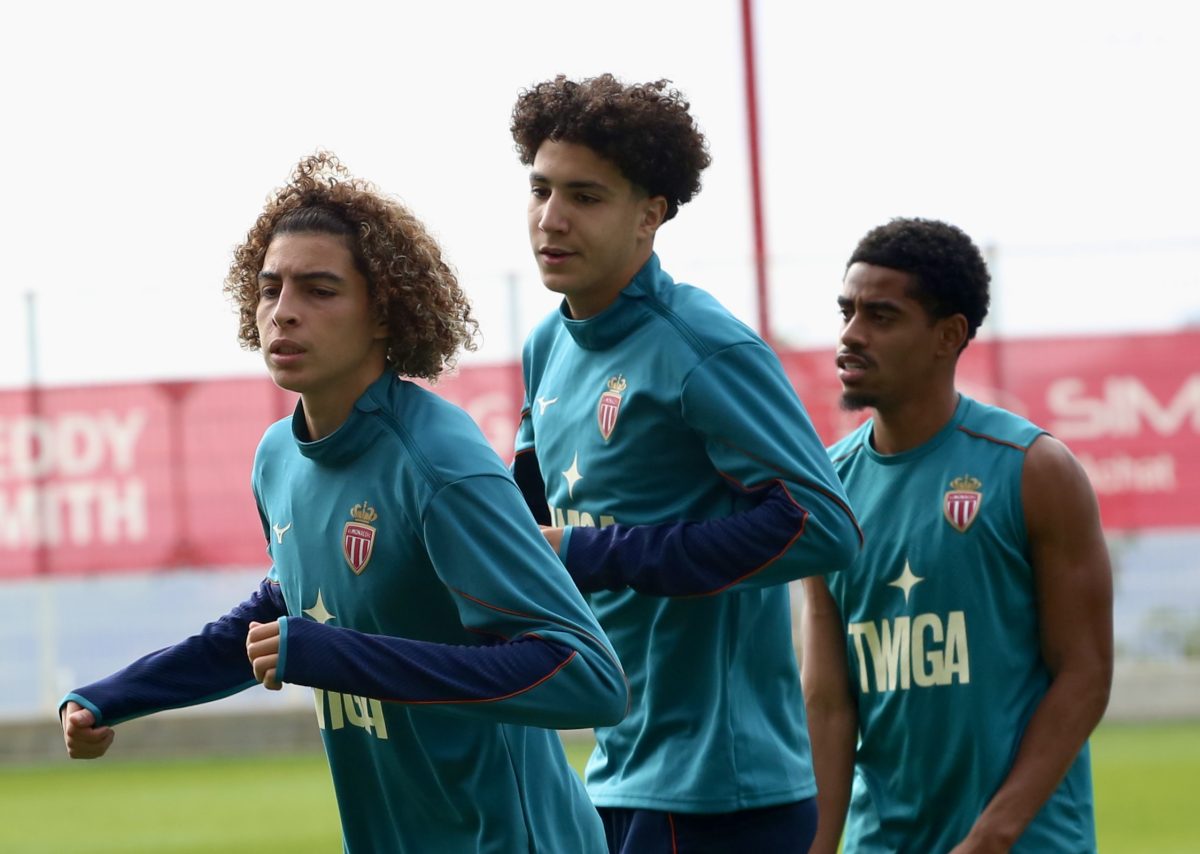
Soubeir in Monaco first-team training on Friday. Photo credit: Monaco Life / Luke Entwistle
He added, “We have an attacker who plays for the Denmark U17s (Ekene Chukwuani) who has been with us for the past two seasons. It means that there is an opening of our borders, beyond Monaco but also beyond France, too. It is quite interesting. Today, it is true that, as well as the French language, we are hearing more and more of the English language within the walls of La Diagonale.”
There is a coherence in this strategy, with the club recruiting a German, Dennis Schmitt, as manager of their Groupe Élite earlier this year. But the fundamentals of Monaco’s strategy remain unchanged; patience, as ever, remains a key ingredient. “Our objective is not to push a player to the highest level. Our objective is to establish a player at the highest level; those are two different things,” Muet tells us.
Monaco set ambitious objective
The new cohort is in the process of establishing itself in Filipe Luís’ first team set-up. The likes of Pape Cabral, Anis Soubeir, Safouane Benzahra, and Ilane Touré have all earned game time with the first team in recent months. They are not only bolstering their values – the importance of which is not negligible – but they are also – and this is key – drivers of performance in the first team, too.
Monaco Life understands that the Principality club has the objective of having 30% of academy products within the first team set-up. Sporting objectives at the club remain ambitious, and so there is no room for passengers; if they are there, they have to perform. The Groupe Élite, as well as loans at partner club Cercle Brugge, ensure that when the step to the first team is made, they are invariably ready for it.
There is an air of change at Monaco’s academy, but just as it has been throughout the Principality club’s storied history, youth development remains the cornerstone of the project.
Monaco’s national rugby sevens team has secured a historic place at the 2027 European Games in Istanbul, marking the Principality’s first representation in a team sport at the competition.
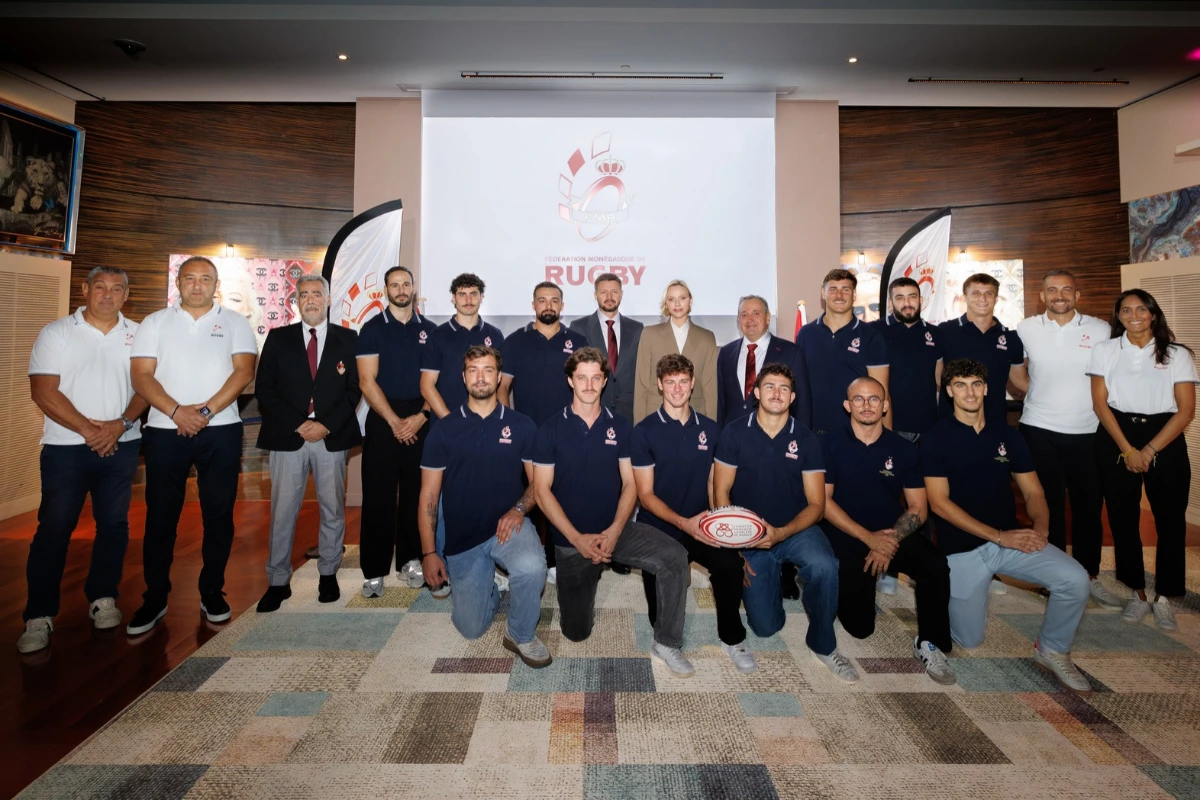
The announcement was made by Princess Charlene, President of the Monegasque Rugby Federation, during the 2026-2027 season presentation on Wednesday 7 October. The Princess personally delivered the news to the team, confirming its qualification for the fourth edition of the European Games, which will take place from 16 to 27 June 2027.
The achievement follows an impressive season for Monaco, whose European Trophy Championship performance in June earned the team fourth place overall in Europe’s second division, placing Monaco among Europe’s top 16 rugby sevens nations and securing its qualification for Istanbul.
Monaco’s place at the Games was earned entirely on the pitch, without an invitation or special status, reflecting the team’s progress.
PRINCESS CHARLENE CELEBRATES MILESTONE
Princess Charlene praised the team’s determination and efforts that brought them to this moment. “For the first time in our history, our senior team has been selected to take part in the European Games next June in Istanbul,” she announced.
“This is not luck. It is the quiet accumulation of early mornings, hard training sessions and matches won by a single point. It is perseverance – the willingness to begin again, season after season, until the work finally speaks for itself.”
She also highlighted the significance of the achievement for a country of Monaco’s size, with the European Games bringing together over 7,000 athletes from nearly 50 countries. “That is what sport does: it gives a small country a very loud voice, and it shows the next generation what is possible when passion meets patience,” she said.
Speaking on behalf of Prince Albert II and herself, Princess Charlene expressed their pride in the players, coaches, families, and staff who dedicated themselves to getting to this point.
POTENTIAL PATHWAY TO LOS ANGELES 2028
The European Games also offer a possible pathway towards Olympic qualification in rugby sevens, giving Monaco another goal to pursue. With an already ambitious calendar ahead, Monaco will compete at home in the Games of the Small States of Europe in May, looking to defend its title before travelling to Istanbul in June.
For Princess Charlene, the achievement recognises the team’s progress and presents an opportunity to inspire younger generations. “Be proud of how far you have come. But above all, be proud of the story you will continue to write together,” she told the players.